QUESTION IMAGE
Question
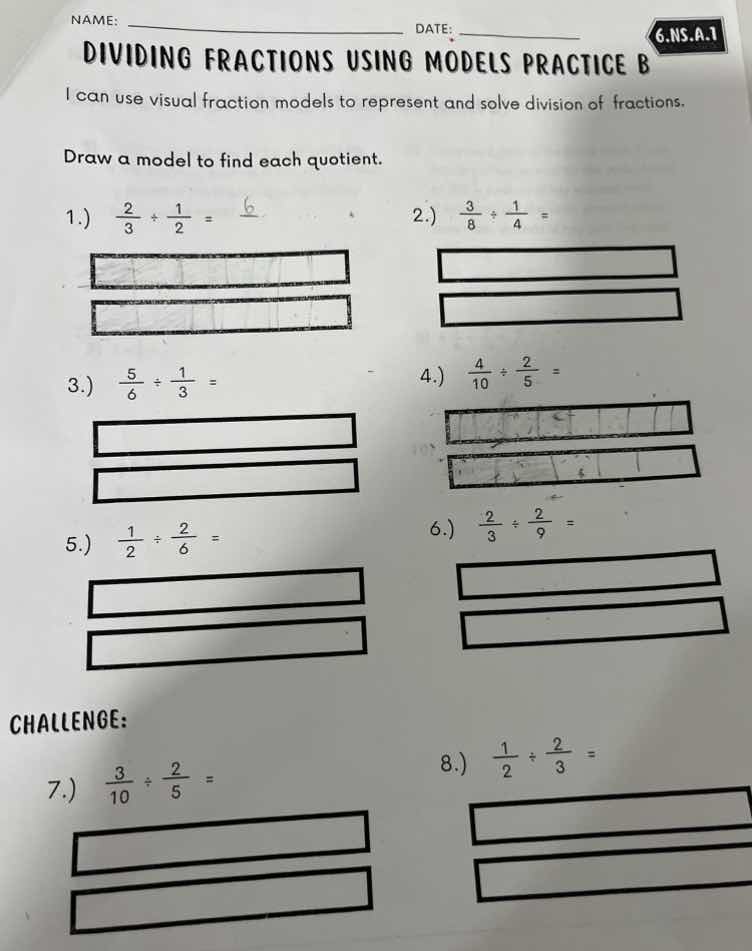
name: ____________________ date: _______ dividing fractions using models practice b i can use visual fraction models to represent and solve division of fractions. draw a model to find each quotient. 1.) $\frac{2}{3} div \frac{1}{2} =$ __ 2.) $\frac{3}{8} div \frac{1}{4} =$ 3.) $\frac{5}{6} div \frac{1}{3} =$ 4.) $\frac{4}{10} div \frac{2}{5} =$ 5.) $\frac{1}{2} div \frac{2}{6} =$ 6.) $\frac{2}{3} div \frac{2}{9} =$ challenge: 7.) $\frac{3}{10} div \frac{2}{5} =$ 8.) $\frac{1}{2} div \frac{2}{3} =$
Step1: Apply reciprocal rule
For fraction division, $\frac{a}{b} \div \frac{c}{d} = \frac{a}{b} \times \frac{d}{c}$
Step2: Calculate 1: $\frac{2}{3} \div \frac{1}{2}$
$\frac{2}{3} \times \frac{2}{1} = \frac{4}{3} = 1\frac{1}{3}$
Step3: Calculate 2: $\frac{3}{8} \div \frac{1}{4}$
$\frac{3}{8} \times \frac{4}{1} = \frac{12}{8} = \frac{3}{2} = 1\frac{1}{2}$
Step4: Calculate 3: $\frac{5}{6} \div \frac{1}{3}$
$\frac{5}{6} \times \frac{3}{1} = \frac{15}{6} = \frac{5}{2} = 2\frac{1}{2}$
Step5: Calculate 4: $\frac{4}{10} \div \frac{2}{5}$
$\frac{4}{10} \times \frac{5}{2} = \frac{20}{20} = 1$
Step6: Calculate 5: $\frac{1}{2} \div \frac{2}{6}$
Simplify $\frac{2}{6}=\frac{1}{3}$, then $\frac{1}{2} \times \frac{3}{1} = \frac{3}{2} = 1\frac{1}{2}$
Step7: Calculate 6: $\frac{2}{3} \div \frac{2}{9}$
$\frac{2}{3} \times \frac{9}{2} = \frac{18}{6} = 3$
Step8: Calculate 7: $\frac{3}{10} \div \frac{2}{5}$
$\frac{3}{10} \times \frac{5}{2} = \frac{15}{20} = \frac{3}{4}$
Step9: Calculate 8: $\frac{1}{2} \div \frac{2}{3}$
$\frac{1}{2} \times \frac{3}{2} = \frac{3}{4}$

Snap & solve any problem in the app
Get step-by-step solutions on Sovi AI
Photo-based solutions with guided steps
Explore more problems and detailed explanations
1.) $\frac{4}{3}$ or $1\frac{1}{3}$
2.) $\frac{3}{2}$ or $1\frac{1}{2}$
3.) $\frac{5}{2}$ or $2\frac{1}{2}$
4.) $1$
5.) $\frac{3}{2}$ or $1\frac{1}{2}$
6.) $3$
7.) $\frac{3}{4}$
8.) $\frac{3}{4}$
Model Guidance (for drawing):
For each problem:
- Draw a rectangle to represent the first fraction (e.g., for $\frac{2}{3}$, divide the rectangle into 3 equal parts, shade 2).
- Divide the same rectangle into sections matching the denominator of the second fraction, then count how many of the second fraction's fit into the shaded area of the first. This will match the calculated quotient.