QUESTION IMAGE
Question
name
date
\a huge feeder, but a poor milker\
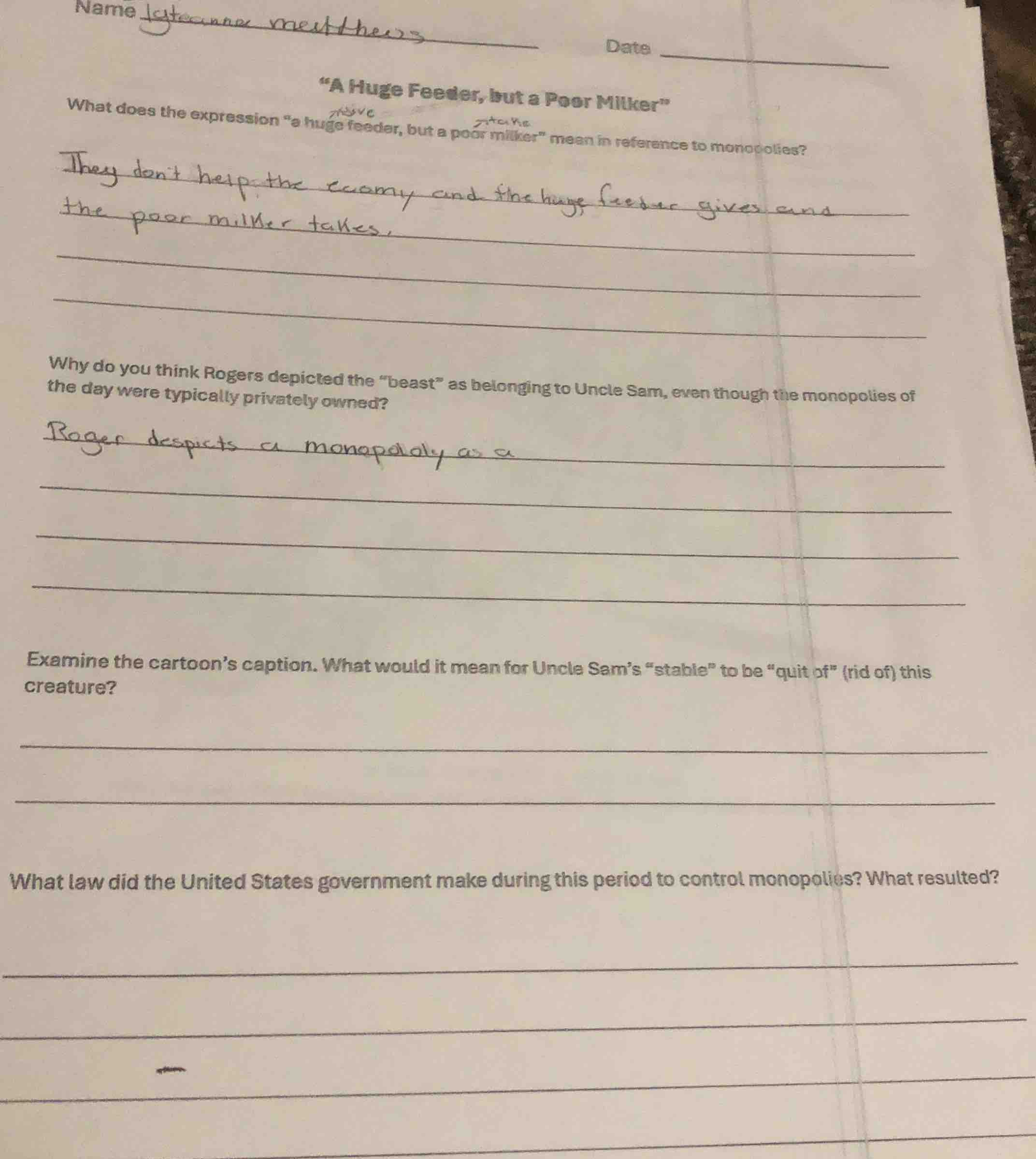
what does the expression \a huge feeder, but a poor milker\ mean in reference to monopolies?
why do you think rogers depicted the \beast\ as belonging to uncle sam, even though the monopolies of the day were typically privately owned?
examine the cartoon’s caption. what would it mean for uncle sam’s \stable\ to be \quit of\ (rid of) this creature?
what law did the united states government make during this period to control monopolies? what resulted?
Brief Explanations
- For the first question: "Huge feeder" means monopolies consume massive resources, capital, and market power from the economy (like a large animal eating a lot of feed). "Poor milker" means they produce very little broad economic benefit—they hoard profits, limit competition, and fail to drive widespread growth or public good, so they take far more than they contribute.
- For the second question: Rogers links the monopoly to Uncle Sam to argue that the U.S. government enabled or failed to rein in monopolies, treating the unchecked power as a burden on the nation that the state was responsible for. It frames the monopoly as a problem tied to the nation (Uncle Sam representing the U.S.) rather than just private owners, emphasizing it harms the whole country.
- For the third question: Uncle Sam's "stable" represents the U.S. economy and nation. Being "quit of" the creature means breaking up or regulating the monopoly to remove its harmful influence: this would open up competition, let small businesses thrive, and redirect resources to benefit the broader public instead of just the monopoly.
- For the fourth question: The key law was the Sherman Antitrust Act of 1890. It banned monopolies and anti-competitive business practices. While it set a legal framework for challenging monopolies, early enforcement was weak, and courts often ruled in favor of businesses, though it laid groundwork for later antitrust action.

Snap & solve any problem in the app
Get step-by-step solutions on Sovi AI
Photo-based solutions with guided steps
Explore more problems and detailed explanations
- Monopolies consume massive economic resources ("huge feeder") but contribute almost no broad public or economic benefit ("poor milker")—they extract far more value than they create for the overall economy.
- Rogers uses Uncle Sam to frame the monopoly as a national burden, implying the U.S. government allowed or failed to control monopolies, tying their harmful power to the nation rather than just private owners.
- It would mean breaking up or regulating the monopoly to eliminate its stranglehold on the economy, allowing competition to flourish and resources to benefit the broader public instead of the monopoly.
- Law: The Sherman Antitrust Act of 1890. Result: It established the first legal ban on monopolies and anti-competitive practices, but early court rulings and weak enforcement limited its immediate impact, though it created a foundation for future antitrust regulation.