QUESTION IMAGE
Question
name: ____ date: __ period: ____
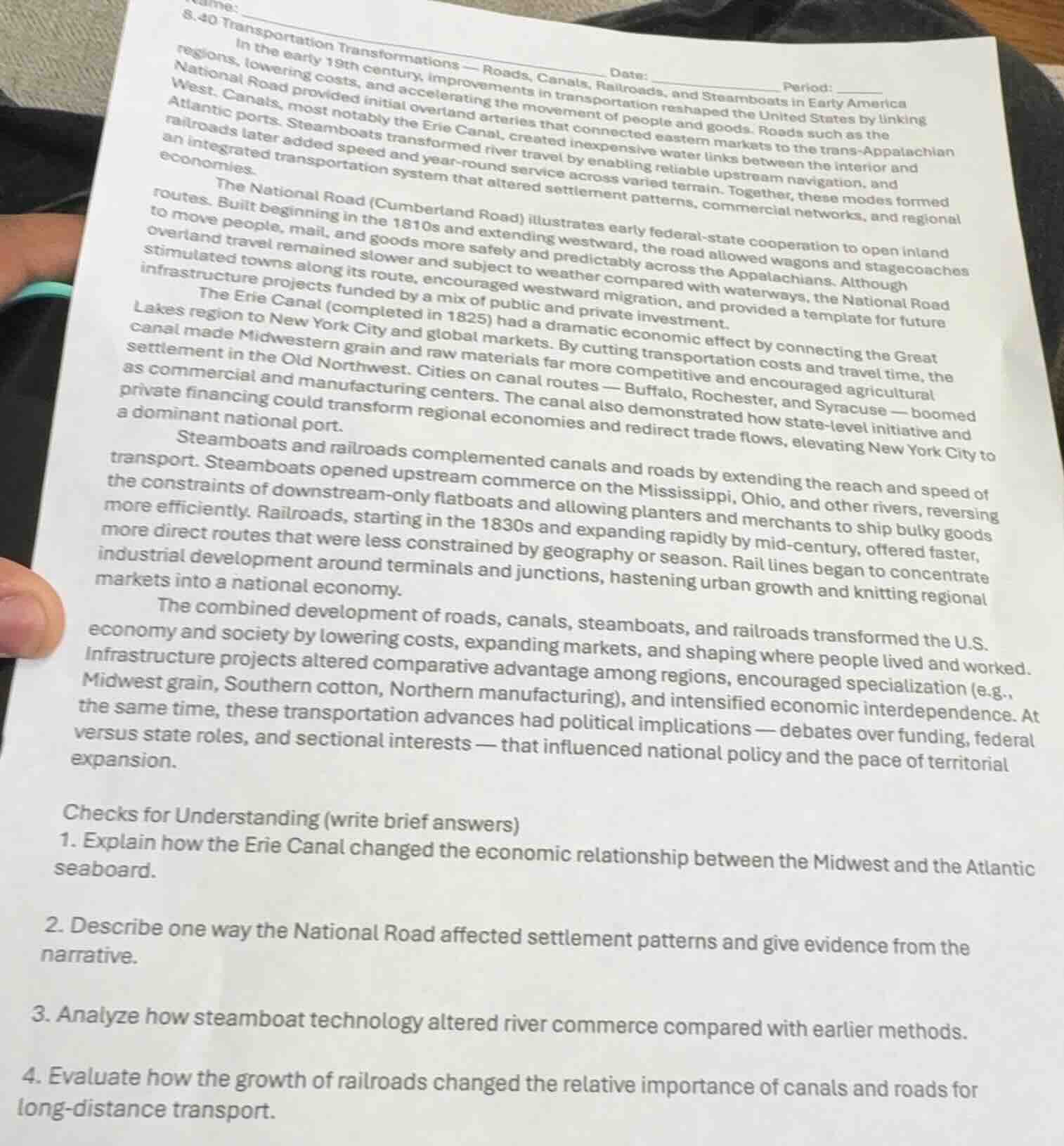
8.40 transportation transformations — roads, canals, railroads, and steamboats in early america
in the early 19th century, improvements in transportation reshaped the united states by linking regions, lowering costs, and accelerating the movement of people and goods. roads such as the national road provided initial overland arteries that connected eastern markets to the trans-appalachian west. canals, most notably the erie canal, created inexpensive water links between the interior and atlantic ports. steamboats transformed river travel by enabling reliable upstream navigation, and railroads later added speed and year-round service across varied terrain. together, these modes formed an integrated transportation system that altered settlement patterns, commercial networks, and regional economies.
the national road (cumberland road) illustrates early federal-state cooperation to open inland routes. built beginning in the 1810s and extending westward, the road allowed wagons and stagecoaches to move people, mail, and goods more safely and predictably across the appalachians. although overland travel remained slower and subject to weather compared with waterways, the national road stimulated towns along its route, encouraged westward migration, and provided a template for future infrastructure projects funded by a mix of public and private investment.
the erie canal (completed in 1825) had a dramatic economic effect by connecting the great lakes region to new york city and global markets. by cutting transportation costs and travel time, the canal made midwestern grain and raw materials far more competitive and encouraged agricultural settlement in the old northwest. cities on canal routes — buffalo, rochester, and syracuse — boomed as commercial and manufacturing centers. the canal also demonstrated how state-level initiative and private financing could transform regional economies and redirect trade flows, elevating new york city to a dominant national port.
steamboats and railroads complemented canals and roads by extending the reach and speed of transport. steamboats opened upstream commerce on the mississippi, ohio, and other rivers, reversing the constraints of downstream-only flatboats and allowing planters and merchants to ship bulky goods more efficiently. railroads, starting in the 1830s and expanding rapidly by mid-century, offered faster, more direct routes that were less constrained by geography or season. rail lines began to concentrate industrial development around terminals and junctions, hastening urban growth and knitting regional markets into a national economy.
the combined development of roads, canals, steamboats, and railroads transformed the u.s. economy and society by lowering costs, expanding markets, and shaping where people lived and worked. infrastructure projects altered comparative advantage among regions, encouraged specialization (e.g., midwest grain, southern cotton, northern manufacturing), and intensified economic interdependence. at the same time, these transportation advances had political implications — debates over funding, federal versus state roles, and sectional interests — that influenced national policy and the pace of territorial expansion.
checks for understanding (write brief answers)
- explain how the erie canal changed the economic relationship between the midwest and the atlantic seaboard.
- describe one way the national road affected settlement patterns and give evidence from the narrative.
- analyze how steamboat technology altered river commerce compared with earlier methods.
- evaluate how the growth of railroads changed the relative importance of canals and roads for long-distance transport.
- The Erie Canal connected the Great Lakes region to New York City, cutting transportation costs and travel time. This made Midwestern grain and raw materials far more competitive in Atlantic seaboard/global markets, encouraged agricultural settlement in the Old Northwest, and boomed canal-side cities as commercial hubs. It redirected trade flows to New York City, making it a dominant national port, and tied the Midwest's economy closely to the Atlantic seaboard's commercial networks.
- The National Road stimulated town growth along its route. Evidence: It allowed wagons and stagecoaches to move people safely across the Appalachians, encouraged westward migration, which led to towns developing along the road.
- Earlier river commerce relied on downstream-only flatboats, limiting trade direction. Steamboats enabled reliable upstream navigation on rivers like the Mississippi and Ohio, reversing this constraint. This allowed planters and merchants to ship bulky goods upstream more efficiently, opening upstream regions to commerce.
- Railroads offered faster, more direct routes that were less constrained by geography or season than canals and roads. They concentrated industrial development around terminals, hastened urban growth, and knitted regional markets into a national economy. This reduced the relative importance of canals and roads for long-distance transport, as railroads became a more flexible, year-round, and efficient alternative.

Snap & solve any problem in the app
Get step-by-step solutions on Sovi AI
Photo-based solutions with guided steps
Explore more problems and detailed explanations
- The Erie Canal cut transportation costs/travel time, making Midwestern grain/raw materials competitive in Atlantic seaboard markets. It tied the Midwest's agricultural economy to the Atlantic's commercial networks, redirected trade flows to New York City (making it a dominant national port), and spurred agricultural settlement in the Old Northwest while growing canal-side commercial hubs that linked the two regions economically.
- It stimulated town growth along its route. Evidence: The road enabled safe, predictable overland travel across the Appalachians, which encouraged westward migration and led to towns developing along its path.
- Unlike downstream-only flatboats, steamboats enabled reliable upstream river navigation, allowing efficient shipment of bulky goods to upstream regions and opening previously limited upstream areas to commerce.
- Railroads were faster, less geographically/seasonally constrained, and more direct than canals and roads. They reduced the relative importance of canals and roads by creating a more flexible, year-round long-distance transport option that integrated regional markets into a national economy, shifting focus to rail terminals for industrial and urban growth.