QUESTION IMAGE
Question
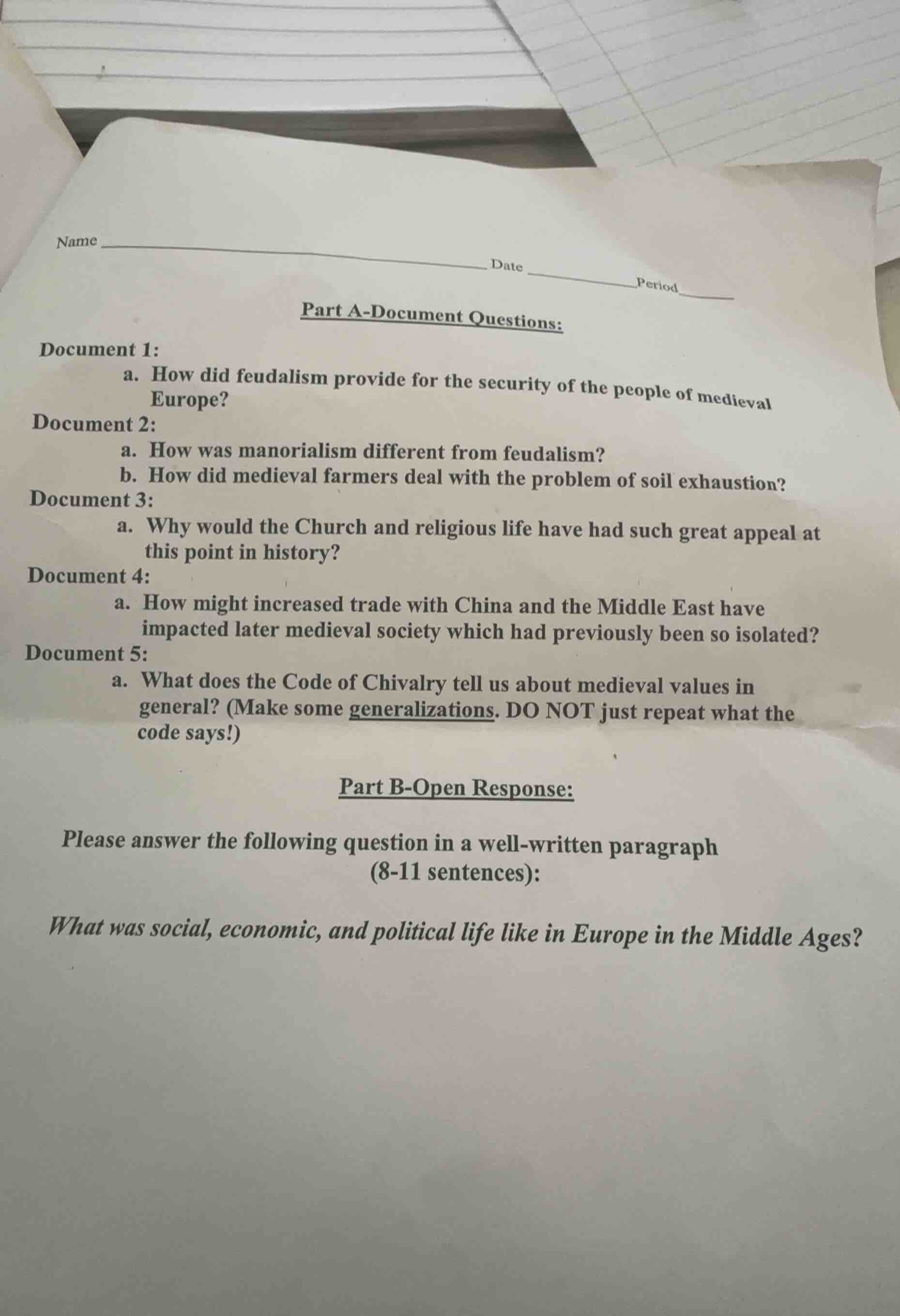
name _____________ date ___________ period_________
part a-document questions:
document 1:
a. how did feudalism provide for the security of the people of medieval europe?
document 2:
a. how was manorialism different from feudalism?
b. how did medieval farmers deal with the problem of soil exhaustion?
document 3:
a. why would the church and religious life have had such great appeal at this point in history?
document 4:
a. how might increased trade with china and the middle east have impacted later medieval society which had previously been so isolated?
document 5:
a. what does the code of chivalry tell us about medieval values in general? (make some generalizations. do not just repeat what the code says!)
part b-open response:
please answer the following question in a well-written paragraph (8-11 sentences):
what was social, economic, and political life like in europe in the middle ages?
Part A-Document Questions:
Document 1a:
Feudalism was a hierarchical system where lords granted land (fiefs) to vassals in exchange for military service and loyalty. Vassals protected the peasants who worked their land, while lords provided protection from external threats like invasions or raids, creating a layered security network across medieval Europe.
Document 2a:
Feudalism was a political and military hierarchy focused on land grants, loyalty, and protection between lords and vassals. Manorialism was the economic system tied to feudalism, centered on self-sufficient manors where peasants worked the land for a lord in exchange for access to land and basic resources, rather than military obligations.
Document 2b:
Medieval farmers used the three-field system: they divided farmland into three sections, planting one with winter crops, one with spring crops, and leaving one fallow (unplanted) each year. This allowed the fallow field to recover nutrients, preventing soil exhaustion.
Document 3a:
The Church offered stability, spiritual comfort, and a sense of community in a chaotic, violent medieval world. It also provided access to education, healthcare (via monasteries), and a path to salvation, which was a central concern for people facing constant hardship, disease, and political instability.
Document 4a:
Increased trade brought new goods (like spices, silk, and metalwork), wealth, and technologies to medieval Europe, stimulating the growth of towns and a merchant class, which weakened the feudal system. It also exposed Europeans to new ideas, cultures, and knowledge (such as ancient Greek and Roman texts preserved in the Middle East), sparking intellectual and economic shifts away from isolated manorial life.
Document 5a:
The Code of Chivalry reveals that medieval values prioritized honor, loyalty to one's lord, protection of the weak (like women, children, and clergy), and courage in battle. It also emphasized piety and respect for the Church, showing that religious and social obligations were deeply intertwined in medieval society, and that status was tied to adhering to a strict moral and behavioral code.
Part B-Open Response:
Medieval European life was structured around rigid social, economic, and political systems that reinforced hierarchy and stability. Politically, feudalism dominated, with a king at the top granting fiefs to powerful lords, who in turn gave land to vassals in exchange for military support and loyalty; this layered system provided basic security but also led to fragmented rule, as local lords often held more real power than distant monarchs. Economically, manorialism was the foundation, with self-sufficient manors where serfs and peasants worked the land to produce food and goods for their lord, in exchange for small plots of their own and protection; trade was limited for much of the period, though it grew in the later Middle Ages, spurring the rise of town-dwelling merchant classes that began to challenge feudal economic structures. Socially, society was divided into a strict hierarchy: the nobility (lords and vassals) held power and land, the clergy controlled religious life and significant wealth, and the vast majority of people were peasants or serfs, tied to the land with few rights. The Catholic Church was a unifying force across all areas of life, shaping laws, education, and cultural norms, and offering spiritual comfort in an era marked by frequent warfare, famine, and disease. By the later Middle Ages, the growth of trade, the rise of towns, and shifting intellectua…

Snap & solve any problem in the app
Get step-by-step solutions on Sovi AI
Photo-based solutions with guided steps
Explore more problems and detailed explanations
Part A-Document Questions:
- Document 1a: Feudalism created a hierarchical network where lords granted land to vassals in exchange for military service and loyalty; vassals protected the peasantry, while lords defended against external threats like invasions, establishing layered local and regional security for medieval Europeans.
- Document 2a: Feudalism was a political/military hierarchy focused on land-for-service pacts between lords and vassals. Manorialism was the accompanying economic system, centered on self-sufficient manors where peasants worked land for a lord in exchange for resources, not military obligations.
- Document 2b: Medieval farmers used the three-field system, dividing land into three sections: one planted with winter crops, one with spring crops, and one left fallow yearly to let soil recover nutrients and avoid exhaustion.
- Document 3a: The Church offered stability, spiritual salvation, community, and practical support (education, healthcare via monasteries) in a chaotic, violent medieval world, making it a vital source of comfort and structure for people facing constant hardship.
- Document 4a: Increased trade brought new goods, wealth, and technologies, spurring town growth and a merchant class that weakened feudalism. It also introduced new ideas and preserved classical knowledge, shifting Europe from isolated manorial life toward more connected, intellectual, and economic activity.
- Document 5a: The Code of Chivalry shows medieval values prioritized honor, loyalty to lords, protection of the vulnerable, courage in battle, and piety, revealing a society where status depended on strict moral/behavioral codes, and religious and social duties were deeply intertwined.
Part B-Open Response:
Medieval European life was defined by interconnected, hierarchical social, economic, and political systems that maintained order but limited mobility. Politically, feudalism ruled as a layered hierarchy: kings granted fiefs to powerful lords, who gave land to vassals in return for military support and loyalty, creating local security but often leaving monarchs with less real power than regional lords. Economically, manorialism was the backbone, with self-sufficient manors where serfs and peasants worked the land to provide food and goods for their lord, receiving small plots of land and protection in exchange; trade was minimal for most of the era, but late medieval growth in trade with Asia and the Middle East spurred town development and a merchant class that began to challenge feudal economic structures. Socially, a strict caste system prevailed: nobles held power and land, the clergy controlled religious life and significant wealth, and peasants/serfs made up the vast majority, tied to the land with few legal rights. The Catholic Church was a unifying force across all spheres, shaping laws, education, and culture, and offering spiritual hope in a time of frequent warfare, famine, and disease. By the end of the Middle Ages, the rise of towns, expanded trade, and new intellectual influences began to erode the rigid feudal and manorial systems, laying groundwork for the early modern era.