QUESTION IMAGE
Question
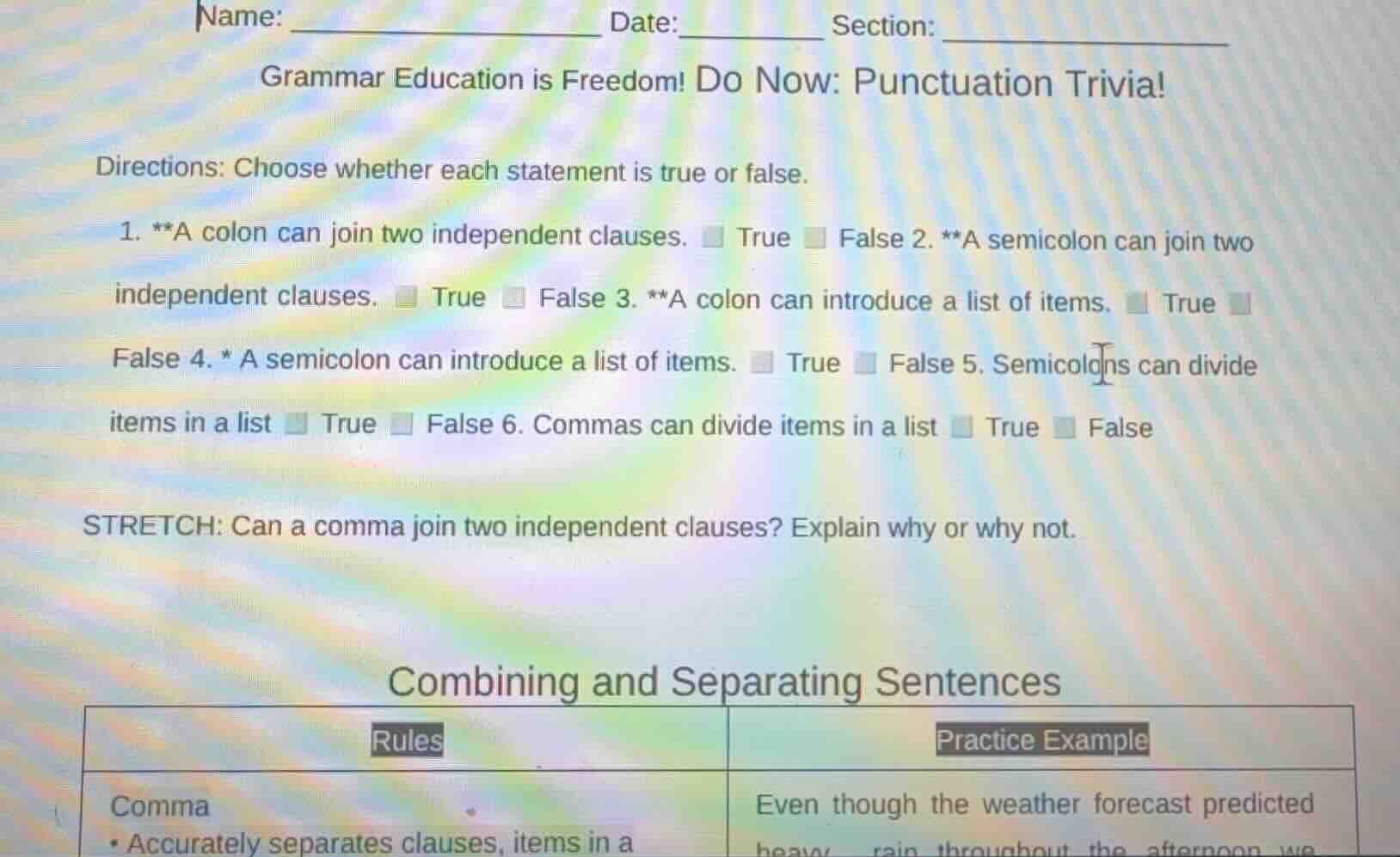
name: __________________ date:____ section: _____________
grammar education is freedom! do now: punctuation trivia!
directions: choose whether each statement is true or false.
- a colon can join two independent clauses. true false 2. a semicolon can join two independent clauses. true false 3. *a colon can introduce a list of items. true false 4. a semicolon can introduce a list of items. true false 5. semicolons can divide items in a list true false 6. commas can divide items in a list true false
stretch: can a comma join two independent clauses? explain why or why not.
combining and separating sentences
| rules | practice example |
|---|
|comma<br>• accurately separates clauses, items in a|even though the weather forecast predicted heavy rain throughout the afternoon, we
Brief Explanations
- A colon can join two independent clauses when the second clause explains or expands on the first, so this is true.
- A semicolon's core function is to connect closely related independent clauses, so this is true.
- A primary use of a colon is to introduce a list of items, so this is true.
- Semicolons do not introduce lists; colons or introductory phrases serve this purpose, so this is false.
- Semicolons are used to divide list items when the items themselves contain commas, so this is true.
- Commas are the standard punctuation to separate items in a simple list, so this is true.
- A comma alone cannot join two independent clauses; this creates a comma splice. A coordinating conjunction, semicolon, or period is required instead.

Snap & solve any problem in the app
Get step-by-step solutions on Sovi AI
Photo-based solutions with guided steps
Explore more problems and detailed explanations
- True
- True
- True
- False
- True
- True
- No, a comma cannot join two independent clauses on its own. Doing so creates a grammatical error called a comma splice. To correctly join two independent clauses, you need to use a comma with a coordinating conjunction (e.g., and, but, or), a semicolon, or a period to separate them into two distinct sentences.