QUESTION IMAGE
Question
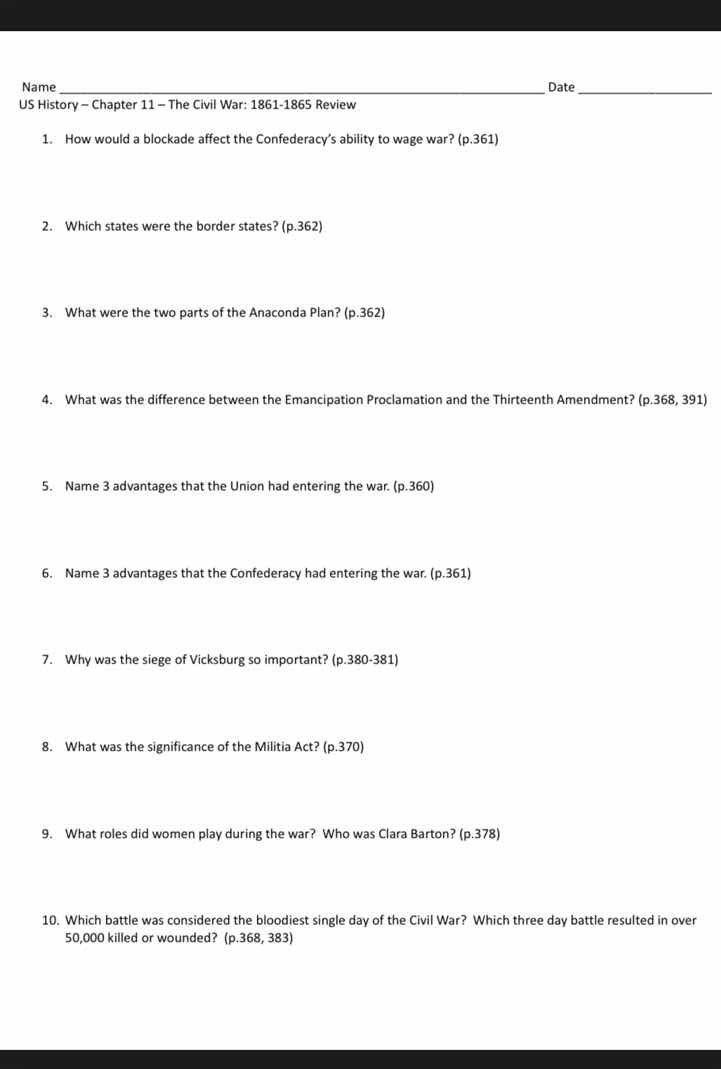
name _______________________________________________________ date _____________
us history – chapter 11 – the civil war: 1861-1865 review
- how would a blockade affect the confederacys ability to wage war? (p.361)
- which states were the border states? (p.362)
- what were the two parts of the anaconda plan? (p.362)
- what was the difference between the emancipation proclamation and the thirteenth amendment? (p.368, 391)
- name 3 advantages that the union had entering the war. (p.360)
- name 3 advantages that the confederacy had entering the war. (p.361)
- why was the siege of vicksburg so important? (p.380-381)
- what was the significance of the militia act? (p.370)
- what roles did women play during the war? who was clara barton? (p.378)
- which battle was considered the bloodiest single day of the civil war? which three day battle resulted in over 50,000 killed or wounded? (p.368, 383)
Brief Explanations
- A blockade would cut off the Confederacy's ability to import war supplies (like weapons, ammunition) and export cash crops (like cotton) to raise funds for the war, crippling their war economy and supply lines.
- Border states were slave states that remained in the Union: Delaware, Maryland, Kentucky, and Missouri.
- The Anaconda Plan had two core parts: a naval blockade of Confederate ports to cut off trade, and a campaign to take control of the Mississippi River to split the Confederacy in two.
- The Emancipation Proclamation (1863) only freed enslaved people in Confederate-controlled areas as a war measure, while the 13th Amendment (1865) was a constitutional amendment that permanently abolished slavery across the entire United States.
- Union advantages: Larger population for troops and labor; more industrial capacity to produce weapons, supplies, and railroads; established federal government with access to more funding and international recognition initially.
- Confederate advantages: Defensive war (fighting on familiar home territory); skilled military leadership with experienced officers; strong motivation to protect their way of life and home.
- The Siege of Vicksburg gave the Union full control of the Mississippi River, splitting the Confederacy into eastern and western halves, cutting off Confederate supply routes and access to resources from the West.
- The Militia Act (1862) allowed Black men to serve in the Union military, expanding the Union's pool of troops and marking a key step toward Black military participation in the Civil War.
- Women served as nurses, spies, cooks, laundresses, and some even disguised themselves as men to fight. Clara Barton was a famous Civil War nurse who later founded the American Red Cross.
- The bloodiest single day of the Civil War was the Battle of Antietam (September 17, 1862). The three-day battle with over 50,000 killed or wounded was the Battle of Gettysburg (July 1-3, 1863).

Snap & solve any problem in the app
Get step-by-step solutions on Sovi AI
Photo-based solutions with guided steps
Explore more problems and detailed explanations
- It would cut off Confederate trade, blocking imports of war supplies and exports of cash crops to fund the war, crippling their war effort.
- Delaware, Maryland, Kentucky, Missouri
- 1. Naval blockade of Confederate ports; 2. Control the Mississippi River to split the Confederacy
- The Emancipation Proclamation freed enslaved people only in Confederate areas (war measure); the 13th Amendment permanently abolished slavery nationwide (constitutional change).
- 1. Larger population for troops/labor; 2. Greater industrial production capacity; 3. Established federal government with more funding
- 1. Defensive, home-territory warfare; 2. Experienced military leadership; 3. Strong defensive motivation
- It gave the Union full control of the Mississippi River, splitting the Confederacy and cutting its supply lines.
- It allowed Black men to enlist in the Union military, expanding Union troop numbers.
- Women worked as nurses, spies, cooks, and some fought disguised as men. Clara Barton was a renowned Civil War nurse and founder of the American Red Cross.
- Bloodiest single day: Battle of Antietam; Three-day battle with 50k+ casualties: Battle of Gettysburg