QUESTION IMAGE
Question
name
directions: answer the questions based on the clusters on chemical bonding.
keeping food fresh and protected
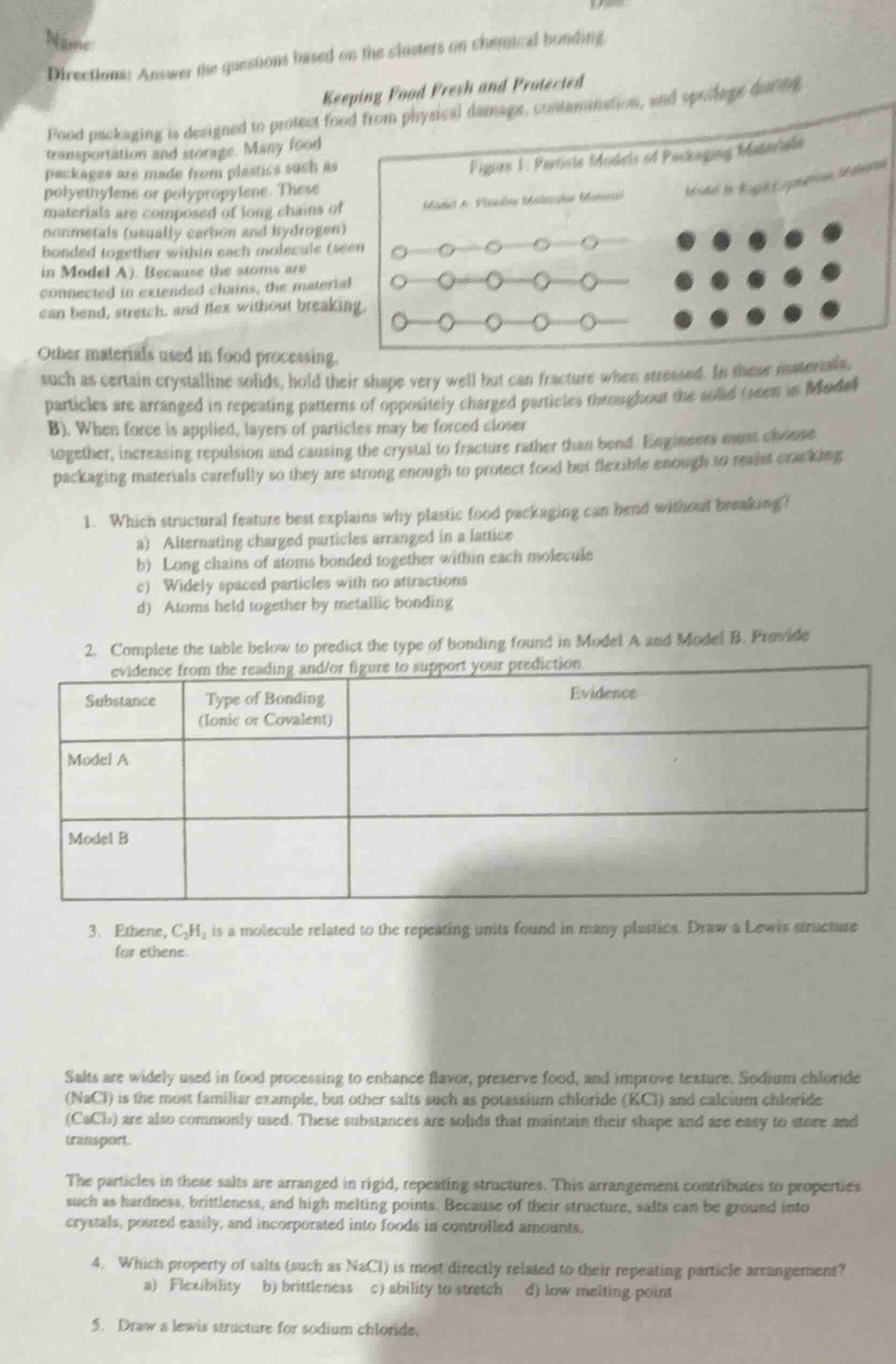
food packaging is designed to protect food from physical damage, contamination, and spoilage during transportation and storage. many food packages are made from plastics such as polyethylene or polypropylene. these materials are composed of long chains of nonmetals (usually carbon and hydrogen) bonded together within each molecule (seen in model a). because the atoms are connected in extended chains, the material can bend, stretch, and flex without breaking.
other materials used in food processing, such as certain crystalline solids, hold their shape very well but can fracture when stressed. in these materials, particles are arranged in repeating patterns of oppositely charged particles throughout the solid (seen in model b). when force is applied, layers of particles may be forced closer together, increasing repulsion and causing the crystal to fracture rather than bend. engineers must choose packaging materials carefully so they are strong enough to protect food but flexible enough to resist cracking.
- which structural feature best explains why plastic food packaging can bend without breaking?
a) alternating charged particles arranged in a lattice
b) long chains of atoms bonded together within each molecule
c) widely spaced particles with no attractions
d) atoms held together by metallic bonding
- complete the table below to predict the type of bonding found in model a and model b. provide evidence from the reading and/or figure to support your prediction.
| substance | type of bonding (ionic or covalent) | evidence |
|---|---|---|
| model b |
- ethene, c₂h₄ is a molecule related to the repeating units found in many plastics. draw a lewis structure for ethene.
salts are widely used in food processing to enhance flavor, preserve food, and improve texture. sodium chloride (nacl) is the most familiar example, but other salts such as potassium chloride (kcl) and calcium chloride (cacl₂) are also commonly used. these substances are solids that maintain their shape and are easy to store and transport.
the particles in these salts are arranged in rigid, repeating structures. this arrangement contributes to properties such as hardness, brittleness, and high melting points. because of their structure, salts can be ground into crystals, poured easily, and incorporated into foods in controlled amounts.
- which property of salts (such as nacl) is most directly related to their repeating particle arrangement?
a) flexibility b) brittleness c) ability to stretch d) low melting point
- draw a lewis structure for sodium chloride.
Step1: Answer Q1 (match text to option)
The reading states plastics (Model A) have long chains of nonmetal atoms bonded within molecules, enabling bending without breaking. This matches option b.
Step2: Complete Q2 table
For Model A: Identify bonding type and cite text/figure evidence. For Model B: Identify bonding type and cite text/figure evidence.
Step3: Draw Q3 Lewis structure
Ethene ($\text{C}_2\text{H}_4$) has a double bond between C atoms, with each C bonded to 2 H atoms.
Step4: Answer Q4 (match text to option)
The reading links salts' repeating rigid structure to brittleness, matching option b.
Step5: Draw Q5 Lewis structure
Sodium chloride ($\text{NaCl}$) is ionic, with $\text{Na}^+$ and $\text{Cl}^-$ ions.

Snap & solve any problem in the app
Get step-by-step solutions on Sovi AI
Photo-based solutions with guided steps
Explore more problems and detailed explanations
- b) Long chains of atoms bonded together within each molecule
2.
| Substance | Type of Bonding (Ionic or Covalent) | Evidence |
|---|---|---|
| Model B | Ionic | Arranged in repeating patterns of oppositely charged particles; fractures when stressed due to repulsion of like-charged layers |
- Lewis Structure for Ethene ($\text{C}_2\text{H}_4$):
      H   H
      |   |
H - C = C - H
(Or in standard Lewis dot form: $\text{H}:\underset{\cdot \cdot}{\text{C}}::\underset{\cdot \cdot}{\text{C}}:\text{H}$ with each C also bonded to one additional H, written as $\text{H}_2\text{C}=\text{CH}_2$ with all valence electrons shown:
with each C having 4 total bonds (double bond between Cs, single bonds to Hs), satisfying octet rule for C and duet rule for H.)
- b) brittleness
- Lewis Structure for Sodium Chloride ($\text{NaCl}$):
$\text{Na}^+[:\underset{\cdot \cdot}{\overset{\cdot \cdot}{\text{Cl}}}:]^-$
(Represents the ionic bond between positively charged sodium ion and negatively charged chloride ion, with full valence shells for both ions.)