QUESTION IMAGE
Question
name _______________________________ due friday, january 25, 2026
celebration of molecules, solids, liquids, gases, and intermolecular forces v2
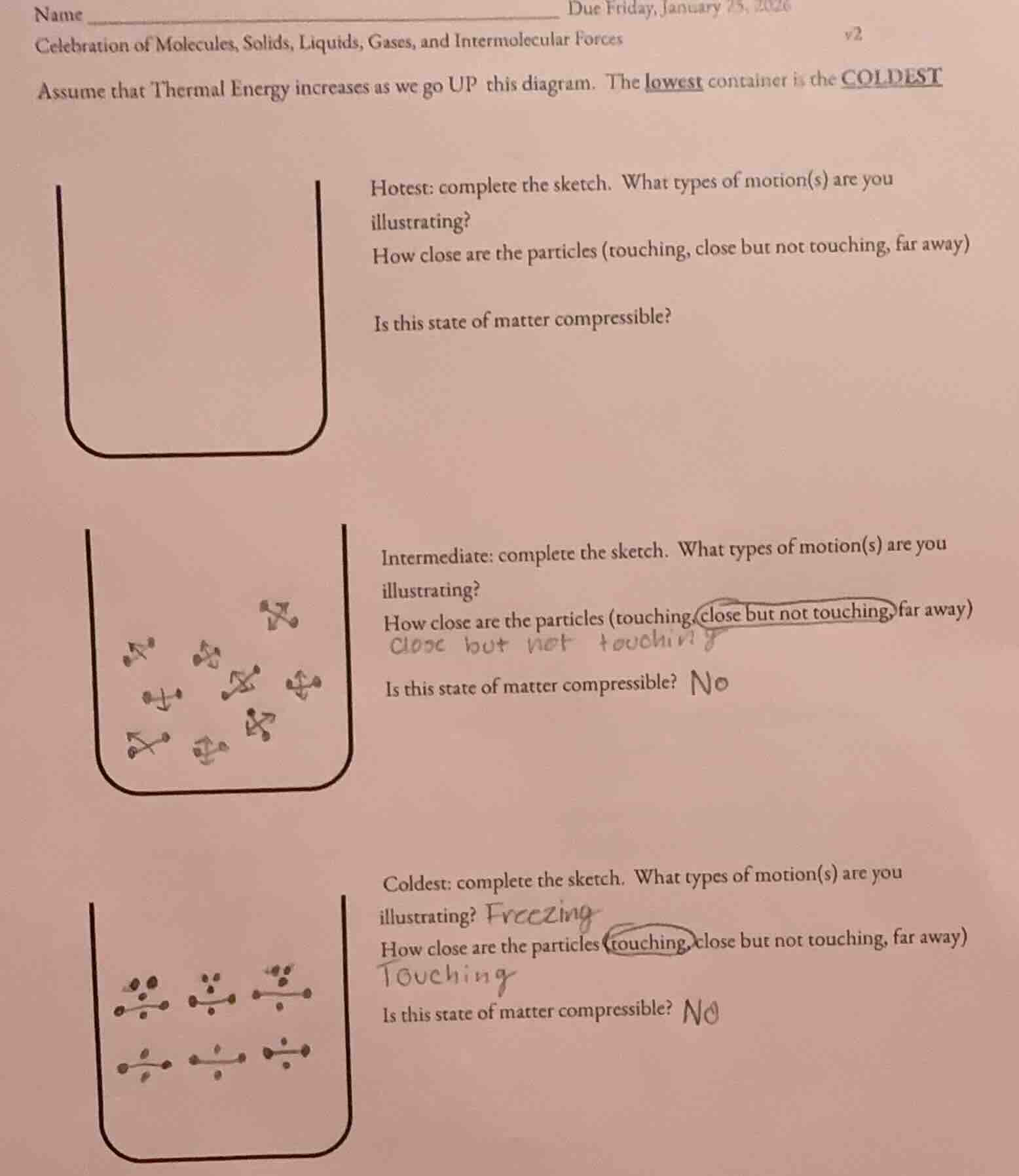
assume that thermal energy increases as we go up this diagram. the lowest container is the coldest
hottest: complete the sketch. what types of motion(s) are you
illustrating?
how close are the particles (touching, close but not touching, far away)
is this state of matter compressible?
intermediate: complete the sketch. what types of motion(s) are you
illustrating?
how close are the particles (touching, close but not touching, far away)
close but not touching
is this state of matter compressible? no
coldest: complete the sketch. what types of motion(s) are you
illustrating? freezing
how close are the particles (touching, close but not touching, far away)
touching
is this state of matter compressible? no
Hotest Container (Gas, assuming thermal energy increases up)
Sketch:
Draw particles (molecules/atoms) far apart, moving freely and randomly (including translational, rotational, and vibrational motion, but translational is most prominent for gas visualization). They should be spread out across the container, not clustered.
Motion:
- Translational motion: Particles move freely in straight lines until they collide with other particles or the container walls.
- Rotational motion: Particles spin around their own axes.
- Vibrational motion: Atoms within molecules vibrate (if applicable, e.g., for diatomic or polyatomic gases).
Particle Distance:
Far away from each other. The intermolecular spaces in gases are large compared to solids/liquids.
Compressibility:
Yes. Gases are highly compressible because the large intermolecular spaces can be reduced by applying pressure (pushing particles closer together).
Intermediate Container (Liquid, as seen in the sketch with “close but not touching” and “No” for compressibility)
Sketch (already partially done):
Particles are close but not touching, arranged with some order but able to slide past each other (fluid motion).
Motion:
- Translational motion: Particles slide past one another (allows liquids to flow).
- Rotational motion: Particles rotate.
- Vibrational motion: Atoms within molecules vibrate.
Particle Distance:
Close but not touching (intermolecular forces are moderate, keeping particles near each other but not locked in place like a solid).
Compressibility:
No (or very slightly). Liquids have little empty space between particles, so applying pressure hardly reduces their volume.
Coldest Container (Solid, as seen with “touching” and “No” for compressibility)
Sketch (already partially done):
Particles are touching (packed closely), arranged in a regular, repeating pattern (crystalline) or slightly disordered (amorphous), vibrating in fixed positions.
Motion:
- Vibrational motion: Particles vibrate in place around fixed equilibrium positions (no translational motion to slide past each other, which is why solids have a fixed shape).
Particle Distance:
Touching (intermolecular forces are strong, holding particles in a rigid structure).
Compressibility:
No (or extremely slightly). Solids have minimal empty space between particles, so they resist compression.
Key Concept Summary:
The diagram relates thermal energy to the states of matter (solid → liquid → gas as thermal energy increases). Higher thermal energy means more particle motion and larger intermolecular distances:
- Solid (coldest): Low thermal energy → particles vibrate in place, close together, rigid structure.
- Liquid (intermediate): Moderate thermal energy → particles slide past each other, close but not touching, fluid structure.
- Gas (hottest): High thermal energy → particles move freely, far apart, compressible structure.

Snap & solve any problem in the app
Get step-by-step solutions on Sovi AI
Photo-based solutions with guided steps
Explore more problems and detailed explanations
Hotest Container (Gas, assuming thermal energy increases up)
Sketch:
Draw particles (molecules/atoms) far apart, moving freely and randomly (including translational, rotational, and vibrational motion, but translational is most prominent for gas visualization). They should be spread out across the container, not clustered.
Motion:
- Translational motion: Particles move freely in straight lines until they collide with other particles or the container walls.
- Rotational motion: Particles spin around their own axes.
- Vibrational motion: Atoms within molecules vibrate (if applicable, e.g., for diatomic or polyatomic gases).
Particle Distance:
Far away from each other. The intermolecular spaces in gases are large compared to solids/liquids.
Compressibility:
Yes. Gases are highly compressible because the large intermolecular spaces can be reduced by applying pressure (pushing particles closer together).
Intermediate Container (Liquid, as seen in the sketch with “close but not touching” and “No” for compressibility)
Sketch (already partially done):
Particles are close but not touching, arranged with some order but able to slide past each other (fluid motion).
Motion:
- Translational motion: Particles slide past one another (allows liquids to flow).
- Rotational motion: Particles rotate.
- Vibrational motion: Atoms within molecules vibrate.
Particle Distance:
Close but not touching (intermolecular forces are moderate, keeping particles near each other but not locked in place like a solid).
Compressibility:
No (or very slightly). Liquids have little empty space between particles, so applying pressure hardly reduces their volume.
Coldest Container (Solid, as seen with “touching” and “No” for compressibility)
Sketch (already partially done):
Particles are touching (packed closely), arranged in a regular, repeating pattern (crystalline) or slightly disordered (amorphous), vibrating in fixed positions.
Motion:
- Vibrational motion: Particles vibrate in place around fixed equilibrium positions (no translational motion to slide past each other, which is why solids have a fixed shape).
Particle Distance:
Touching (intermolecular forces are strong, holding particles in a rigid structure).
Compressibility:
No (or extremely slightly). Solids have minimal empty space between particles, so they resist compression.
Key Concept Summary:
The diagram relates thermal energy to the states of matter (solid → liquid → gas as thermal energy increases). Higher thermal energy means more particle motion and larger intermolecular distances:
- Solid (coldest): Low thermal energy → particles vibrate in place, close together, rigid structure.
- Liquid (intermediate): Moderate thermal energy → particles slide past each other, close but not touching, fluid structure.
- Gas (hottest): High thermal energy → particles move freely, far apart, compressible structure.