QUESTION IMAGE
Question
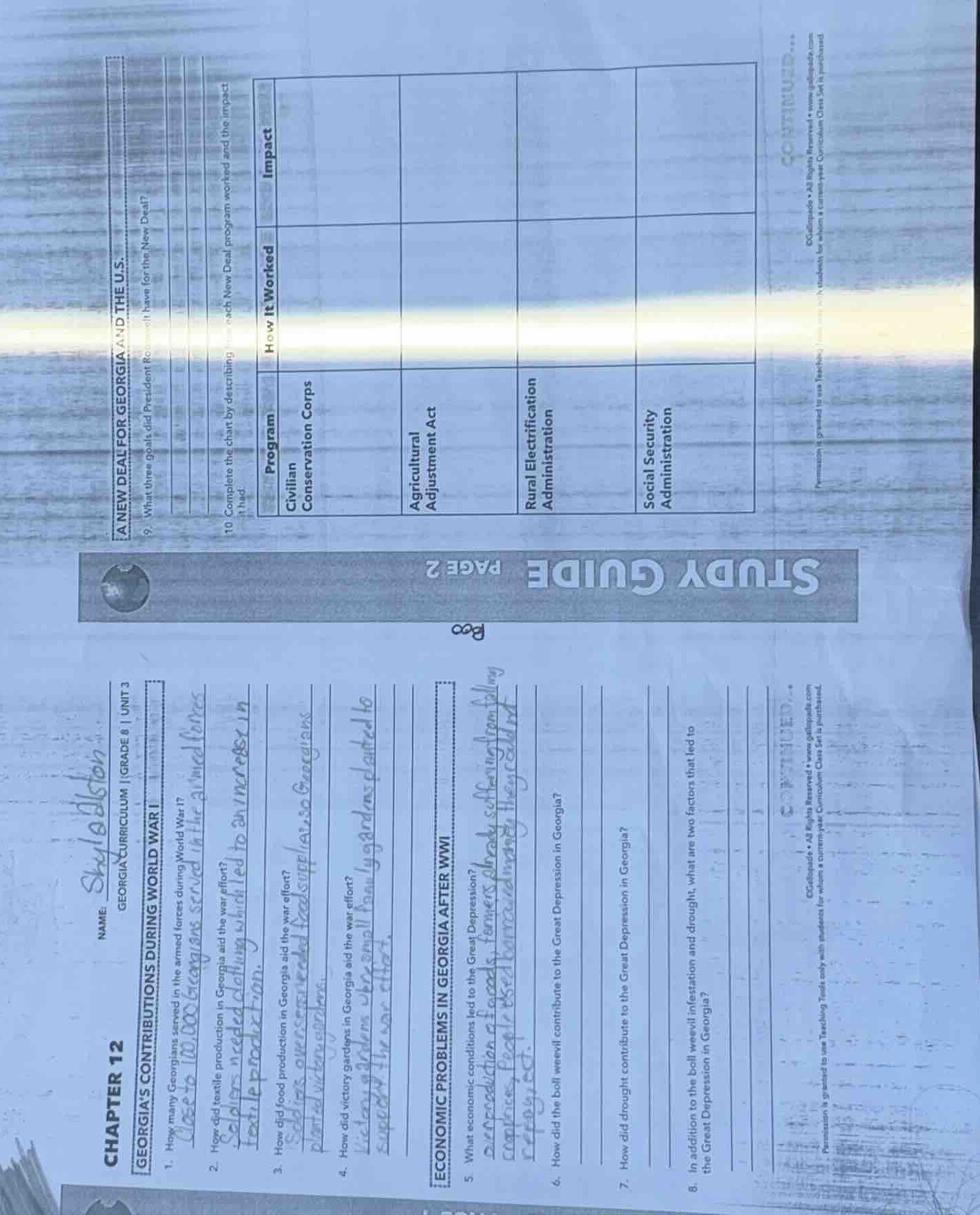
name:georgia curriculum | grade 8 | unit 3chapter 12georgias contributions during world war i1. how many georgians served in the armed forces during world war 1?2. how did textile production in georgia aid the war effort?3. how did food production in georgia aid the war effort?4. how did victory gardens in georgia aid the war effort?economic problems in georgia after wwi5. what economic conditions led to the great depression?6. how did the boll weevil contribute to the great depression in georgia?7. how did drought contribute to the great depression in georgia?8. in addition to the boll weevil infestation and drought, what are two factors that led tothe great depression in georgia?a new deal for georgia and the u.s.9. what three goals did president roosevelt have for the new deal?10. complete the chart by describing each new deal program worked and the impactit had.|program|how it worked|impact|| ---- | ---- | ---- ||civilian conservation corps| | ||agricultural adjustment act| | ||rural electrification administration| | ||social security administration| | |
Questions 1-4 (WWI Contributions)
- Historical records confirm Georgia's WWI military enlistment numbers.
- Textiles were critical for military supplies during WWI.
- Food production supported troops and home front populations.
- Victory gardens reduced commercial food demand for the war effort.
Questions 5-8 (Great Depression in Georgia)
- Post-WWI overproduction and debt crashed farm incomes.
- The boll weevil destroyed Georgia's core cotton crop.
- Drought parched farmland, ruining crops and livestock.
- Economic and environmental factors worsened the crisis.
Questions 9-10 (New Deal)
- Roosevelt's New Deal focused on relief, recovery, and reform.
- Each program had distinct operations and regional impacts.

Snap & solve any problem in the app
Get step-by-step solutions on Sovi AI
Photo-based solutions with guided steps
Explore more problems and detailed explanations
GEORGIA'S CONTRIBUTIONS DURING WORLD WAR I
- Close to 100,000 Georgians served in the armed forces during World War I.
- Georgia's textile production increased to supply uniforms, tents, and other textile goods needed by soldiers, directly supporting the war effort.
- Georgia expanded food production (especially staple crops) and planted victory gardens to ensure a steady food supply for troops and civilians, reducing reliance on imported food.
- Victory gardens (small family gardens) were planted across Georgia to grow additional food, which allowed more commercial food crops to be sent to support Allied troops overseas.
ECONOMIC PROBLEMS IN GEORGIA AFTER WWI
- Overproduction of crops (leading to plummeting crop prices) and heavy debt from overborrowing by farmers (who expanded operations during WWI) led to economic collapse that worsened into the Great Depression.
- The boll weevil destroyed most of Georgia's cotton crop (the state's primary economic driver), wiping out farm incomes, putting farmers out of work, and devastating local economies dependent on cotton.
- Drought dried up farmland, killed crops and livestock, made farming impossible in many areas, and displaced rural workers, amplifying the economic hardship of the Great Depression.
- Two additional factors: overproduction of agricultural goods (which kept crop prices extremely low) and widespread farm debt (from loans taken out during WWI that farmers could not repay when profits collapsed).
A NEW DEAL FOR GEORGIA AND THE U.S.
- President Roosevelt's three main goals for the New Deal were:
- Relief: Provide immediate aid to unemployed and suffering Americans
- Recovery: Help the economy bounce back from the Depression
- Reform: Create laws and programs to prevent a future economic crisis
10.
| Program | How It Worked | Impact |
|---|---|---|
| Agricultural Adjustment Act (AAA) | Paid farmers to reduce crop production to raise crop prices | Raised income for some Georgia farmers, but harmed sharecroppers and tenant farmers who lost work when land was taken out of production |
| Rural Electrification Administration (REA) | Provided low-cost loans to build electric power lines in rural areas | Brought electricity to most rural Georgia homes, improving quality of life and enabling modern farming and household technologies |
| Social Security Administration (SSA) | Created a pension system for elderly workers, unemployment insurance, and aid to dependent children | Provided financial security for Georgia's elderly and unemployed; reduced poverty among vulnerable populations |