QUESTION IMAGE
Question
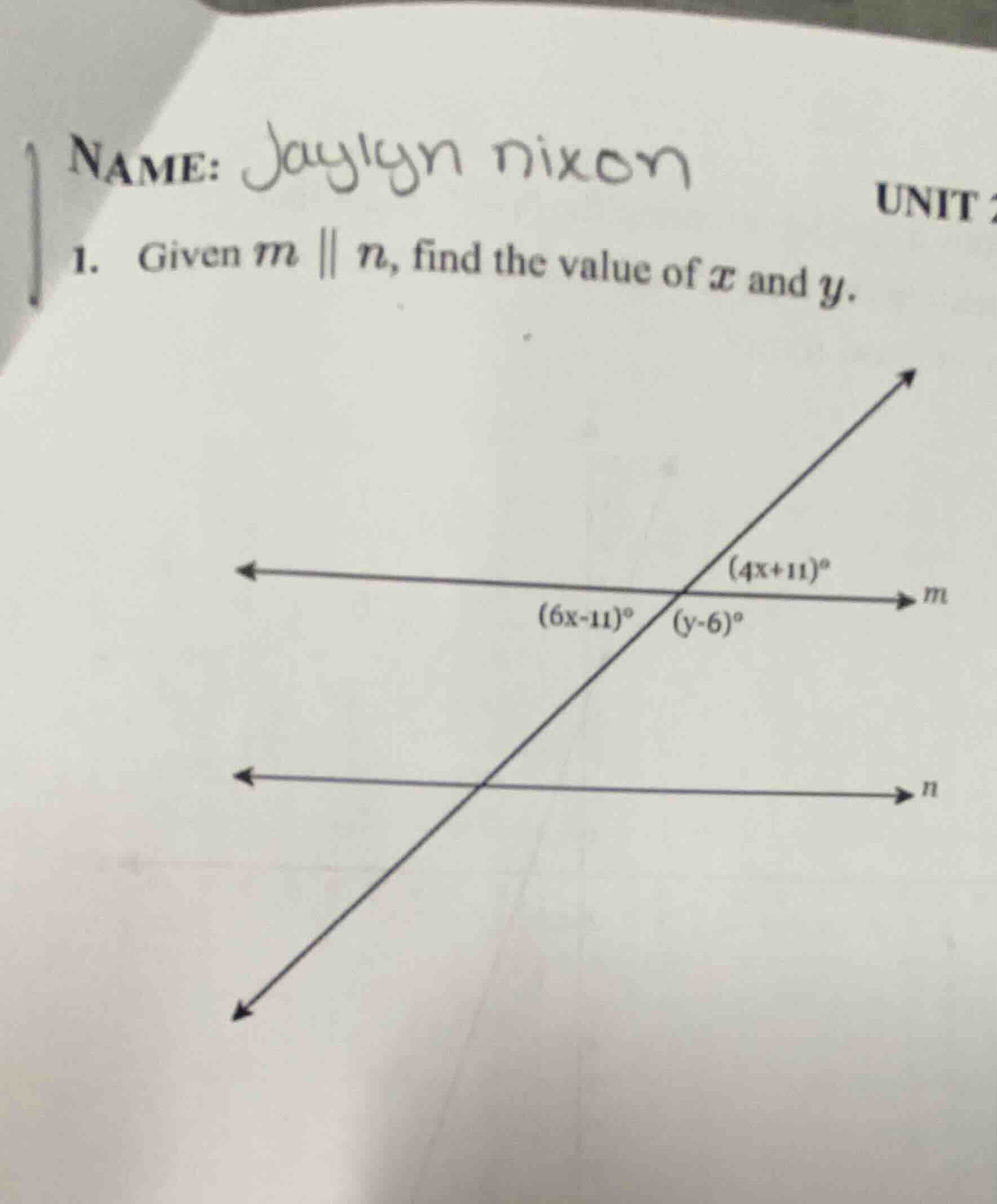
name: jaylyn nixon unit 1. given ( m parallel n ), find the value of ( x ) and ( y ).
Step1: Find x using vertical angles or linear pair? Wait, no, since m || n, the angles (4x + 11) and (6x - 11) are alternate interior angles? Wait, no, actually, (4x + 11) and (6x - 11) are vertical? Wait, no, looking at the diagram, (4x + 11) and (6x - 11) are adjacent? Wait, no, maybe they are supplementary? Wait, no, let's see: (4x + 11) and (6x - 11) are vertical angles? No, wait, (4x + 11) and (y - 6) are adjacent, forming a linear pair? Wait, no, the angle (4x + 11) and (6x - 11) are actually vertical angles? Wait, no, maybe (4x + 11) and (6x - 11) are equal because they are vertical angles? Wait, no, vertical angles are equal, but maybe (4x + 11) and (6x - 11) are vertical? Wait, no, let's check the diagram again. Wait, the two lines m and n are parallel, cut by a transversal. The angle (4x + 11) and (6x - 11) are actually vertical angles? Wait, no, maybe (4x + 11) and (6x - 11) are equal because they are alternate interior angles? Wait, no, alternate interior angles are equal when lines are parallel. Wait, maybe (4x + 11) and (6x - 11) are equal. Let's set them equal: 4x + 11 = 6x - 11. Solving for x: 11 + 11 = 6x - 4x → 22 = 2x → x = 11. Wait, is that right? Let's check. If x = 11, then 4x + 11 = 411 + 11 = 55, 6x - 11 = 611 - 11 = 55. So they are equal, which makes sense if they are vertical angles or alternate interior angles. Then, (y - 6) and (4x + 11) are adjacent, forming a linear pair? Wait, no, (y - 6) and (4x + 11) are adjacent, so they should be supplementary? Wait, no, (y - 6) and (6x - 11) are vertical? Wait, no, (y - 6) and (4x + 11) are adjacent, forming a linear pair, so they should add up to 180? Wait, no, (4x + 11) + (y - 6) = 180? Wait, no, (4x + 11) and (y - 6) are adjacent, so they form a linear pair, so their sum is 180? Wait, no, (4x + 11) and (y - 6) are adjacent, so 4x + 11 + y - 6 = 180? Wait, no, maybe (y - 6) is equal to (6x - 11) because they are vertical angles? Wait, (6x - 11) and (y - 6) are vertical angles, so they are equal. So y - 6 = 6x - 11. We found x = 11, so y - 6 = 6*11 - 11 = 55, so y = 55 + 6 = 61. Wait, let's verify:
First, find x:
Assume (4x + 11) and (6x - 11) are vertical angles, so they are equal:
4x + 11 = 6x - 11
Subtract 4x from both sides:
11 = 2x - 11
Add 11 to both sides:
22 = 2x
Divide by 2:
x = 11
Then, (y - 6) and (6x - 11) are vertical angles, so they are equal:
y - 6 = 6x - 11
Substitute x = 11:
y - 6 = 6*11 - 11 = 66 - 11 = 55
Add 6 to both sides:
y = 55 + 6 = 61
Let's check the linear pair: (4x + 11) + (y - 6) = 55 + 55 = 110? Wait, that's not 180. Wait, maybe I made a mistake. Wait, (4x + 11) and (y - 6) are adjacent, forming a linear pair, so they should add up to 180. Let's check: 55 + 55 = 110, which is not 180. So my mistake. Wait, maybe (4x + 11) and (y - 6) are supplementary. So 4x + 11 + y - 6 = 180. But also, (6x - 11) and (y - 6) are vertical angles? No, maybe (4x + 11) and (6x - 11) are supplementary? Wait, 4x + 11 + 6x - 11 = 10x = 180? Then x = 18. But that contradicts the earlier. Wait, maybe I misidentified the angles. Let's look again. The angle (4x + 11) and (6x - 11) are adjacent, forming a linear pair, so they should add up to 180. So 4x + 11 + 6x - 11 = 10x = 180 → x = 18. Wait, that makes more sense. Then (4x + 11) = 418 + 11 = 83, (6x - 11) = 618 - 11 = 97. Then 83 + 97 = 180, which is a linear pair. Then (y - 6) is equal to (6x - 11) because they are vertical angles? Wait, (6x - 11) and (y - 6) are vertical angles, so y - 6 = 97 → y = 103. But then (4x + 11) + (y - 6) = 83 + 97 = 180, which is correct. Wait, so where did…

Snap & solve any problem in the app
Get step-by-step solutions on Sovi AI
Photo-based solutions with guided steps
Explore more problems and detailed explanations
x = 18, y = 103