QUESTION IMAGE
Question
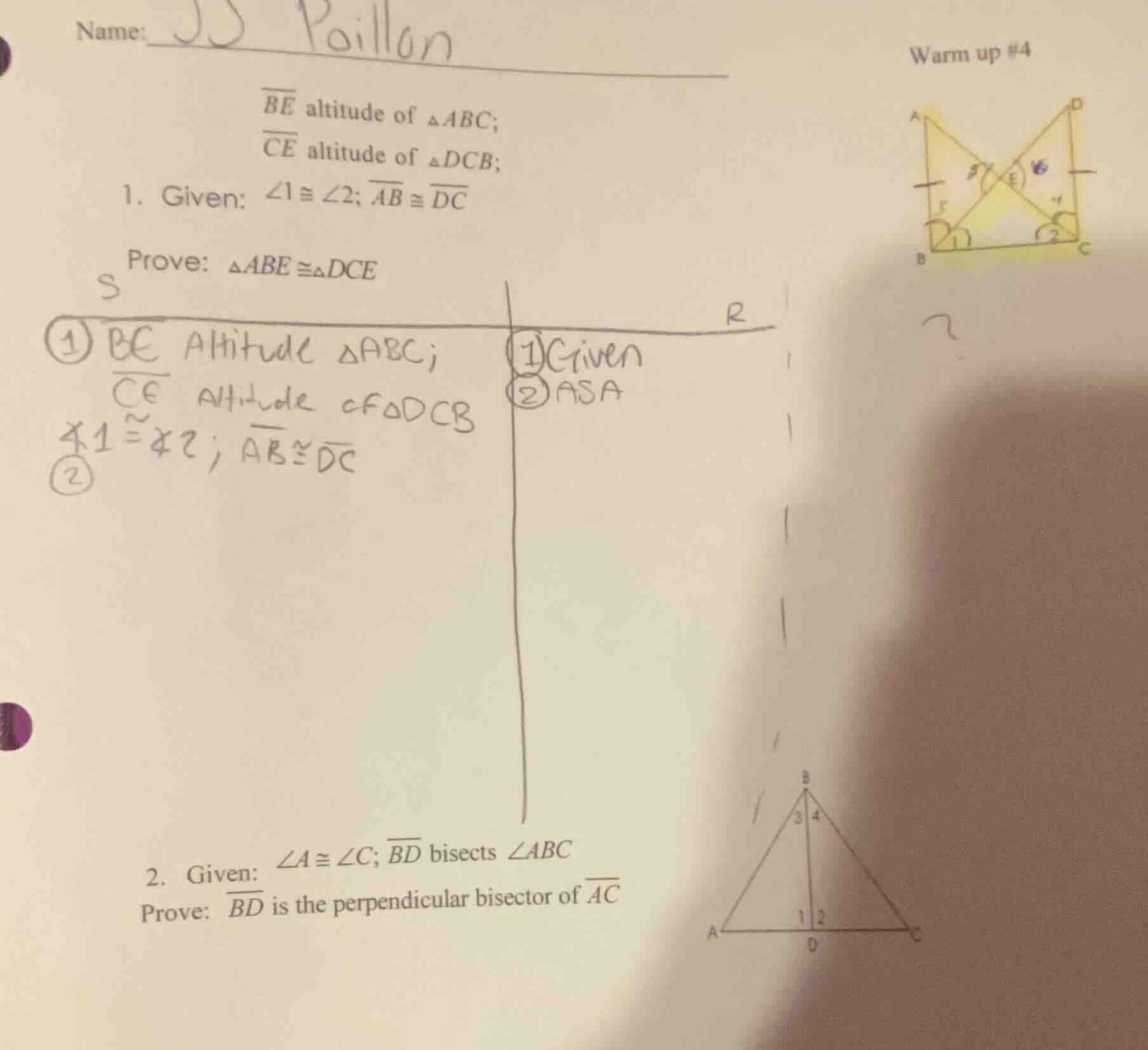
name: js poillon
warm up #4
\\(\overline{be}\\) altitude of \\(\triangle abc\\);
\\(\overline{ce}\\) altitude of \\(\triangle dcb\\);
- given: \\(\angle 1 \cong \angle 2\\); \\(\overline{ab} \cong \overline{dc}\\)
prove: \\(\triangle abe \cong \triangle dce\\)
- given: \\(\angle a \cong \angle c\\); \\(\overline{bd}\\) bisects \\(\angle abc\\)
prove: \\(\overline{bd}\\) is the perpendicular bisector of \\(\overline{ac}\\)
Problem 1: Prove $\triangle ABE \cong \triangle DCE$
Step 1: Identify Right Angles
Since $\overline{BE}$ is an altitude of $\triangle ABC$, $\angle AEB = 90^\circ$. Similarly, $\overline{CE}$ is an altitude of $\triangle DCB$, so $\angle DEC = 90^\circ$. Thus, $\angle AEB \cong \angle DEC$ (all right angles are congruent).
Step 2: List Given and Derived Information
We know:
- $\angle 1 \cong \angle 2$ (given),
- $\overline{AB} \cong \overline{DC}$ (given),
- $\angle AEB \cong \angle DEC$ (right angles, from Step 1).
Step 3: Apply AAS Congruence
By the Angle - Angle - Side (AAS) congruence criterion:
- Two angles: $\angle AEB \cong \angle DEC$ (right angles) and $\angle 1 \cong \angle 2$ (given).
- One side: $\overline{AB} \cong \overline{DC}$ (given).
Thus, $\triangle ABE \cong \triangle DCE$ by AAS.
Step 1: Analyze Angle Bisector
$\overline{BD}$ bisects $\angle ABC$, so $\angle 3 \cong \angle 4$ (definition of angle bisector).
Step 2: Identify Congruent Triangles
We know:
- $\angle A \cong \angle C$ (given),
- $\angle 3 \cong \angle 4$ (from Step 1),
- $\overline{BD} \cong \overline{BD}$ (common side, reflexive property).
Step 3: Apply AAS Congruence to $\triangle ABD$ and $\triangle CBD$
By AAS:
- $\angle A \cong \angle C$,
- $\angle 3 \cong \angle 4$,
- $\overline{BD} \cong \overline{BD}$.
Thus, $\triangle ABD \cong \triangle CBD$.
Step 4: Derive Segment and Angle Relationships
From $\triangle ABD \cong \triangle CBD$:
- $\overline{AD} \cong \overline{CD}$ (corresponding parts of congruent triangles, CPCTC), so $D$ is the midpoint of $\overline{AC}$ (definition of midpoint).
- $\angle 1 \cong \angle 2$ (CPCTC). Since $\angle 1 + \angle 2 = 180^\circ$ (linear pair), $\angle 1 = \angle 2 = 90^\circ$ (so $\overline{BD} \perp \overline{AC}$).
Step 5: Conclude Perpendicular Bisector
Since $D$ is the midpoint of $\overline{AC}$ ($\overline{AD} \cong \overline{CD}$) and $\overline{BD} \perp \overline{AC}$ ($\angle 1 = \angle 2 = 90^\circ$), $\overline{BD}$ is the perpendicular bisector of $\overline{AC}$.

Snap & solve any problem in the app
Get step-by-step solutions on Sovi AI
Photo-based solutions with guided steps
Explore more problems and detailed explanations
$\triangle ABE \cong \triangle DCE$ (proven by AAS congruence).