QUESTION IMAGE
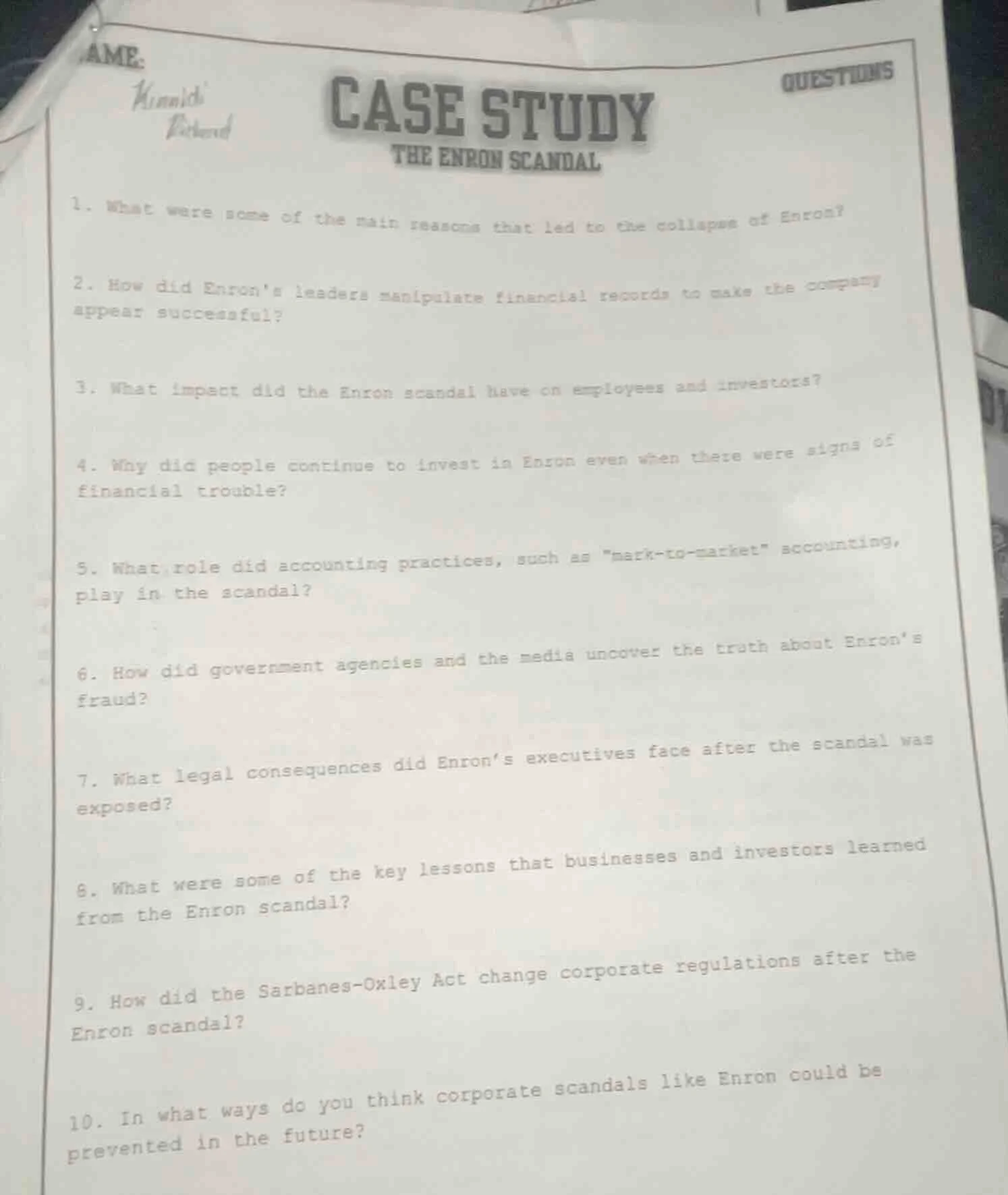
Question
name:
kenneth
richard
case study
the enron scandal
questions
- what were some of the main reasons that led to the collapse of enron?
- how did enrons leaders manipulate financial records to make the company appear successful?
- what impact did the enron scandal have on employees and investors?
- why did people continue to invest in enron even when there were signs of financial trouble?
- what role did accounting practices, such as \mark - to - market\ accounting, play in the scandal?
- how did government agencies and the media uncover the truth about enrons fraud?
- what legal consequences did enrons executives face after the scandal was exposed?
- what were some of the key lessons that businesses and investors learned from the enron scandal?
- how did the sarbanes - oxley act change corporate regulations after the enron scandal?
- in what ways do you think corporate scandals like enron could be prevented in the future?
Response
To answer these questions about the Enron scandal, we analyze each one:
1. What were some of the main reasons that led to the collapse of Enron?
- Corporate Fraud: Executives (e.g., Jeff Skilling, Andrew Fastow) engaged in accounting fraud to inflate profits.
- Misleading Accounting Practices: Used “mark-to-market” accounting to book projected (not actual) profits from energy trades, hiding losses.
- Conflict of Interest: Andrew Fastow created off - balance - sheet entities (e.g., LJM) to disguise debt and manipulate earnings, enriching himself.
- Poor Corporate Governance: The board failed to oversee executives, allowing unethical practices.
- Over - Reliance on Speculative Trades: Shifted from stable energy production to risky trading, making revenue volatile.
2. How did Enron’s leaders manipulate financial records to make the company appear successful?
- Off - Balance - Sheet Entities: Fastow’s LJM entities kept Enron’s debt and losses off financial statements, reducing reported liabilities.
- Mark - to - Market Accounting: Booked future revenue from energy contracts immediately (even if uncertain), inflating current profits.
- Inflated Asset Valuations: Overvalued assets (e.g., broadband division) to boost net worth on paper.
- Revenue Recognition Tricks: Recognized revenue too early or from non - arm’s - length transactions.
3. What impact did the Enron scandal have on employees and investors?
- Employees: Lost jobs (Enron went bankrupt, ~20,000 laid off) and retirement savings (401(k)s heavily invested in Enron stock, which became worthless).
- Investors: Shareholders lost billions (stock dropped from ~$90 to less than $1). Pension funds, mutual funds, and individual investors suffered massive losses.
4. Why did people continue to invest in Enron even when there were signs of financial trouble?
- Reputation and Hype: Enron was seen as an “innovative” energy giant with a strong brand, trusted by Wall Street.
- Misleading Financial Reports: Falsified statements (e.g., inflated profits, hidden debt) deceived investors.
- Analyst Endorsements: Wall Street analysts (e.g., from investment banks) continued to recommend Enron stock, boosting confidence.
- Herd Mentality: Investors followed others, assuming Enron’s success would persist.
5. What role did accounting practices, such as “mark - to - market” accounting, play in the scandal?
- Mark - to - Market (MTM): Allowed Enron to record projected profits from energy contracts upfront. For example, if Enron signed a 10 - year energy contract, it booked the total expected profit immediately. When contracts underperformed, losses were hidden or delayed.
- Facilitated Fraud: MTM gave executives flexibility to inflate earnings, as future revenue was speculative. Combined with off - balance - sheet tricks, it created a false image of profitability.
6. How did government agencies and the media uncover the truth about Enron’s fraud?
- *Media (e.g., Fortune, The Wall Street Journal)*: Reporters (e.g., Bethany McLean) investigated Enron’s opaque finances, questioning its high valuation and accounting practices.
- Government Agencies: The SEC (Securities and Exchange Commission) launched an investigation after media reports. Internal whistleblowers (e.g., Sherron Watkins, an Enron accountant) also alerted the SEC and Enron’s board.
- Audit Failures Exposed: Arthur Andersen (Enron’s auditor) destroyed documents, drawing legal scrutiny and revealing audit negligence.
7. What legal co…

Snap & solve any problem in the app
Get step-by-step solutions on Sovi AI
Photo-based solutions with guided steps
Explore more problems and detailed explanations
To answer these questions about the Enron scandal, we analyze each one:
1. What were some of the main reasons that led to the collapse of Enron?
- Corporate Fraud: Executives (e.g., Jeff Skilling, Andrew Fastow) engaged in accounting fraud to inflate profits.
- Misleading Accounting Practices: Used “mark-to-market” accounting to book projected (not actual) profits from energy trades, hiding losses.
- Conflict of Interest: Andrew Fastow created off - balance - sheet entities (e.g., LJM) to disguise debt and manipulate earnings, enriching himself.
- Poor Corporate Governance: The board failed to oversee executives, allowing unethical practices.
- Over - Reliance on Speculative Trades: Shifted from stable energy production to risky trading, making revenue volatile.
2. How did Enron’s leaders manipulate financial records to make the company appear successful?
- Off - Balance - Sheet Entities: Fastow’s LJM entities kept Enron’s debt and losses off financial statements, reducing reported liabilities.
- Mark - to - Market Accounting: Booked future revenue from energy contracts immediately (even if uncertain), inflating current profits.
- Inflated Asset Valuations: Overvalued assets (e.g., broadband division) to boost net worth on paper.
- Revenue Recognition Tricks: Recognized revenue too early or from non - arm’s - length transactions.
3. What impact did the Enron scandal have on employees and investors?
- Employees: Lost jobs (Enron went bankrupt, ~20,000 laid off) and retirement savings (401(k)s heavily invested in Enron stock, which became worthless).
- Investors: Shareholders lost billions (stock dropped from ~$90 to less than $1). Pension funds, mutual funds, and individual investors suffered massive losses.
4. Why did people continue to invest in Enron even when there were signs of financial trouble?
- Reputation and Hype: Enron was seen as an “innovative” energy giant with a strong brand, trusted by Wall Street.
- Misleading Financial Reports: Falsified statements (e.g., inflated profits, hidden debt) deceived investors.
- Analyst Endorsements: Wall Street analysts (e.g., from investment banks) continued to recommend Enron stock, boosting confidence.
- Herd Mentality: Investors followed others, assuming Enron’s success would persist.
5. What role did accounting practices, such as “mark - to - market” accounting, play in the scandal?
- Mark - to - Market (MTM): Allowed Enron to record projected profits from energy contracts upfront. For example, if Enron signed a 10 - year energy contract, it booked the total expected profit immediately. When contracts underperformed, losses were hidden or delayed.
- Facilitated Fraud: MTM gave executives flexibility to inflate earnings, as future revenue was speculative. Combined with off - balance - sheet tricks, it created a false image of profitability.
6. How did government agencies and the media uncover the truth about Enron’s fraud?
- *Media (e.g., Fortune, The Wall Street Journal)*: Reporters (e.g., Bethany McLean) investigated Enron’s opaque finances, questioning its high valuation and accounting practices.
- Government Agencies: The SEC (Securities and Exchange Commission) launched an investigation after media reports. Internal whistleblowers (e.g., Sherron Watkins, an Enron accountant) also alerted the SEC and Enron’s board.
- Audit Failures Exposed: Arthur Andersen (Enron’s auditor) destroyed documents, drawing legal scrutiny and revealing audit negligence.
7. What legal consequences did Enron’s executives face after the scandal was exposed?
- Jeff Skilling: Convicted of fraud, conspiracy, and insider trading; sentenced to 24 years (later reduced).
- Andrew Fastow: Pleaded guilty to fraud, cooperated with prosecutors, and received a 6 - year sentence.
- Kenneth Lay: Convicted of fraud (died before sentencing).
- Arthur Andersen: Convicted of obstruction of justice (conviction later overturned, but the firm collapsed).
- Civil Lawsuits: Executives paid millions in fines and settlements to investors/employees.
8. What were some of the key lessons that businesses and investors learned from the Enron scandal?
- Businesses:
- Strengthen corporate governance (independent boards, ethical oversight).
- Improve accounting transparency (avoid aggressive revenue recognition).
- Enforce ethical leadership and accountability.
- Investors:
- Scrutinize financial statements (e.g., check for off - balance - sheet risks).
- Diversify investments (avoid over - reliance on one company).
- Be cautious of “too good to be true” growth stories.
9. How did the Sarbanes - Oxley Act change corporate regulations after the Enron scandal?
- Audit Oversight: Created the Public Company Accounting Oversight Board (PCAOB) to regulate auditors, reducing conflicts of interest.
- Financial Transparency: Required CEOs/CFOs to personally certify financial statements (Section 302), increasing accountability.
- Internal Controls: Mandated companies to document and test internal financial controls (Section 404).
- Whistleblower Protection: Protected employees who report fraud.
- Auditor Independence: Restricted non - audit services (e.g., consulting) auditors can provide to audit clients.
10. In what ways do you think corporate scandals like Enron could be prevented in the future?
- Stricter Regulatory Enforcement: Regular SEC audits, harsher penalties for fraud.
- Ethical Corporate Culture: Train employees/executives on ethics, reward transparency.
- Improved Corporate Governance: Independent boards with power to challenge executives.
- Investor Education: Teach investors to analyze financials and spot red flags (e.g., excessive off - balance - sheet activity).
- Whistleblower Incentives: Offer rewards/protection to encourage reporting fraud.
These answers draw on business ethics, corporate finance, and regulatory studies related to the Enron scandal.