QUESTION IMAGE
Question
name marcus harris
english/language arts period ____
due date ____
poetry information and analysis worksheet
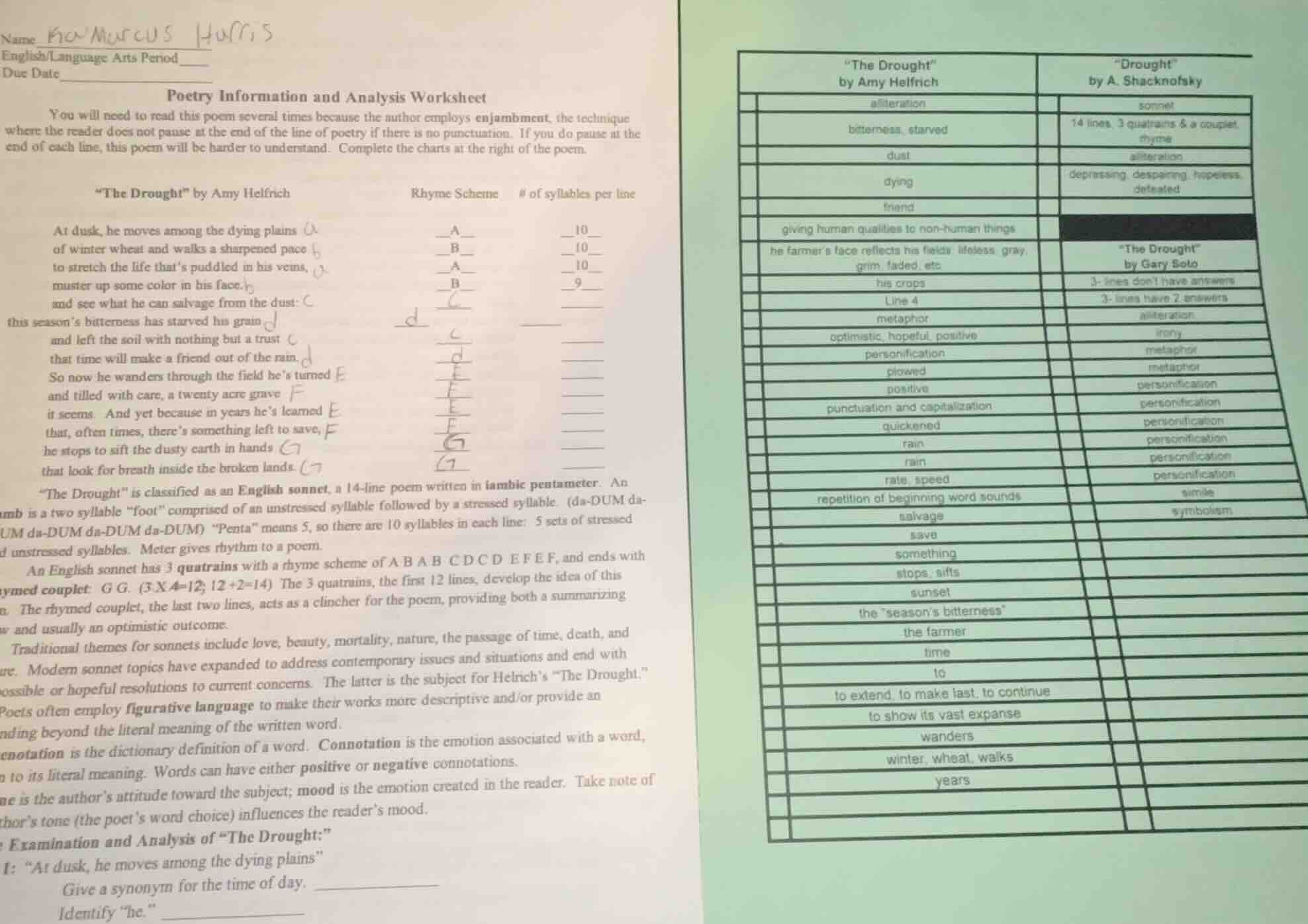
you will need to read this poem several times because the author employs enjambment, the technique where the reader does not pause at the end of the line of poetry if there is no punctuation. if you do pause at the end of each line, this poem will be harder to understand. complete the charts at the right of the poem.
\the drought\ by amy helfrich
at dusk, he moves among the dying plains
of winter wheat and walks a sharpened pace
to stretch the life that’s puddled in his veins,
muster up some color in his face
and see what he can salvage from the dust:
this season’s bitterness has starved his grain
and left the soil with nothing but a trust
that time will make a friend out of the rain.
so now he wanders through the field he’s turned
and tilled with care, a twenty acre grave
it seems. and yet because in years he’s learned
that, often times, there’s something left to save,
he stops to sift the dusty earth in hands
that look for breath inside the broken lands.
\the drought\ is classified as an english sonnet, a 14 - line poem written in iambic pentameter. an iamb is a two syllable \foot\ comprised of an unstressed syllable followed by a stressed syllable. (da - dum da - dum da - dum da - dum) \penta\ means 5, so there are 10 syllables in each line: 5 sets of stressed and unstressed syllables. meter gives rhythm to a poem.
an english sonnet has 3 quatrains with a rhyme scheme of a b a b c d c d e f e f, and ends with a rhymed couplet: g g. (3×4 = 12; 12 + 2 = 14) the 3 quatrains, the first 12 lines, develop the idea of the sonnet. the rhymed couplet, the last two lines, acts as a clincher for the poem, providing both a summarizing and usually an optimistic outcome.
traditional themes for sonnets include love, beauty, mortality, nature, the passage of time, death, and more. modern sonnet topics have expanded to address contemporary issues and situations and end with possible or hopeful resolutions to current concerns. the latter is the subject for helfrich’s \the drought.\
poets often employ figurative language to make their works more descriptive and/or provide an ending beyond the literal meaning of the written word.
denotation is the dictionary definition of a word. connotation is the emotion associated with a word, in addition to its literal meaning. words can have either positive or negative connotations.
tone is the author’s attitude toward the subject; mood is the emotion created in the reader. take note of how the author’s tone (the poet’s word choice) influences the reader’s mood.
examination and analysis of \the drought:\
1: \at dusk, he moves among the dying plains\
give a synonym for the time of day. ____
identify \he.\ ____
(and there is a chart on the right side with information about different poems including \the drought\ by amy helfrich, \drought\ by a. shacknofsky, and \the drought\ by gary soto, with various terms and their related content for analysis.)
For "The Drought" by Amy Helfrich Worksheet Sections:
- Syllable Count (remaining lines):
- Lines 5-14 follow iambic pentameter (10 syllables per line, except line 4 which has 9).
- Line 5: "and see what he can salvage from the dust:" = 10 syllables
- Line 6: "this season's bitterness has starved his grain" = 10 syllables
- Line 7: "and left the soil with nothing but a trust" = 10 syllables
- Line 8: "that time will make a friend out of the rain." = 10 syllables
- Line 9: "So now he wanders through the field he's turned" = 10 syllables
- Line 10: "and tilled with care, a twenty acre grave" = 10 syllables
- Line 11: "it seems. And yet because in years he's learned" = 10 syllables
- Line 12: "that, often times, there's something left to save," = 10 syllables
- Line 13: "he stops to sift the dusty earth in hands" = 10 syllables
- Line 14: "that look for breath inside the broken lands." = 10 syllables
- Rhyme Scheme (remaining lines):
- Follows English sonnet structure: ABAB CDCD EFEF GG
- Line 5: rhymes with line 1 → A
- Line 6: rhymes with line 2 → B
- Line 7: rhymes with line 3 → C
- Line 8: rhymes with line 4 → D
- Line 9: new rhyme → E
- Line 10: new rhyme → F
- Line 11: rhymes with line 9 → E
- Line 12: rhymes with line 10 → F
- Line 13: new rhyme → G
- Line 14: rhymes with line 13 → G
- Examination and Analysis Section:
- "Dusk" synonym: late afternoon/early evening (evening is a concise synonym)
- "he" refers to the farmer (established by context of tending drought-stricken fields)
- Right Chart Matching (for Amy Helfrich's poem):
- alliteration: winter, wheat, walks (repeating "w" sound)
- bitterness, starved: the "season's bitterness"
- dust: sifts the dusty earth in hands
- dying: dying plains
- friend: make a friend out of the rain
- giving human qualities to non-human things: personification (seen in "dying plains", "broken lands that look for breath")
- the farmer's face reflects his fields: grim, faded, etc.
- his crops: starved his grain
- Line 4: 9 syllables
- metaphor: a twenty acre grave (compares tilled field to a grave)
- optimistic, hopeful, positive: something left to save
- personification: dying plains, broken lands that look for breath, friend out of the rain
- plowed: tilled with care
- positive: something left to save
- punctuation and capitalization: enjambment (no end punctuation on most lines)
- quickened: sharpened pace
- rain: make a friend out of the rain; broken lands look for breath (rain as life source)
- rain: (second entry) same as above
- rate, speed: sharpened pace
- repetition of beginning word sounds: alliteration (winter, wheat, walks)
- salvage: can salvage from the dust
- save: something left to save
- something: something left to save
- stops, sifts: stops to sift the dusty earth
- sunset: dusk
- the farmer: the speaker "he" in the poem
- time: time will make a friend out of the rain
- to: to stretch the life, to save
- to extend, to make last, to continue: stretch the life that's puddled in his veins
- to show its vast expanse: among the dying plains
- wanders: wanders through the field
- years: in years he's learned

Snap & solve any problem in the app
Get step-by-step solutions on Sovi AI
Photo-based solutions with guided steps
Explore more problems and detailed explanations
Rhyme Scheme & Syllable Count (Full Poem)
| Line | Rhyme Scheme | # of Syllables |
|---|---|---|
| 2 | B | 10 |
| 3 | A | 10 |
| 4 | B | 9 |
| 5 | A | 10 |
| 6 | B | 10 |
| 7 | C | 10 |
| 8 | D | 10 |
| 9 | E | 10 |
| 10 | F | 10 |
| 11 | E | 10 |
| 12 | F | 10 |
| 13 | G | 10 |
| 14 | G | 10 |
Examination and Analysis
- Synonym for dusk: Evening
- Identify "he": The farmer
Right Chart Matches (Amy Helfrich's "The Drought")
- alliteration: winter, wheat, walks
- bitterness, starved: the "season's bitterness"
- dust: sifts the dusty earth in hands
- dying: dying plains
- friend: make a friend out of the rain
- giving human qualities to non-human things: personification (dying plains, broken lands)
- the farmer's face reflects his fields: grim, faded, etc.
- his crops: starved his grain
- Line 4: 9 syllables
- metaphor: a twenty acre grave
- optimistic, hopeful, positive: something left to save
- personification: dying plains, broken lands that look for breath
- plowed: tilled with care
- positive: something left to save
- punctuation and capitalization: enjambment (no end-line punctuation)
- quickened: sharpened pace
- rain: make a friend out of the rain
- rain: broken lands that look for breath
- rate, speed: sharpened pace
- repetition of beginning word sounds: alliteration (winter, wheat, walks)
- salvage: can salvage from the dust
- save: something left to save
- something: something left to save
- stops, sifts: stops to sift the dusty earth
- sunset: dusk
- the farmer: the poem's central "he" figure
- time: time will make a friend out of the rain
- to: to stretch the life, to save
- to extend, to make last, to continue: stretch the life that's puddled in his veins
- to show its vast expanse: among the dying plains
- wanders: wanders through the field
- years: in years he's learned