QUESTION IMAGE
Question
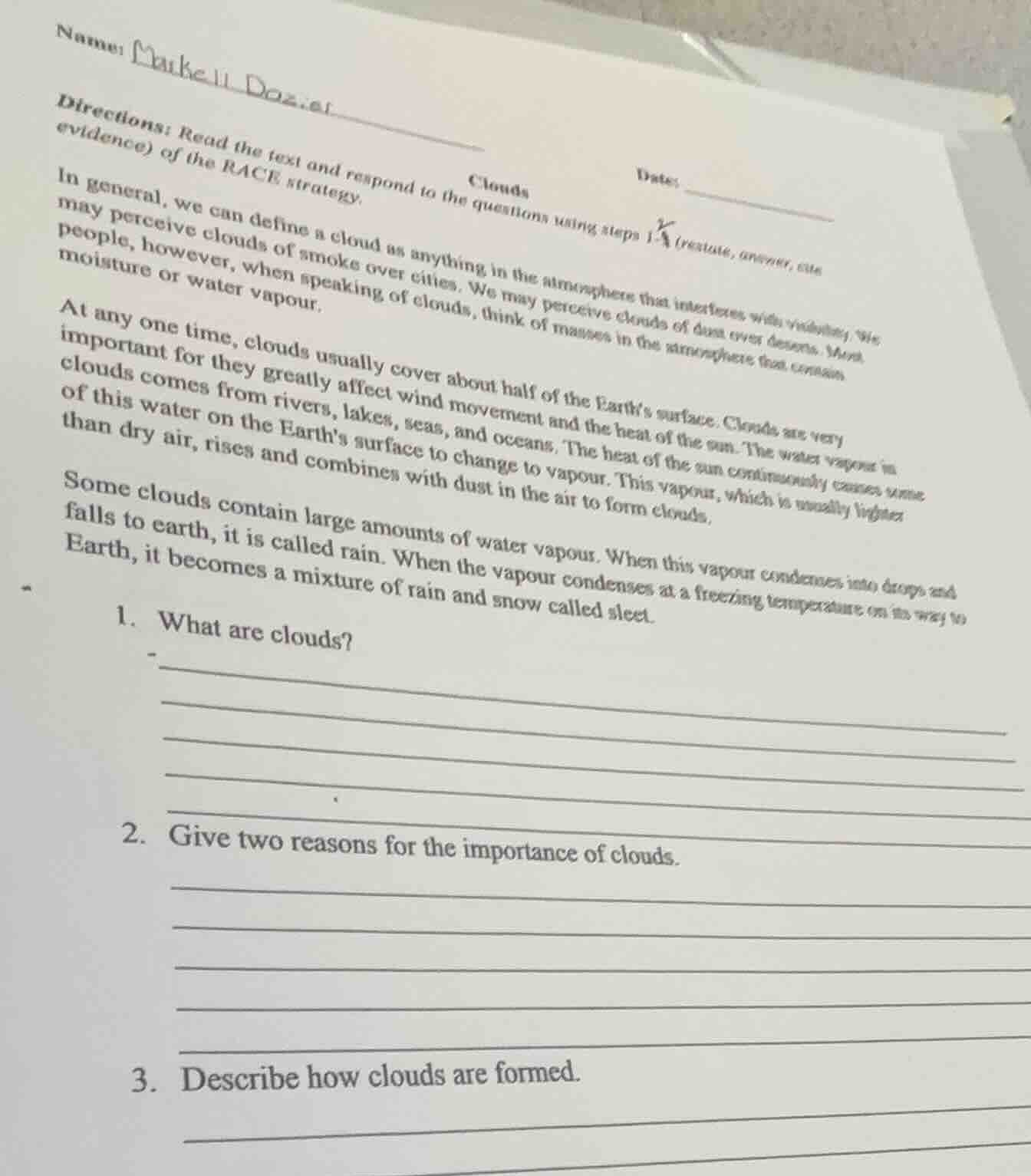
name: markell dozierdate:cloudsdirections: read the text and respond to the questions using steps 1-4 (restate, answer, cite evidence) of the race strategy.in general, we can define a cloud as anything in the atmosphere that interferes with visibility. we may perceive clouds of smoke over cities. we may perceive clouds of dust over deserts. most people, however, when speaking of clouds, think of masses in the atmosphere that contain moisture or water vapour.at any one time, clouds usually cover about half of the earths surface. clouds are very important for they greatly affect wind movement and the heat of the sun. the water vapour in clouds comes from rivers, lakes, seas, and oceans. the heat of the sun continuously causes some of this water on the earths surface to change to vapour. this vapour, which is usually lighter than dry air, rises and combines with dust in the air to form clouds.some clouds contain large amounts of water vapour. when this vapour condenses into drops and falls to earth, it is called rain. when the vapour condenses at a freezing temperature on its way to earth, it becomes a mixture of rain and snow called sleet.1. what are clouds?2. give two reasons for the importance of clouds.3. describe how clouds are formed.
- For question 1, the definition is pulled directly from the text, distinguishing the general and common understanding of clouds.
- For question 2, two key impacts of clouds stated in the text are identified as their importance.
- For question 3, the step-by-step process of cloud formation from the text is summarized.

Snap & solve any problem in the app
Get step-by-step solutions on Sovi AI
Photo-based solutions with guided steps
Explore more problems and detailed explanations
- In general, clouds are anything in the atmosphere that interferes with visibility (like dust over deserts or smoke over cities). Most commonly, they are masses in the atmosphere that contain moisture or water vapour.
- - Clouds greatly affect wind movement and the heat of the sun.
- Clouds are a source of precipitation (rain, sleet) that falls to Earth.
- The sun's heat turns water from Earth's rivers, lakes, seas, and oceans into water vapour. This vapour, which is lighter than dry air, rises, then combines with dust in the air to form clouds.