QUESTION IMAGE
Question
name: mya delrones
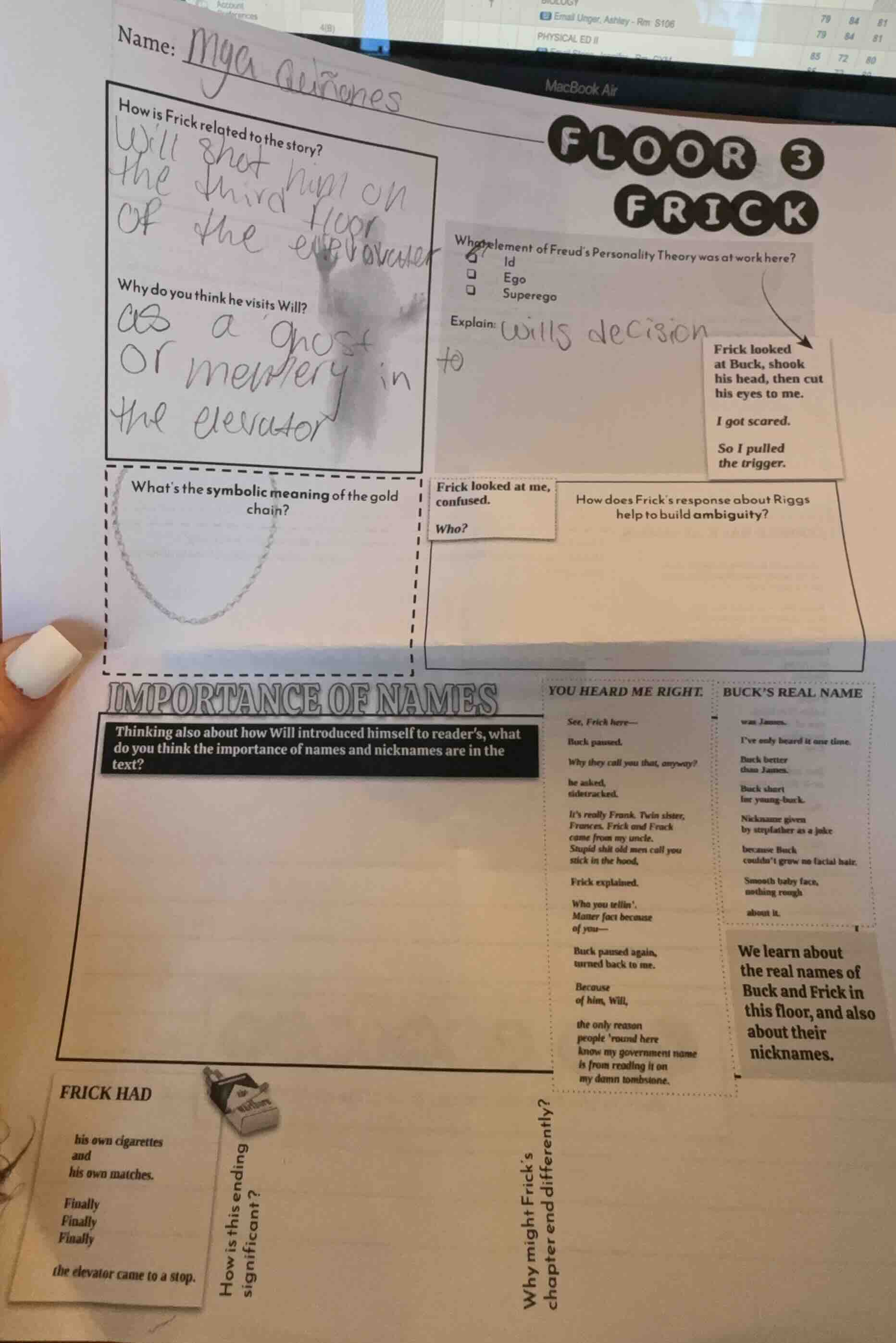
floor 3 frick
how is frick related to the story?
will shot him on the third floor of the elevator
why do you think he visits will?
as a ghost or memory in the elevator
what element of freud’s personality theory was at work here?
id
ego
superego
explain: wills decision to
frick looked at buck, shook his head, then cut his eyes to me.
i got scared.
so i pulled the trigger.
what’s the symbolic meaning of the gold chain?
frick looked at me, confused.
who?
how does frick’s response about riggs help to build ambiguity?
importance of names
thinking also about how will introduced himself to reader’s, what do you think the importance of names and nicknames are in the text?
you heard me right.
see, frick here—
buck paused.
why they call you that, anyway?
he asked, sidetracked.
it’s really frank. twin sister, frances. frick and frack came from my uncle.
stupid shit old men call you stick in the hood,
frick explained.
who you tellin’.
matter fact because of you—
buck paused again, turned back to me.
because of him, will,
the only reason people ’round here know my government name is from reading it on my damn tombstone.
buck’s real name
was james.
i’ve only heard it one time.
buck better than james.
black shirt for young-buck.
nickname given by stepfather as a joke because buck couldn’t grow no facial hair.
smooth baby face, nothing rough about it.
frick had
his own cigarettes
and
his own matches.
finally
finally
finally
the elevator came to a stop.
how is this ending significant?
why might frick’s chapter end differently?
- What element of Freud's Personality Theory was at work here?: The Id is the primitive, instinct-driven part of personality focused on immediate gratification and survival; Will acted on fear and impulse to pull the trigger, which aligns with the Id.
- What's the symbolic meaning of the gold chain?: Gold chains often symbolize identity, status, or a tangible link to personal history in literary contexts; for Frick, it likely represents his sense of self or a connection to his past in the story.
- How does Frick's response about Riggs help to build ambiguity?: Frick's confused "Who?" creates uncertainty about whether he truly doesn't recall Riggs, or is hiding his memory, leaving the reader unsure of his true knowledge and motives.
- Importance of names and nicknames: Names/nicknames shape identity—they distinguish between public (street names like Buck/Frick) and private (real names like James/Frank) selves, reflecting how characters are perceived vs. who they truly are, and tying to themes of reputation and mortality (Frick's real name only known via his tombstone).
- How is this ending significant?: The elevator stopping mirrors the abrupt, unresolved end of Frick's presence, emphasizing the story's focus on unfinished business and lingering trauma/memory.
- Why might Frick's chapter end differently?: A different ending could clarify his motives, resolve the ambiguity around his identity, or shift the focus from Will's guilt and memory to a more concrete resolution of their conflict.

Snap & solve any problem in the app
Get step-by-step solutions on Sovi AI
Photo-based solutions with guided steps
Explore more problems and detailed explanations
- Freud's Personality Theory element: Id (Will acted on immediate fear/impulse)
- Gold chain symbolic meaning: Likely represents Frick's identity, personal history, or street status
- Frick's response builds ambiguity: His confused "Who?" creates uncertainty about whether he truly does not remember Riggs, leaving his motives and knowledge unclear
- Importance of names/nicknames: They separate public street identities from private true selves, reflecting themes of perception, reputation, and mortality (seen in Frick's real name only being known from his tombstone)
- Significance of the ending: The elevator stopping mirrors the unresolved, abrupt nature of Frick's presence, highlighting lingering trauma and unfinished business
- Reason for different chapter ending: To resolve ambiguity around Frick's motives, clarify his identity, or shift focus away from Will's guilt to a more concrete resolution