QUESTION IMAGE
Question
name
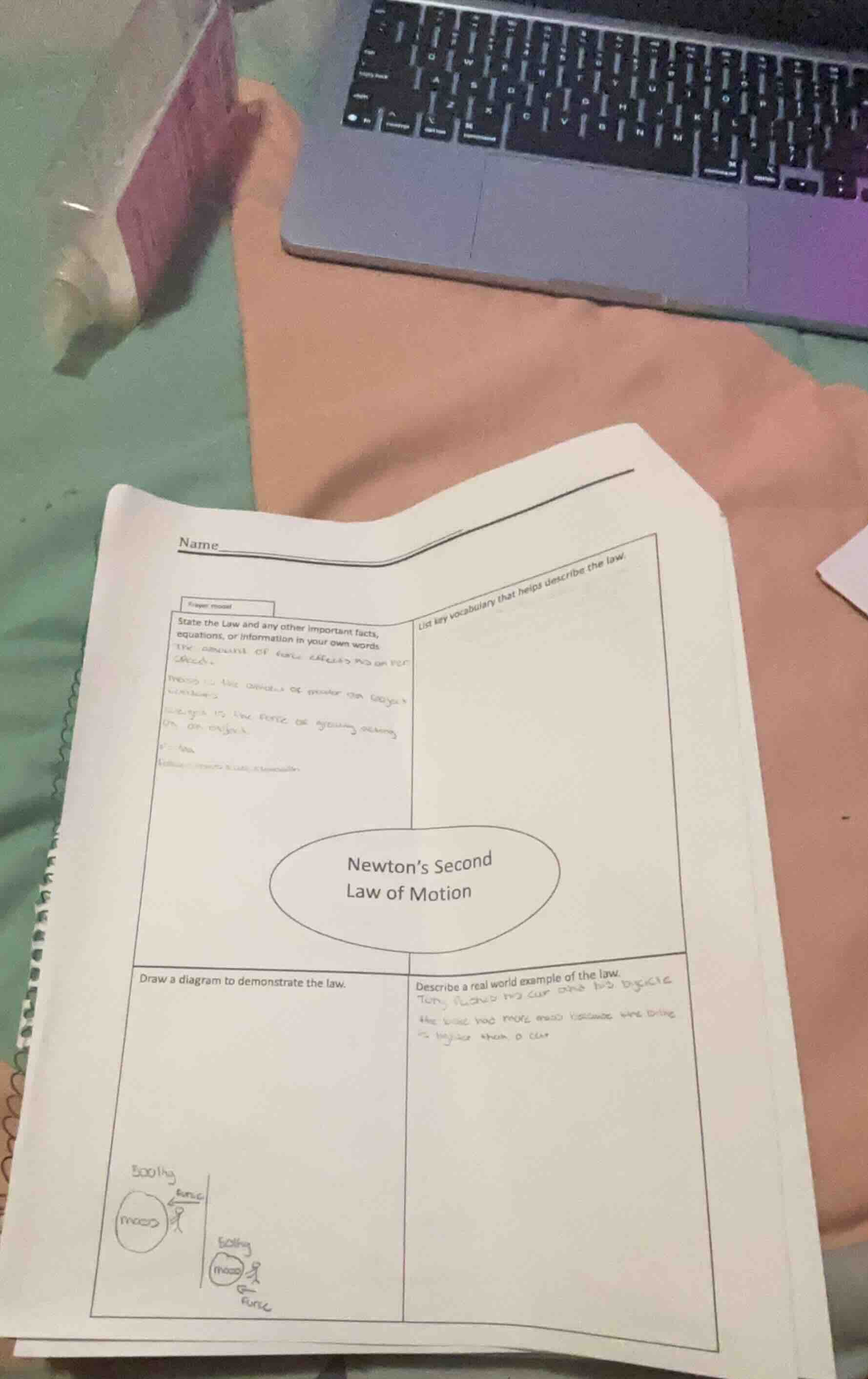
newton’s second law of motion
state the law and any other important facts, equations, or information in your own words.
list key vocabulary that helps describe the law.
draw a diagram to demonstrate the law.
describe a real world example of the law.
Brief Explanations
- State the Law: Newton's Second Law of Motion states that the acceleration of an object is directly proportional to the net force acting on it and inversely proportional to its mass. The core equation is $F_{net}=ma$, where $F_{net}$ is net force, $m$ is mass, and $a$ is acceleration.
- Key Vocabulary: Terms that describe the law include net force, mass, acceleration, proportionality, and inertia.
- Diagram: The existing diagram can be refined to clearly label: a large mass (e.g., 500 kg object) with a given force, showing small acceleration; a small mass (e.g., 50 kg object) with the same force, showing large acceleration, with arrows for force and acceleration.
- Real World Example: A more clear example: Pushing an empty shopping cart vs. a full shopping cart. Applying the same amount of force, the empty cart (lower mass) accelerates much faster than the full cart (higher mass), which directly demonstrates that acceleration decreases as mass increases when force is constant.

Snap & solve any problem in the app
Get step-by-step solutions on Sovi AI
Photo-based solutions with guided steps
Explore more problems and detailed explanations
- State the Law: The acceleration of an object depends on the net force applied to it and its mass; acceleration increases with more force and decreases with more mass. The equation is $F_{net}=ma$.
- Key Vocabulary: Net force, mass, acceleration, proportionality, inertia
- Diagram (Refined): A 500 kg box with a rightward force arrow labeled $F$, and a small rightward acceleration arrow labeled $a_1$; a 50 kg box with the same rightward $F$ arrow, and a much larger rightward acceleration arrow labeled $a_2$ (where $a_2 > a_1$)
- Real World Example: Pushing an empty shopping cart and a full shopping cart with the same force. The empty cart speeds up (accelerates) much more quickly than the full, heavy cart, since acceleration is inversely proportional to mass when force is constant.