QUESTION IMAGE
Question
name:
pd: 2 date: 01/21/26
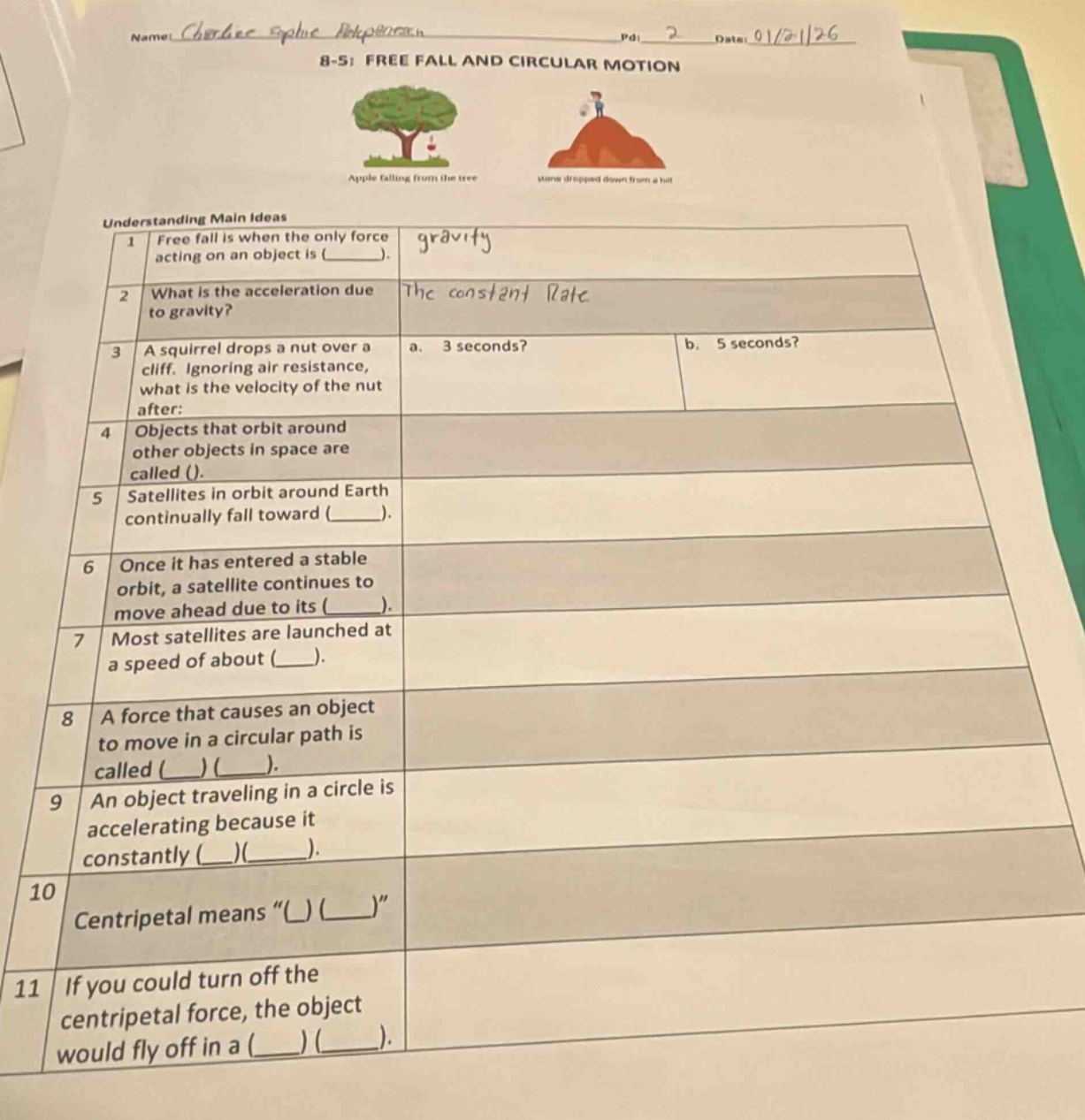
8-5: free fall and circular motion
apple falling from the tree
stone dropped down from a hill
understanding main ideas
1 free fall is when the only force acting on an object is (______).
gravity
2 what is the acceleration due to gravity?
the constant rate
3 a squirrel drops a nut over a cliff. ignoring air resistance, what is the velocity of the nut after:
a. 3 seconds?
b. 5 seconds?
4 objects that orbit around other objects in space are called ().
5 satellites in orbit around earth continually fall toward (______).
6 once it has entered a stable orbit, a satellite continues to move ahead due to its (______).
7 most satellites are launched at a speed of about (____).
8 a force that causes an object to move in a circular path is called (_) (_).
9 an object traveling in a circle is accelerating because it constantly (_)(____).
10
centripetal means “(_) (_)”
11 if you could turn off the centripetal force, the object would fly off in a (_) (___).
- Defines the key force in free fall.
- States the standard gravitational acceleration value near Earth's surface.
- Uses the free fall velocity formula $v = gt$ where $g=9.8\ \text{m/s}^2$.
- Identifies the term for orbiting space objects.
- Notes the direction of gravitational pull for Earth satellites.
- Identifies the property keeping satellites moving forward.
- States the typical orbital launch speed for Earth satellites.
- Names the force for circular motion.
- Explains why circular motion involves acceleration.
- Gives the literal meaning of "centripetal".
- Describes the path of an object when centripetal force is removed.

Snap & solve any problem in the app
Get step-by-step solutions on Sovi AI
Photo-based solutions with guided steps
Explore more problems and detailed explanations
- gravity
- $9.8\ \text{m/s}^2$ (or 32 ft/s²)
- a. $29.4\ \text{m/s}$
b. $49\ \text{m/s}$
- satellites
- Earth
- inertia
- 8 km/s (or 18,000 mph)
- centripetal force
- changes direction
- center seeking
- straight line