QUESTION IMAGE
Question
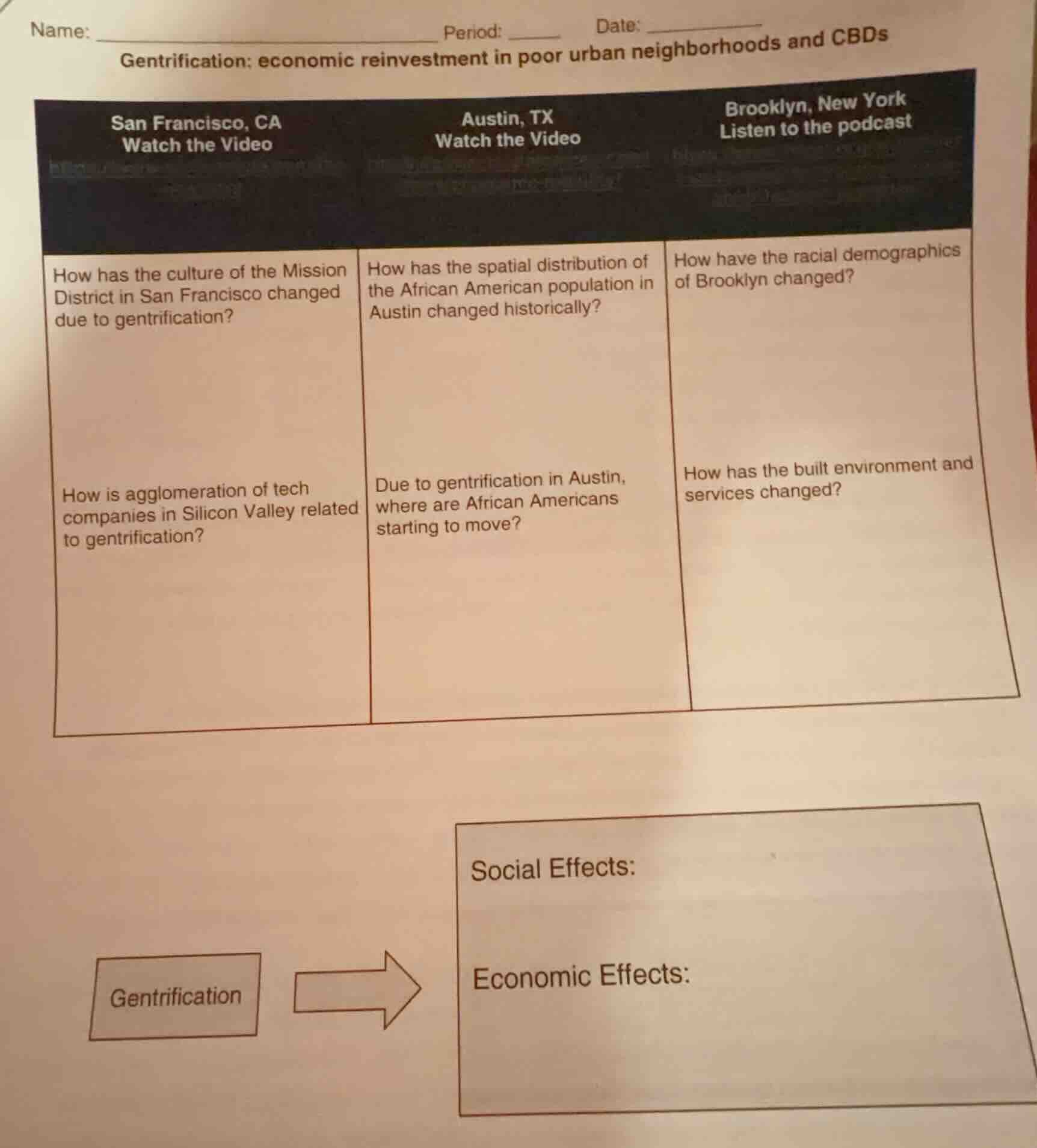
name: _________________________ period: __ date: ____________gentrification: economic reinvestment in poor urban neighborhoods and cbdssan francisco, cawatch the videoaustin, txwatch the videobrooklyn, new yorklisten to the podcasthow has the culture of the mission district in san francisco changed due to gentrification?how is agglomeration of tech companies in silicon valley related to gentrification?how has the spatial distribution of the african american population in austin changed historically?due to gentrification in austin, where are african americans starting to move?how have the racial demographics of brooklyn changed?how has the built environment and services changed?gentrification →social effects:economic effects:
San Francisco, CA
- For Mission District culture: Gentrification displaced working-class Latino residents, leading to closure of traditional Latino-owned businesses (taquerías, murals, cultural centers) and replacement with upscale cafes, boutiques, and art spaces that cater to wealthier newcomers, eroding the neighborhood's historic Chicano/Latino cultural identity while bringing in new, more affluent cultural amenities.
- For tech agglomeration: Silicon Valley's tech boom drew high-income workers to the Bay Area. The agglomeration of tech companies increased demand for housing in nearby San Francisco, driving up property values and rents. This pushed lower-income residents out of neighborhoods like the Mission District, directly fueling gentrification.
Austin, TX
- For African American spatial distribution: Historically, Austin's African American population was concentrated in East Austin, due to redlining and discriminatory housing policies. Post-WWII, urban renewal and highway construction fragmented these neighborhoods. In recent decades, gentrification of East Austin has accelerated this displacement.
- For current African American migration: Due to rising costs in East Austin, many African American residents are moving to suburban areas on Austin's eastern and southeastern fringes (e.g., Pflugerville, Round Rock, Manor) where housing is more affordable.
Brooklyn, NY
- For racial demographics: Brooklyn has seen a sharp decline in its Black population (from ~37% in 2000 to ~29% in 2020) and a rapid increase in its white and Asian populations. Gentrification in neighborhoods like Williamsburg, Bushwick, and Bedford-Stuyvesant has driven up housing costs, displacing long-term Black and Latino residents, while wealthier white and professional newcomers move in.
- For built environment/services: Gentrified areas have seen new luxury apartment buildings, upscale grocery stores, craft breweries, and co-working spaces replace older, low-rise housing, bodegas, and local businesses. Public transit access has been improved in trendy areas, while neglected infrastructure in non-gentrified parts of Brooklyn remains underfunded.
General Gentrification Effects
- Social Effects: Displacement of low-income, minority residents; erosion of long-standing community ties and cultural identities; increased racial and economic segregation; tension between long-term residents and new, wealthier newcomers; loss of affordable housing options.
- Economic Effects: Rising property values and tax revenues for local governments; increased property taxes and rents that burden low-income residents; influx of new businesses that cater to affluent consumers, leading to the closure of local, family-owned establishments; creation of high-skill, low-wage service jobs (e.g., baristas, retail workers) that do not pay enough to afford local housing.

Snap & solve any problem in the app
Get step-by-step solutions on Sovi AI
Photo-based solutions with guided steps
Explore more problems and detailed explanations
San Francisco, CA
- The Mission District's historic Chicano/Latino culture has eroded as traditional local businesses closed, replaced by upscale amenities for wealthy newcomers, while many long-term Latino residents were displaced.
- Silicon Valley's tech agglomeration drew high-income workers, increasing housing demand in SF, which drove up rents/property values and displaced low-income residents, fueling gentrification.
Austin, TX
- Historically, Austin's African American population was concentrated in East Austin due to redlining; urban renewal and later gentrification fragmented and displaced this population.
- African American residents are moving to more affordable eastern/southeastern Austin suburbs like Pflugerville, Round Rock, and Manor.
Brooklyn, NY
- Brooklyn's Black population has declined significantly (from ~37% in 2000 to ~29% in 2020), while white and Asian populations have grown, as gentrification displaced long-term low-income minority residents.
- Gentrified areas now have luxury housing, upscale businesses, and improved transit, while older local businesses and low-rise housing have been lost; non-gentrified areas still face underfunded infrastructure.
General Effects
- Social Effects: Displacement of low-income/minority residents; eroded community/cultural identity; increased racial/economic segregation; resident tension; loss of affordable housing.
- Economic Effects: Rising property values/tax revenues; higher rents/taxes burdening low-income residents; closure of local businesses; creation of low-wage service jobs unaffordable for local housing.