QUESTION IMAGE
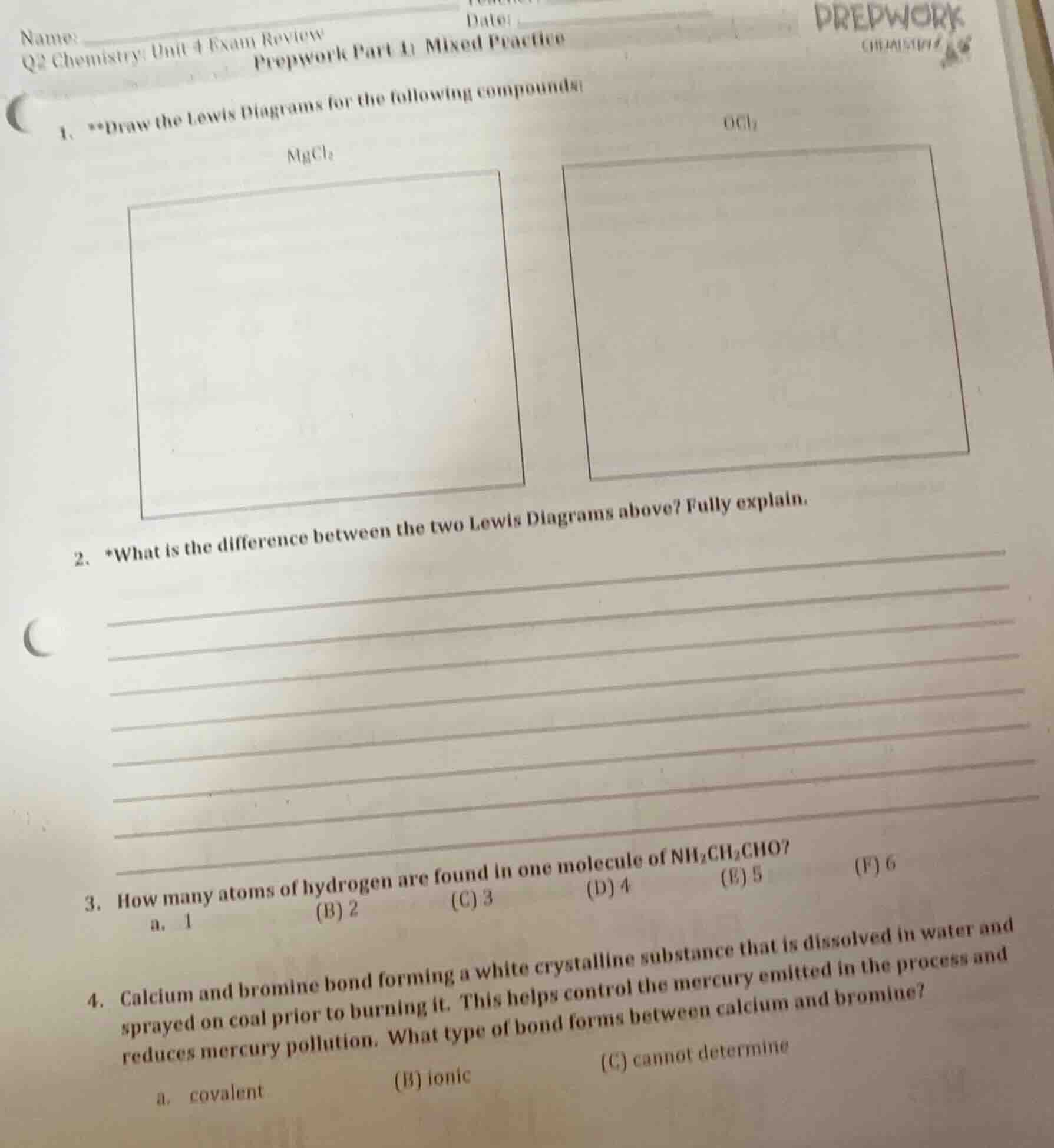
Question
name:
q2 chemistry: unit 4 exam review
date:
prepwork part 1: mixed practice
- **draw the lewis diagrams for the following compounds:
mgcl₂
ocl₂
- *what is the difference between the two lewis diagrams above? fully explain.
- how many atoms of hydrogen are found in one molecule of nh₂ch₂cho?
a. 1
(b) 2
(c) 3
(d) 4
(e) 5
(f) 6
- calcium and bromine bond forming a white crystalline substance that is dissolved in water and sprayed on coal prior to burning it. this helps control the mercury emitted in the process and reduces mercury pollution. what type of bond forms between calcium and bromine?
a. covalent
(b) ionic
(c) cannot determine
Question 3
Step 1: Analyze the formula \(NH_2CH_2CHO\)
We break down the formula to identify the number of hydrogen atoms. Let's look at each part:
- \(NH_2\): This group has 2 hydrogen atoms.
- \(CH_2\): This group has 2 hydrogen atoms.
- The remaining part (there's no other hydrogen - containing group, but wait, let's re - examine. Wait, the formula is \(NH_2 - CH_2 - CHO\). Wait, \(CHO\) is a formyl group (\(C = O\) and \(H\) attached to \(C\))? Wait, no, the formula is \(NH_2CH_2CHO\). Let's count the subscripts:
For \(NH_2\): \(H\) subscript is 2.
For \(CH_2\): \(H\) subscript is 2.
For the last \(H\) in \(CHO\)? Wait, no, the formula is \(NH_2CH_2CHO\). Let's write it as \(N\), \(H_2\), \(C\), \(H_2\), \(C\), \(H\), \(O\)? Wait, no, the correct way is to expand the formula:
\(NH_2CH_2CHO\) can be written as \(N - H_2 - C - H_2 - C - H - O\). Wait, no, let's do it properly. The formula is \(NH_2CH_2CHO\), which is equivalent to \(C_2H_5NO\) (wait, no, let's count the number of each atom:
- \(N\): 1
- \(H\): Let's see, \(NH_2\) has 2, \(CH_2\) has 2, and \(CHO\) has 1 (the \(H\) in \(CHO\)). Wait, \(CHO\) is \(C = O\) with a \(H\) attached to \(C\), so the \(H\) in \(CHO\) is 1. So total \(H\): \(2 + 2+ 1=5\)? Wait, no, wait the formula is \(NH_2CH_2CHO\). Let's write the structure:
\(NH_2 - CH_2 - CH = O\) (aldehyde group). So the hydrogens are:
- From \(NH_2\): 2
- From \(CH_2\): 2
- From the aldehyde group (\(CHO\)): 1? Wait, no, the aldehyde group is \( - CHO\), which has one \(H\) attached to the \(C\) of the aldehyde. Wait, but also, the \(CH_2\) is between \(NH_2\) and \(CHO\). Wait, maybe I made a mistake. Let's count the subscripts:
In the formula \(NH_2CH_2CHO\), the number of \(H\) atoms is calculated by adding the subscripts of \(H\) in each group:
- \(NH_2\): \(H\) count = 2
- \(CH_2\): \(H\) count = 2
- The \(H\) in \(CHO\): Wait, \(CHO\) is \(C\) bonded to \(H\) and \(O\) (double - bonded), so that's 1 \(H\). Wait, but wait, is the formula \(NH_2CH_2CHO\) or \(NH_2CH_2COH\)? No, it's \(CHO\). Wait, maybe the correct count is:
\(NH_2\): 2 H
\(CH_2\): 2 H
\(CHO\): 1 H
Total \(H\): \(2 + 2+ 1 = 5\)? Wait, but let's check the formula again. Wait, the formula is \(NH_2CH_2CHO\), which is \(C_2H_5NO\) (since \(C\): 2, \(H\): 5, \(N\): 1, \(O\): 1). Yes, because \(NH_2\) (2 H), \(CH_2\) (2 H), and \(CHO\) (1 H) gives \(2 + 2+ 1=5\) H atoms.
Calcium (Ca) is a metal and bromine (Br) is a non - metal. Ionic bonds form between metals and non - metals when electrons are transferred from the metal to the non - metal. Calcium will lose electrons to form a cation (\(Ca^{2+}\)) and bromine will gain electrons to form an anion (\(Br^-\)). Covalent bonds form between non - metals through electron sharing, which is not the case here. So the bond between calcium and bromine is ionic.

Snap & solve any problem in the app
Get step-by-step solutions on Sovi AI
Photo-based solutions with guided steps
Explore more problems and detailed explanations
E. 5