QUESTION IMAGE
Question
name
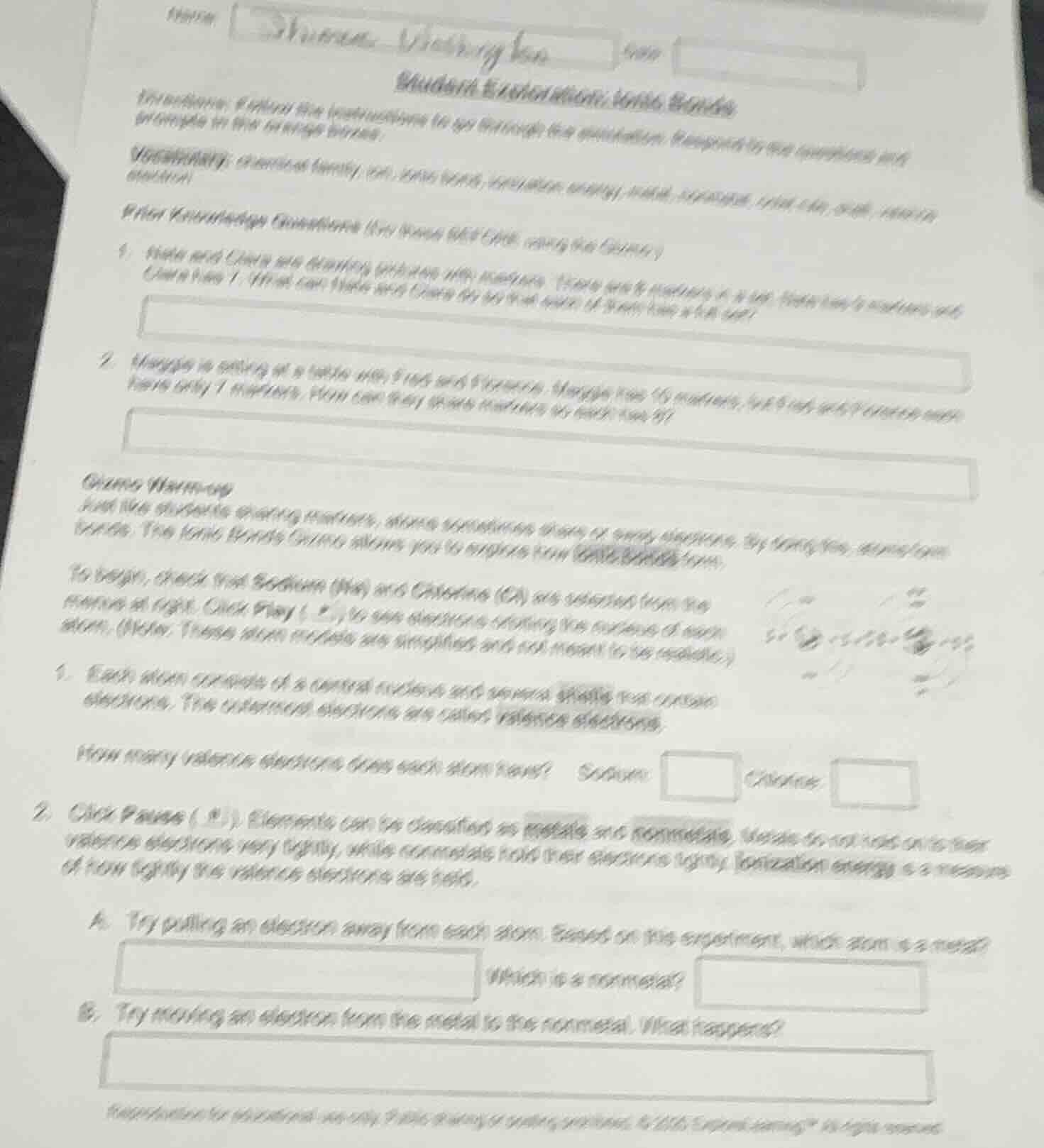
student exploration: ionic bonds
introduction: follow the instructions to go through the simulation. respond to the questions and prompts in the orange boxes.
vocabulary: chemical family, ion, ionic bond, ionization energy, metal, nonmetal, octet rule, shell, valence electron
prior knowledge questions (do these before using the gizmo.)
- claire and dave are sharing popcorn with allison. there are 8 pieces in a bag. dave has 3, allison has 3, and claire has 1. what can claire do so that each of them has a full bag?
- maggie is eating at a table with 3 food and 3 friends. maggie has 10 napkins, but 3 food and 3 friends mean there only 7 napkins. how can they share napkins to make it fair?
gizmo warm-up
just like students sharing markers, atoms sometimes share or swap electrons. by doing this, atoms form bonds. the ionic bonds gizmo allows you to explore how ionic bonds form.
to begin, check that sodium (na) and chlorine (cl) are selected from the menu at right. click play ( ) to see electrons orbiting the nucleus of each atom. (note: these atom models are simplified and not meant to be realistic.)
- each atom consists of a central nucleus and several shells that contain electrons. the outermost electrons are called valence electrons.
how many valence electrons does each atom have? sodium: chlorine:
- click pause ( ). elements can be classified as metals and nonmetals. metals do not hold on to their valence electrons very tightly, while nonmetals hold their electrons tightly. ionization energy is a measure of how tightly the valence electrons are held.
a. try pulling an electron away from each atom. based on this experiment, which atom is a metal? which is a nonmetal?
b. try moving an electron from the metal to the nonmetal. what happens?
reproduction for educational use only. public sharing or posting prohibited. © 2015 explorelearning™ all rights reserved.
Question 1 (Valence Electrons of Sodium and Chlorine)
Step 1: Recall electron configuration rules
Sodium (Na) has an atomic number of 11. Its electron configuration is \(1s^2 2s^2 2p^6 3s^1\). The outermost shell (3rd shell) has 1 electron.
Chlorine (Cl) has an atomic number of 17. Its electron configuration is \(1s^2 2s^2 2p^6 3s^2 3p^5\). The outermost shell (3rd shell) has \(2 + 5=7\) electrons.
Step 1: Recall metal/nonmetal electron behavior
Metals (like Na) have low ionization energy (lose electrons easily), nonmetals (like Cl) have high ionization energy (gain electrons easily). When pulling an electron:
- Sodium (Na) loses its valence electron easily (low ionization energy) → metal.
- Chlorine (Cl) holds its electrons tightly (high ionization energy) → nonmetal.
Step 1: Analyze electron transfer
Sodium (metal) loses its 1 valence electron (becomes \(Na^+\), a cation). Chlorine (nonmetal) gains this electron (completes its outer shell to 8, becomes \(Cl^-\), an anion). These oppositely charged ions are attracted, forming an ionic bond (sodium chloride, \(NaCl\)).

Snap & solve any problem in the app
Get step-by-step solutions on Sovi AI
Photo-based solutions with guided steps
Explore more problems and detailed explanations
Sodium: 1
Chlorine: 7