QUESTION IMAGE
Question
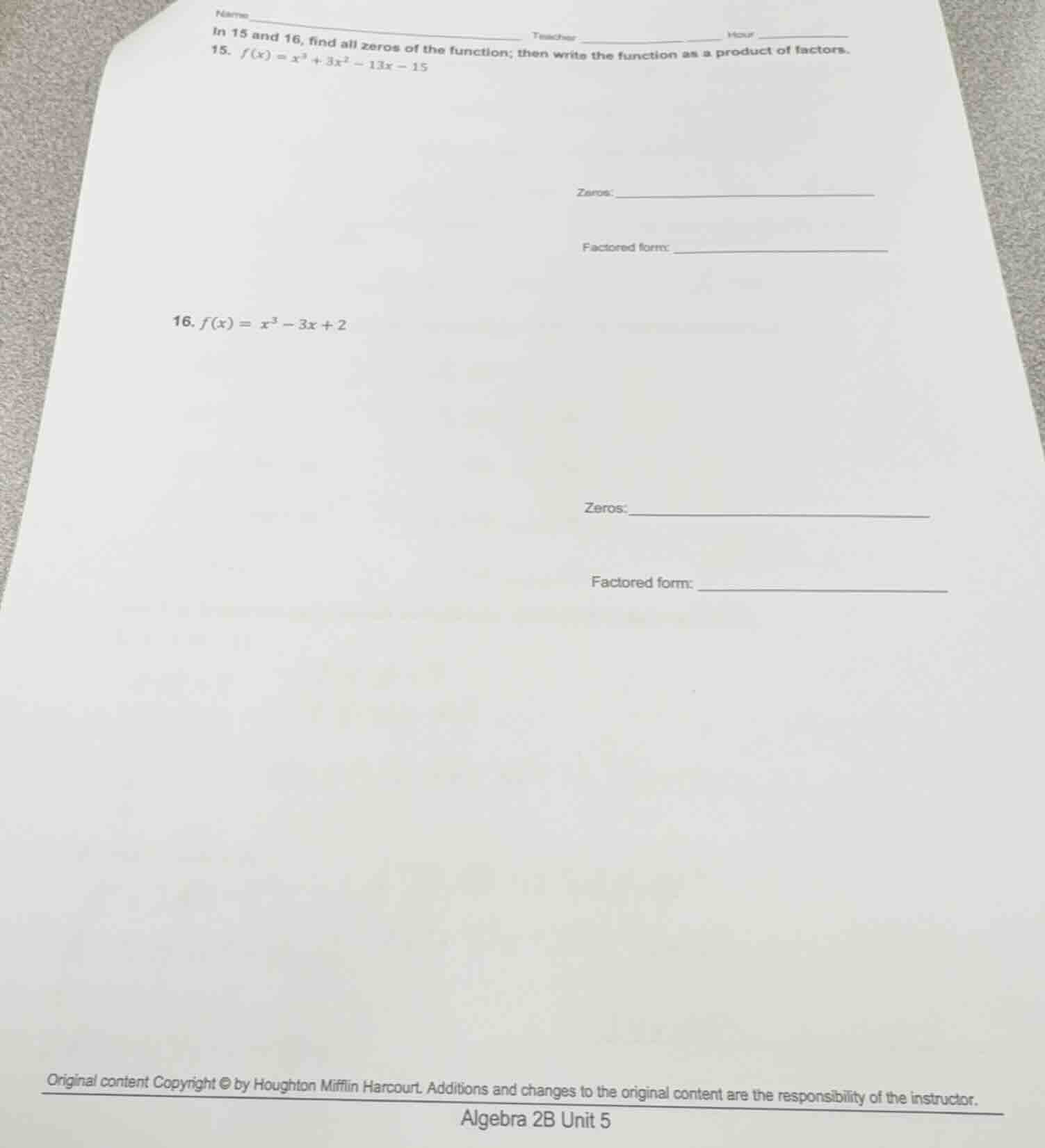
name teacher hour
in 15 and 16, find all zeros of the function; then write the function as a product of factors.
- $f(x)=x^3 + 3x^2 - 13x - 15$
zeros:
factored form:
- $f(x)=x^3 - 3x + 2$
zeros:
factored form:
original content copyright © by houghton mifflin harcourt. additions and changes to the original content are the responsibility of the instructor.
algebra 2b unit 5
Problem 15: \( f(x) = x^3 + 3x^2 - 13x - 15 \)
Step 1: Try Rational Roots
Use Rational Root Theorem. Possible roots: \( \pm1, \pm3, \pm5, \pm15 \). Test \( x = -1 \): \( (-1)^3 + 3(-1)^2 - 13(-1) - 15 = -1 + 3 + 13 - 15 = 0 \). So \( x = -1 \) is a root.
Step 2: Factor Out \( (x + 1) \)
Divide \( x^3 + 3x^2 - 13x - 15 \) by \( (x + 1) \) using polynomial division or synthetic division. Result: \( x^2 + 2x - 15 \).
Step 3: Factor Quadratic
Factor \( x^2 + 2x - 15 = (x + 5)(x - 3) \).
Step 4: Find Zeros
Set each factor to zero: \( x + 1 = 0 \Rightarrow x = -1 \); \( x + 5 = 0 \Rightarrow x = -5 \); \( x - 3 = 0 \Rightarrow x = 3 \).
Step 5: Write Factored Form
\( f(x) = (x + 1)(x + 5)(x - 3) \).
Zeros: \( -5, -1, 3 \)
Factored form: \( (x + 5)(x + 1)(x - 3) \)
Problem 16: \( f(x) = x^3 - 3x + 2 \)
Step 1: Try Rational Roots
Possible roots: \( \pm1, \pm2 \). Test \( x = 1 \): \( 1^3 - 3(1) + 2 = 1 - 3 + 2 = 0 \). So \( x = 1 \) is a root (double root? Test \( x = 1 \) again: derivative \( f'(x) = 3x^2 - 3 \), \( f'(1) = 0 \), so double root).
Step 2: Factor Out \( (x - 1)^2 \)
Divide \( x^3 - 3x + 2 \) by \( (x - 1)^2 = x^2 - 2x + 1 \). Result: \( x + 2 \).
Step 3: Find Zeros
Set factors to zero: \( (x - 1)^2 = 0 \Rightarrow x = 1 \) (double root); \( x + 2 = 0 \Rightarrow x = -2 \).
Step 4: Write Factored Form
\( f(x) = (x - 1)^2(x + 2) \).
Zeros: \( -2, 1 \) (with multiplicity 2)
Factored form: \( (x + 2)(x - 1)^2 \)

Snap & solve any problem in the app
Get step-by-step solutions on Sovi AI
Photo-based solutions with guided steps
Explore more problems and detailed explanations
Step 1: Try Rational Roots
Possible roots: \( \pm1, \pm2 \). Test \( x = 1 \): \( 1^3 - 3(1) + 2 = 1 - 3 + 2 = 0 \). So \( x = 1 \) is a root (double root? Test \( x = 1 \) again: derivative \( f'(x) = 3x^2 - 3 \), \( f'(1) = 0 \), so double root).
Step 2: Factor Out \( (x - 1)^2 \)
Divide \( x^3 - 3x + 2 \) by \( (x - 1)^2 = x^2 - 2x + 1 \). Result: \( x + 2 \).
Step 3: Find Zeros
Set factors to zero: \( (x - 1)^2 = 0 \Rightarrow x = 1 \) (double root); \( x + 2 = 0 \Rightarrow x = -2 \).
Step 4: Write Factored Form
\( f(x) = (x - 1)^2(x + 2) \).