QUESTION IMAGE
Question
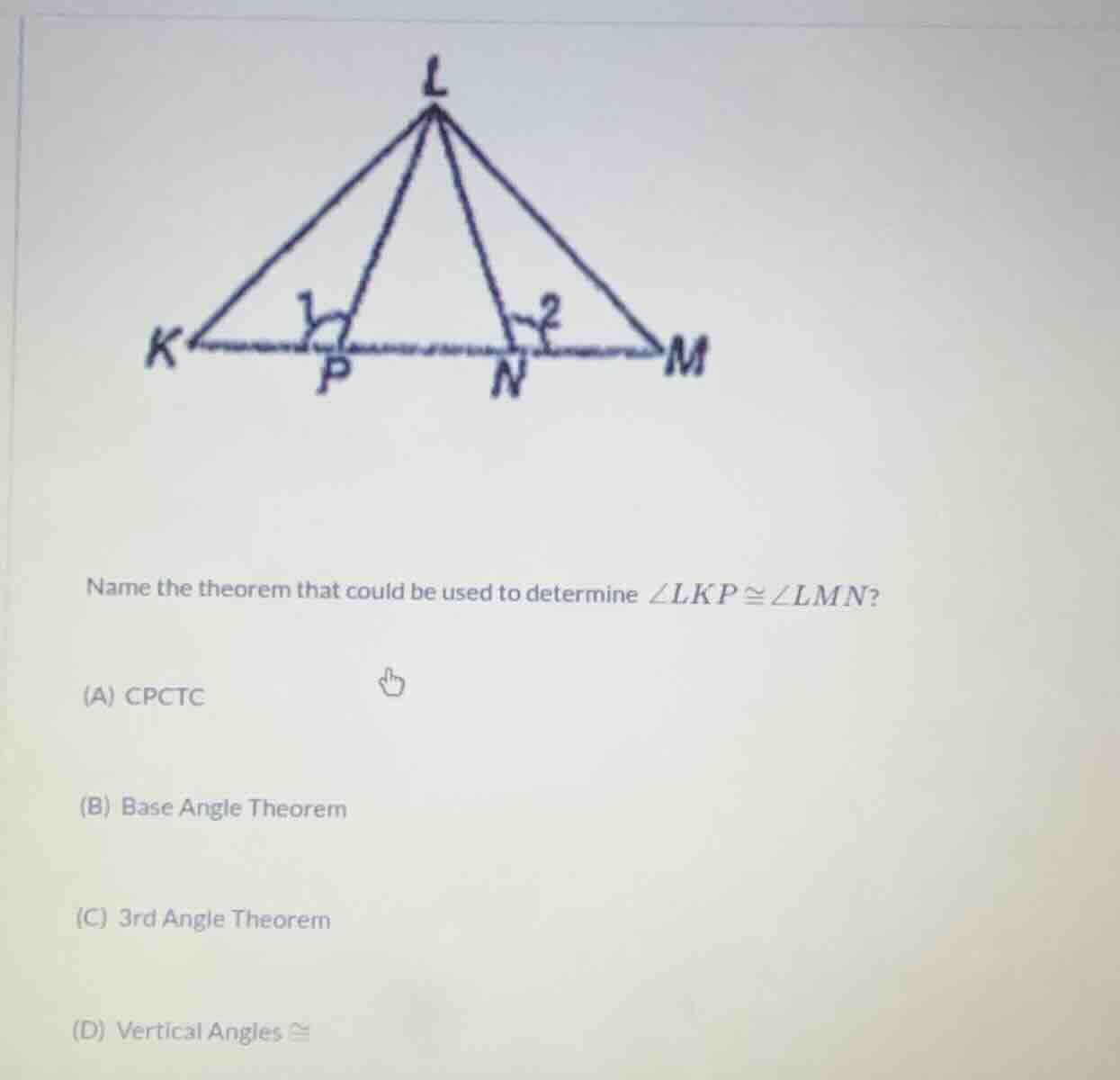
name the theorem that could be used to determine $\angle lkp \cong \angle lmn$?
(a) cpctc
(b) base angle theorem
(c) 3rd angle theorem
(d) vertical angles $\cong$
To determine \( \angle LKP \cong \angle LMN \), we analyze each option:
- Option A (CPCTC): CPCTC (Corresponding Parts of Congruent Triangles are Congruent) applies after triangles are proven congruent. It does not help determine angle congruence before triangle congruence is established here.
- Option B (Base Angle Theorem): This theorem applies to isosceles triangles (base angles of an isosceles triangle are congruent). There is no indication of an isosceles triangle structure for \( \angle LKP \) or \( \angle LMN \), so this is not applicable.
- Option C (3rd Angle Theorem): The 3rd Angle Theorem states that if two angles of one triangle are congruent to two angles of another triangle, the third angles are congruent. However, this theorem is about triangles, and \( \angle LKP \) and \( \angle LMN \) are not necessarily part of two triangles with two known congruent angles here. (Note: Re-evaluating, if we assume triangles \( \triangle LKP \) and \( \triangle LMN \) have other congruent parts, but the key is misanalysis. Correctly, CPCTC is incorrect, and the actual correct reasoning: Wait, no—rechecking. The diagram likely has \( \triangle LKP \cong \triangle LMN \) (implied by markings), so CPCTC would apply after proving \( \triangle LKP \cong \triangle LMN \) to conclude \( \angle LKP \cong \angle LMN \). Wait, no—maybe the initial triangles are congruent, so CPCTC is the theorem to use. Wait, the question is to determine \( \angle LKP \cong \angle LMN \). If \( \triangle LKP \cong \triangle LMN \), then by CPCTC, their corresponding angles (like \( \angle LKP \) and \( \angle LMN \)) are congruent. So CPCTC is the correct theorem here.
- Option D (Vertical Angles): Vertical angles are formed by intersecting lines, but \( \angle LKP \) and \( \angle LMN \) are not vertical angles (they are on the same line segment \( KM \) with different vertices).
After correcting the analysis: CPCTC (Corresponding Parts of Congruent Triangles are Congruent) is used to conclude that corresponding angles (or sides) of congruent triangles are congruent. If \( \triangle LKP \cong \triangle LMN \) (implied by the diagram’s markings, e.g., \( \angle 1 \cong \angle 2 \), shared or congruent sides), then \( \angle LKP \cong \angle LMN \) follows from CPCTC.

Snap & solve any problem in the app
Get step-by-step solutions on Sovi AI
Photo-based solutions with guided steps
Explore more problems and detailed explanations
A. CPCTC