QUESTION IMAGE
Question
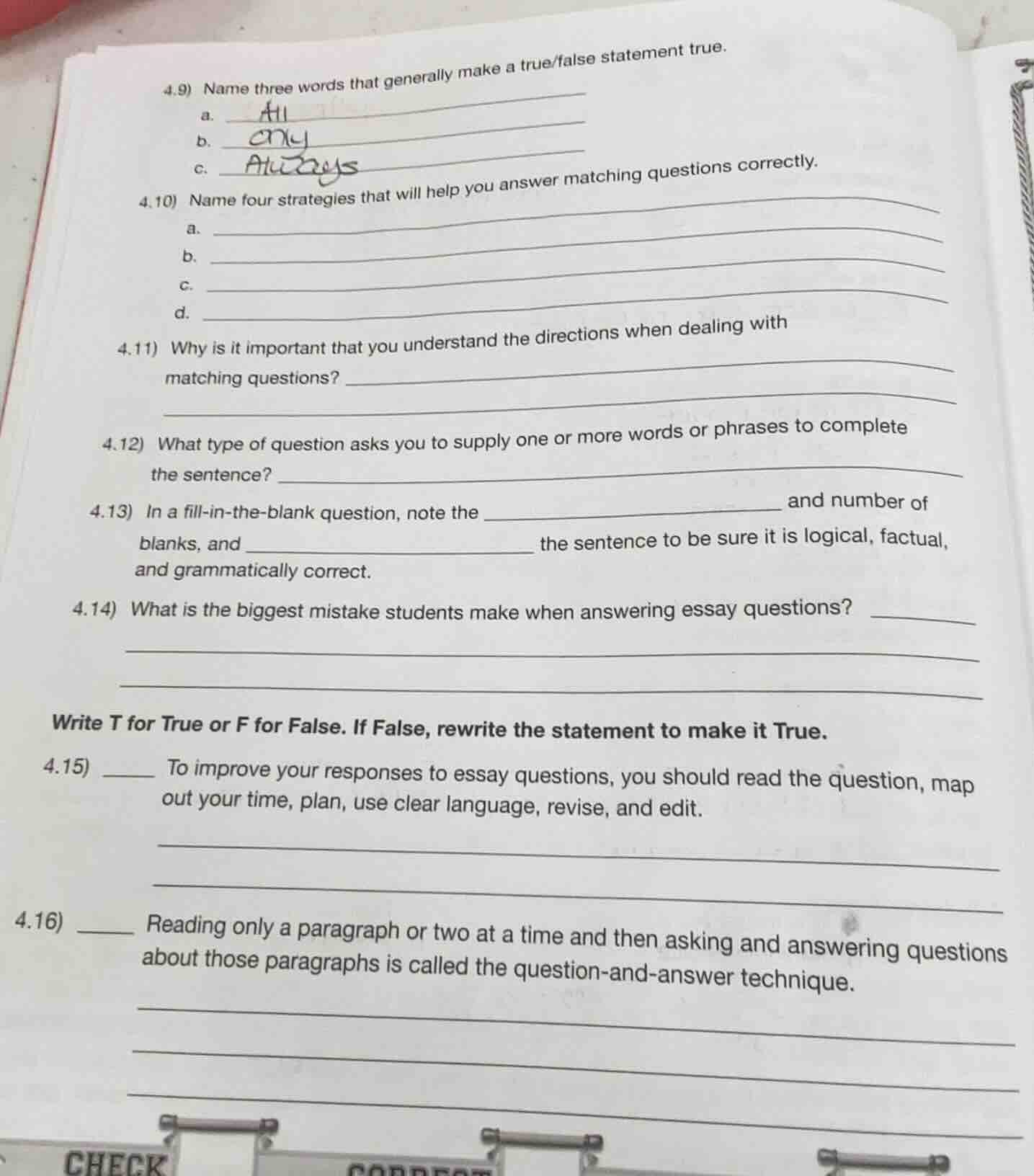
4.9) name three words that generally make a true/false statement true.
a.
b.
c.
4.10) name four strategies that will help you answer matching questions correctly.
a.
b.
c.
d.
4.11) why is it important that you understand the directions when dealing with
matching questions?
4.12) what type of question asks you to supply one or more words or phrases to complete
the sentence?
4.13) in a fill - in - the - blank question, note the and number of
blanks, and the sentence to be sure it is logical, factual,
and grammatically correct.
4.14) what is the biggest mistake students make when answering essay questions?
write t for true or f for false. if false, rewrite the statement to make it true.
4.15) to improve your responses to essay questions, you should read the question, map
out your time, plan, use clear language, revise, and edit.
4.16) reading only a paragraph or two at a time and then asking and answering questions
about those paragraphs is called the question - and - answer technique.
4.9
True/false statements with words like "All", "Always", "Every" are often false as they imply universality, but the question asks for words that make them true. Wait, actually, words that make a true/false statement true (i.e., when the statement is true, these words are part of it). Common ones are "All", "Always", "Every" (but actually, sometimes these can make it false, but the question is about words that generally make it true. Maybe "Some", "Often", "Sometimes" are for false, but the question is reverse. Wait, maybe the intended words are "All", "Always", "Every" but actually, no—wait, the question is "Name three words that generally make a true/false statement true." So when a true/false statement has these words and is true. So examples: "All", "Always", "Every" (but in reality, these are more likely to make a statement false, but maybe the textbook considers them as words that, when the statement is true, are used. Alternatively, maybe "Some", "Often", "Sometimes" are for false, but the question is about true. Wait, maybe the answer is "All", "Always", "Every" (even though they are more likely to make a statement false, maybe the textbook's perspective is different). Or maybe "True", "Correct", "Valid" but that's not right. Wait, the original handwritten answer has "All", "Any", "Always"—maybe that's what's expected.
Strategies for matching questions: 1. Read all options first. 2. Match the easiest ones first. 3. Cross out used options. 4. Check directions (e.g., if one-to-one or multiple matches).
Understanding directions for matching questions is important because directions tell you how to match (e.g., one - to - one, multiple matches, type of items to match), which prevents mistakes like mismatching or using wrong matching rules.

Snap & solve any problem in the app
Get step-by-step solutions on Sovi AI
Photo-based solutions with guided steps
Explore more problems and detailed explanations
a. All
b. Any
c. Always