QUESTION IMAGE
Question
- name two examples of oceanic - continental plates separated by a convergent boundary.
-north america and
-south america and
- why does the oceanic plate move under the continental plate? what is this zone called?
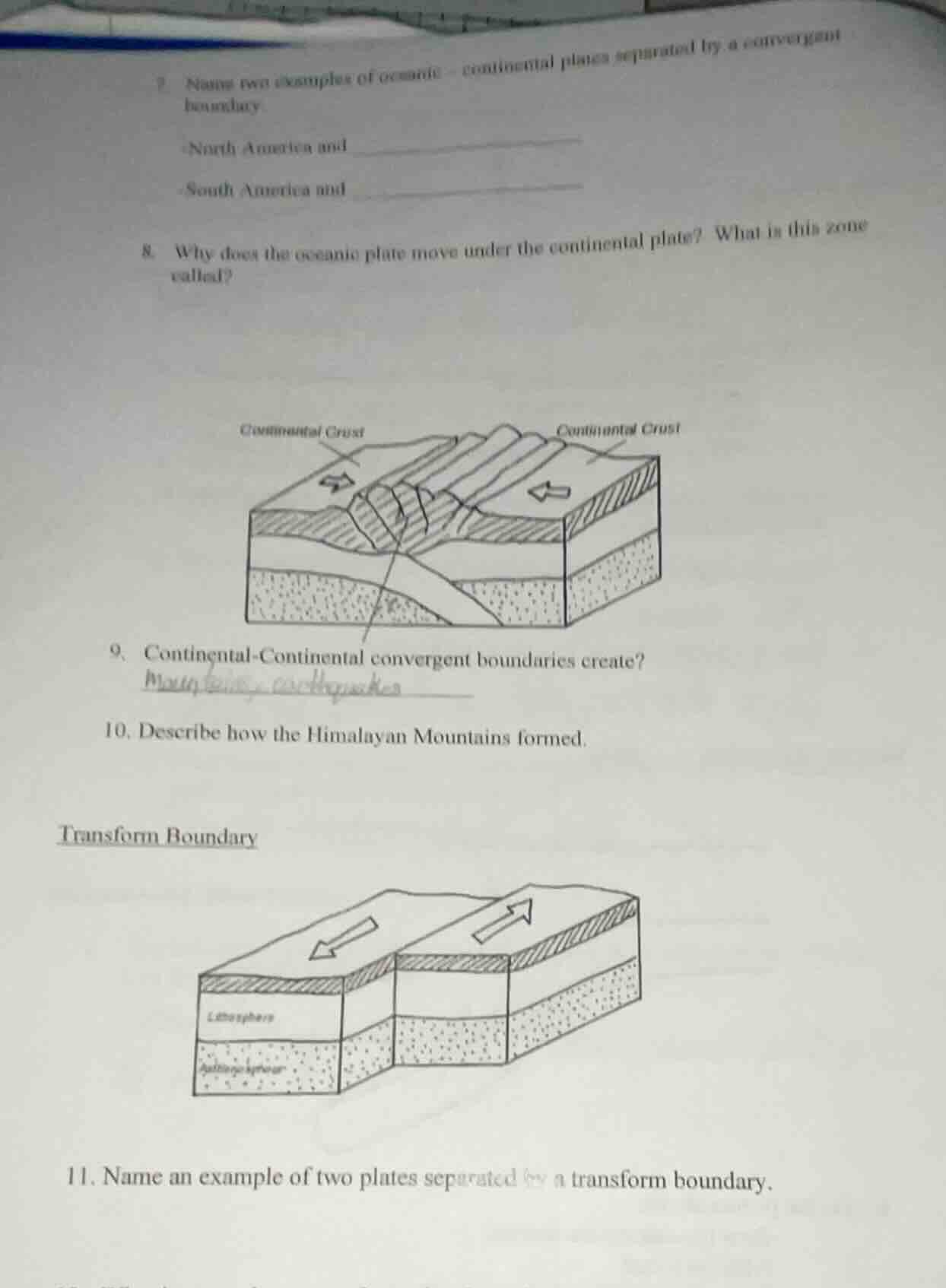
(image: a diagram showing continental crust and a convergent boundary between two continental crusts with arrows indicating movement)
- continental - continental convergent boundaries create?
- describe how the himalayan mountains formed.
transform boundary
(image: a diagram showing a transform boundary with lithosphere and asthenosphere layers and arrows indicating movement)
- name an example of two plates separated by a transform boundary.
Question 7
For oceanic - continental convergent boundaries:
- The North American plate and the Juan de Fuca plate (or the Cocos plate, or the Pacific plate in some regions) form an oceanic - continental convergent boundary. Another common example for North America is the North American plate and the Pacific plate (in the region of the Cascade Range).
- For South America, the South American plate and the Nazca plate form an oceanic - continental convergent boundary. The Nazca plate is an oceanic plate that subducts beneath the South American (continental) plate, leading to the formation of the Andes Mountains.
- Why the oceanic plate moves under the continental plate: Oceanic plates are denser (because they are composed of basaltic rock which is denser) than continental plates (composed of granitic rock which is less dense). When an oceanic plate and a continental plate converge, due to the difference in density, the denser oceanic plate is forced to subduct (move under) the less dense continental plate.
- Name of the zone: The zone where the oceanic plate subducts under the continental plate is called a subduction zone. In the subduction zone, the subducting oceanic plate can also lead to volcanic activity and earthquakes as the plate melts and the magma rises, or as the plates interact along the boundary.
At continental - continental convergent boundaries, where two continental plates converge (move towards each other), since both plates are relatively less dense and thick, instead of subduction (as in oceanic - continental or oceanic - oceanic boundaries), the plates collide and crumple. This collision leads to the uplift of the crust, forming large mountain ranges. For example, the collision of the Indian plate and the Eurasian plate formed the Himalayan mountain range. Earthquakes are also common in these regions due to the stress build - up and release during the collision.

Snap & solve any problem in the app
Get step-by-step solutions on Sovi AI
Photo-based solutions with guided steps
Explore more problems and detailed explanations
- North America and Juan de Fuca Plate (or Pacific Plate)
- South America and Nazca Plate