QUESTION IMAGE
Question
name:
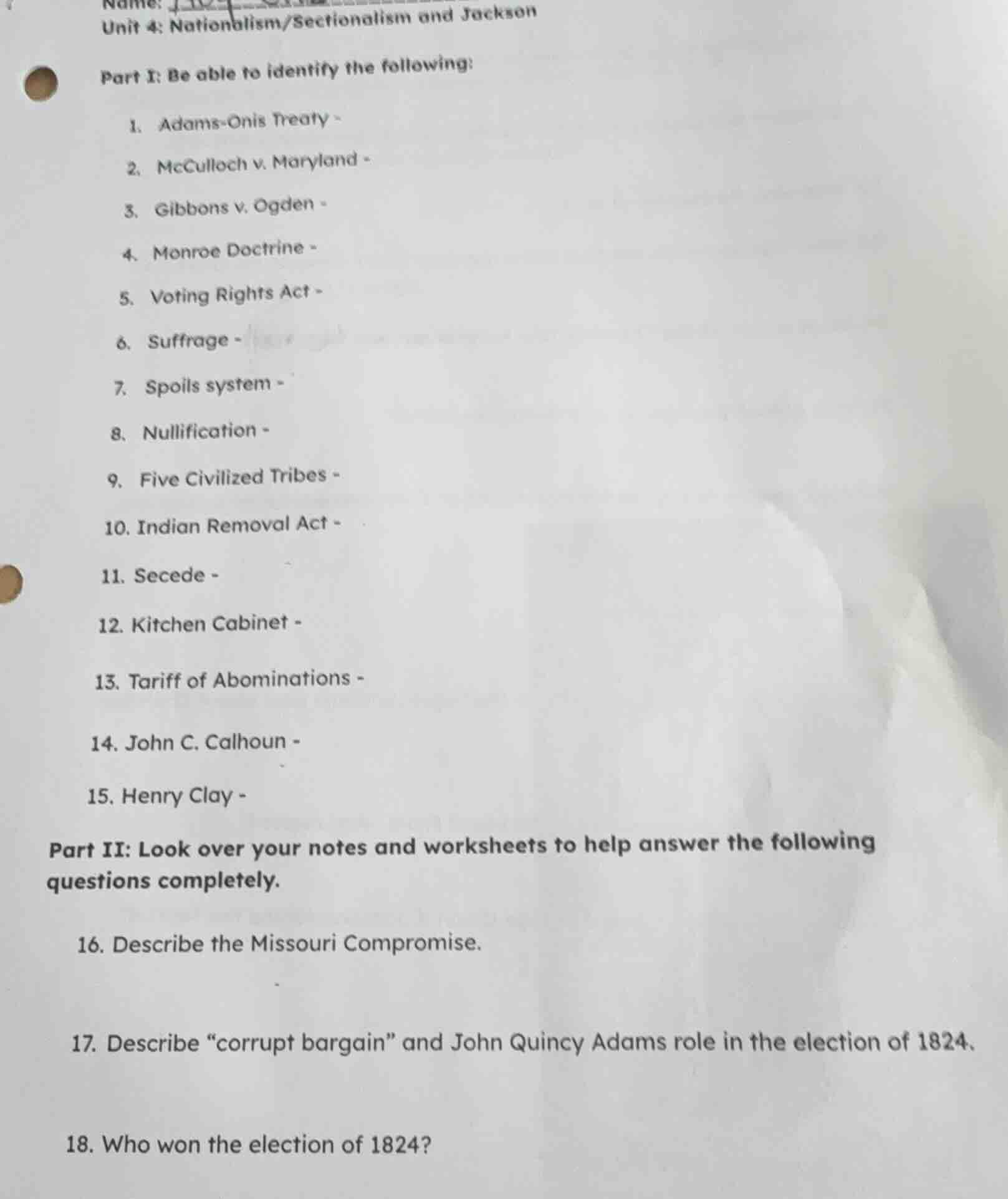
unit 4: nationalism/sectionalism and jackson
part i: be able to identify the following:
- adams - onis treaty
- mcculloch v. maryland
- gibbons v. ogden
- monroe doctrine
- voting rights act
- suffrage
- spoils system
- nullification
- five civilized tribes
- indian removal act
- secede
- kitchen cabinet
- tariff of abominations
- john c. calhoun
- henry clay
part ii: look over your notes and worksheets to help answer the following questions completely.
- describe the missouri compromise.
- describe “corrupt bargain” and john quincy adams role in the election of 1824.
- who won the election of 1824?
Brief Explanations
- Adams-Onis Treaty: 1819 agreement where Spain ceded Florida to the U.S. and defined the U.S.-Spanish border in North America.
- McCulloch v. Maryland: 1819 Supreme Court case that established federal law supremacy and Congress's implied powers via the Necessary and Proper Clause.
- Gibbons v. Ogden: 1824 Supreme Court case that gave Congress sole power to regulate interstate commerce.
- Monroe Doctrine: 1823 U.S. foreign policy opposing European interference in the Americas and U.S. non-involvement in European conflicts.
- Voting Rights Act: 1965 federal law eliminating racial barriers to voting, like literacy tests, in the U.S.
- Suffrage: The legal right to vote in political elections.
- Spoils system: Practice of winning politicians appointing loyal supporters to government jobs.
- Nullification: Idea that states can invalidate federal laws they deem unconstitutional.
- Five Civilized Tribes: Term for the Cherokee, Chickasaw, Choctaw, Creek, and Seminole nations, who adopted European-American cultural practices.
- Indian Removal Act: 1830 law authorizing the U.S. government to force Indigenous tribes east of the Mississippi to move to Oklahoma Territory.
- Secede: To formally withdraw from a union or political entity, most notably Southern U.S. states before the Civil War.
- Kitchen Cabinet: Informal group of advisors to President Andrew Jackson, separate from his official cabinet.
- Tariff of Abominations: 1828 high protective tariff that angered Southern states, who saw it as harmful to their economy.
- John C. Calhoun: U.S. politician, vice president, and advocate for states' rights, nullification, and Southern interests.
- Henry Clay: U.S. politician, known as the "Great Compromiser," who drafted key sectional compromises to avoid civil war.
- Missouri Compromise: 1820 agreement admitting Missouri as a slave state, Maine as a free state, and banning slavery north of the 36°30' parallel in the Louisiana Territory.
- Corrupt Bargain & 1824 Election: No candidate won an electoral college majority, so the House chose John Quincy Adams. Andrew Jackson claimed Adams made a "corrupt bargain" by appointing Henry Clay (who backed Adams) as Secretary of State in exchange for his support.
- 1824 Election Winner: John Quincy Adams was elected president by the U.S. House of Representatives after no candidate won an electoral college majority.

Snap & solve any problem in the app
Get step-by-step solutions on Sovi AI
Photo-based solutions with guided steps
Explore more problems and detailed explanations
- Adams-Onis Treaty: 1819 treaty; U.S. gains Florida, defines border with Spain.
- McCulloch v. Maryland: 1819 ruling; federal law > state law, Congress has implied powers.
- Gibbons v. Ogden: 1824 ruling; Congress regulates interstate commerce.
- Monroe Doctrine: 1823 policy; opposes European interference in Americas.
- Voting Rights Act: 1965 law; ends racial voting barriers.
- Suffrage: Legal right to vote in elections.
- Spoils system: Politicians appoint loyalists to government roles.
- Nullification: States can reject unconstitutional federal laws.
- Five Civilized Tribes: Cherokee, Chickasaw, Choctaw, Creek, Seminole nations.
- Indian Removal Act: 1830 law; forces Indigenous tribes west of Mississippi.
- Secede: Formal withdrawal from a political union.
- Kitchen Cabinet: Andrew Jackson's informal group of advisors.
- Tariff of Abominations: 1828 high tariff; hated by Southern states.
- John C. Calhoun: Politician; advocate for states' rights and slavery.
- Henry Clay: "Great Compromiser"; drafted sectional peace agreements.
- Missouri Compromise: 1820 deal; balances free/slave states, bans slavery north of 36°30'.
- "Corrupt bargain" & 1824 Election: No electoral college majority; House picks Adams, who appoints Clay (his supporter) as Secretary of State; Jackson calls this a corrupt deal.
- Election of 1824 winner: John Quincy Adams