QUESTION IMAGE
Question
name:
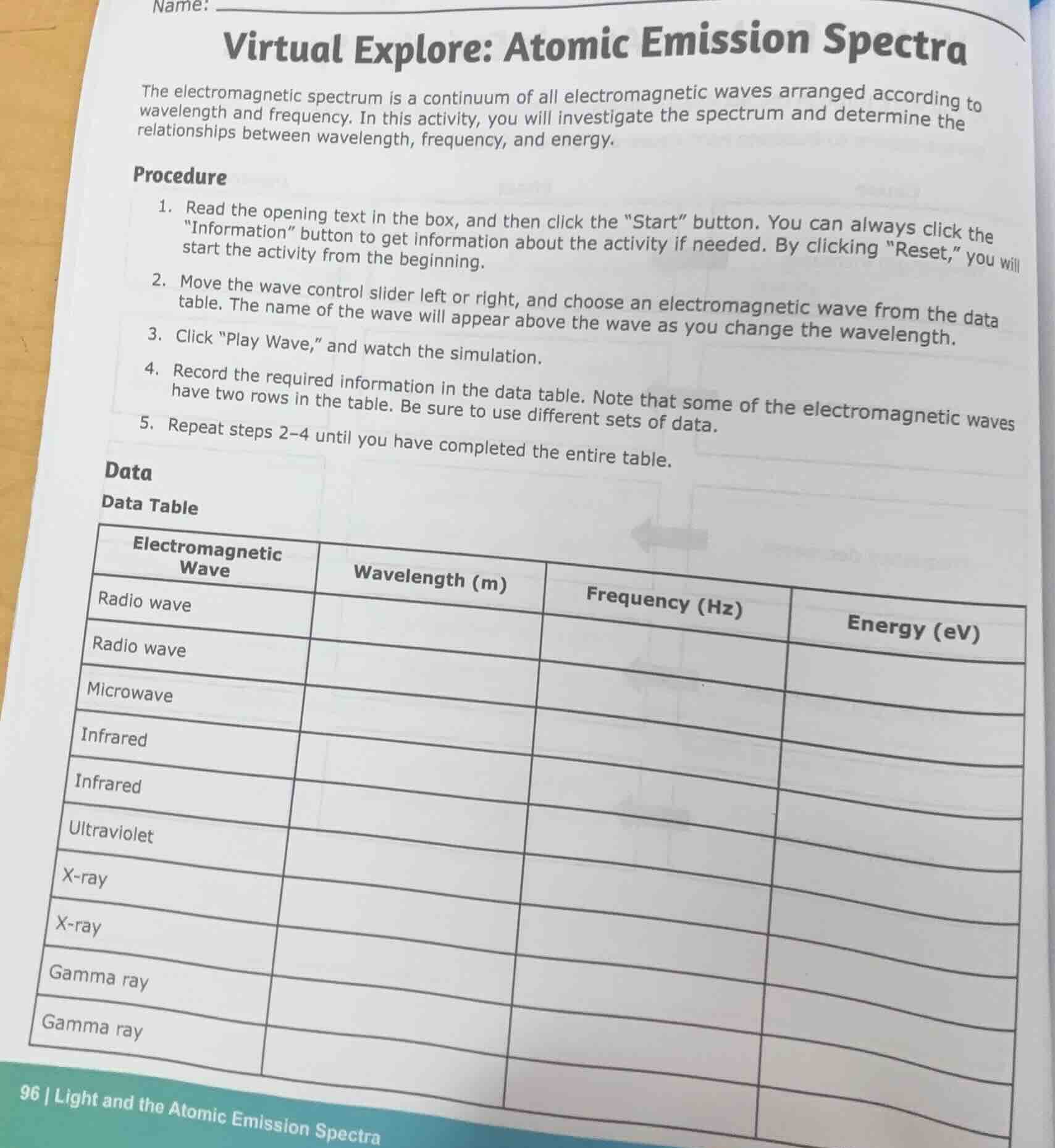
virtual explore: atomic emission spectra
the electromagnetic spectrum is a continuum of all electromagnetic waves arranged according to wavelength and frequency. in this activity, you will investigate the spectrum and determine the relationships between wavelength, frequency, and energy.
procedure
- read the opening text in the box, and then click the \start\ button. you can always click the \information\ button to get information about the activity if needed. by clicking
eset,\ you will start the activity from the beginning.
- move the wave control slider left or right, and choose an electromagnetic wave from the data table. the name of the wave will appear above the wave as you change the wavelength.
- click \play wave,\ and watch the simulation.
- record the required information in the data table. note that some of the electromagnetic waves have two rows in the table. be sure to use different sets of data.
- repeat steps 2 - 4 until you have completed the entire table.
data
data table
| electromagnetic wave | wavelength (m) | frequency (hz) | energy (ev) |
|---|---|---|---|
| radio wave | |||
| microwave | |||
| infrared | |||
| infrared | |||
| ultraviolet | |||
| x - ray | |||
| x - ray | |||
| gamma ray | |||
| gamma ray |
96 | light and the atomic emission spectra
To complete this activity, you would typically use the relationships between wavelength ($\lambda$), frequency ($f$), and energy ($E$) of electromagnetic waves. The key formulas are:
Step 1: Recall the wave - speed relationship
The speed of an electromagnetic wave in a vacuum is $c = 3\times10^{8}\space m/s$, and the relationship between wavelength, frequency, and speed is $c=\lambda f$. So, to find frequency from wavelength, we can rearrange this formula to $f=\frac{c}{\lambda}$.
Step 2: Recall the energy - frequency relationship
The energy of a photon (a quantum of electromagnetic radiation) is given by $E = hf$, where $h = 4.136\times10^{-15}\space eV\cdot s$ (Planck's constant). We can also combine this with the previous formula to get $E=\frac{hc}{\lambda}$, since $f = \frac{c}{\lambda}$.
Step 3: Collect data for each wave
For example, for a radio wave:
- Typical wavelength range for radio waves is from about $1\space mm$ to $100\space km$. Let's take a radio wave with $\lambda = 100\space m$.
- Using $f=\frac{c}{\lambda}$, substitute $c = 3\times10^{8}\space m/s$ and $\lambda=100\space m$. Then $f=\frac{3\times 10^{8}}{100}=3\times 10^{6}\space Hz$.
- Using $E = hf$, substitute $h = 4.136\times10^{-15}\space eV\cdot s$ and $f = 3\times10^{6}\space Hz$. Then $E=(4.136\times 10^{-15})\times(3\times 10^{6})\approx1.24\times 10^{-8}\space eV$.
Repeat this process for each type of electromagnetic wave (microwave, infrared, ultraviolet, X - ray, gamma ray) by choosing appropriate wavelengths (from the known ranges of each wave type) and calculating the corresponding frequency and energy.
Step 4: Fill in the data table
After calculating the values for wavelength, frequency, and energy for each electromagnetic wave (using the appropriate wavelength values for each wave type), fill in the data table. For waves with two rows (like radio wave, infrared, X - ray, gamma ray), use different wavelength values within the range of that wave type to see how wavelength, frequency, and energy change.
For example, a partially filled table (using approximate values) could look like this:
| Electromagnetic Wave | Wavelength (m) | Frequency (Hz) | Energy (eV) |
|---|---|---|---|
| Radio wave | $1000$ | $3\times10^{5}$ | $1.24\times10^{-9}$ |
| Microwave | $0.01$ | $3\times10^{10}$ | $1.24\times10^{-4}$ |
| Infrared | $1\times10^{-5}$ | $3\times10^{13}$ | $0.124$ |
| Infrared | $2\times10^{-5}$ | $1.5\times10^{13}$ | $0.062$ |
| Ultraviolet | $3\times10^{-7}$ | $1\times10^{15}$ | $4.14$ |
| X - ray | $1\times10^{-10}$ | $3\times10^{18}$ | $1.24\times10^{4}$ |
| X - ray | $2\times10^{-10}$ | $1.5\times10^{18}$ | $6.2\times10^{3}$ |
| Gamma ray | $1\times10^{-12}$ | $3\times10^{20}$ | $1.24\times10^{6}$ |
| Gamma ray | $2\times10^{-12}$ | $1.5\times10^{20}$ | $6.2\times10^{5}$ |
(Note: These are approximate values for illustration. The actual values may vary depending on the specific wavelengths chosen within the range of each electromagnetic wave type. When doing the activity, you should use the values obtained from the simulation or from accurate reference sources for the wavelengths of each wave type.)

Snap & solve any problem in the app
Get step-by-step solutions on Sovi AI
Photo-based solutions with guided steps
Explore more problems and detailed explanations
To complete this activity, you would typically use the relationships between wavelength ($\lambda$), frequency ($f$), and energy ($E$) of electromagnetic waves. The key formulas are:
Step 1: Recall the wave - speed relationship
The speed of an electromagnetic wave in a vacuum is $c = 3\times10^{8}\space m/s$, and the relationship between wavelength, frequency, and speed is $c=\lambda f$. So, to find frequency from wavelength, we can rearrange this formula to $f=\frac{c}{\lambda}$.
Step 2: Recall the energy - frequency relationship
The energy of a photon (a quantum of electromagnetic radiation) is given by $E = hf$, where $h = 4.136\times10^{-15}\space eV\cdot s$ (Planck's constant). We can also combine this with the previous formula to get $E=\frac{hc}{\lambda}$, since $f = \frac{c}{\lambda}$.
Step 3: Collect data for each wave
For example, for a radio wave:
- Typical wavelength range for radio waves is from about $1\space mm$ to $100\space km$. Let's take a radio wave with $\lambda = 100\space m$.
- Using $f=\frac{c}{\lambda}$, substitute $c = 3\times10^{8}\space m/s$ and $\lambda=100\space m$. Then $f=\frac{3\times 10^{8}}{100}=3\times 10^{6}\space Hz$.
- Using $E = hf$, substitute $h = 4.136\times10^{-15}\space eV\cdot s$ and $f = 3\times10^{6}\space Hz$. Then $E=(4.136\times 10^{-15})\times(3\times 10^{6})\approx1.24\times 10^{-8}\space eV$.
Repeat this process for each type of electromagnetic wave (microwave, infrared, ultraviolet, X - ray, gamma ray) by choosing appropriate wavelengths (from the known ranges of each wave type) and calculating the corresponding frequency and energy.
Step 4: Fill in the data table
After calculating the values for wavelength, frequency, and energy for each electromagnetic wave (using the appropriate wavelength values for each wave type), fill in the data table. For waves with two rows (like radio wave, infrared, X - ray, gamma ray), use different wavelength values within the range of that wave type to see how wavelength, frequency, and energy change.
For example, a partially filled table (using approximate values) could look like this:
| Electromagnetic Wave | Wavelength (m) | Frequency (Hz) | Energy (eV) |
|---|---|---|---|
| Radio wave | $1000$ | $3\times10^{5}$ | $1.24\times10^{-9}$ |
| Microwave | $0.01$ | $3\times10^{10}$ | $1.24\times10^{-4}$ |
| Infrared | $1\times10^{-5}$ | $3\times10^{13}$ | $0.124$ |
| Infrared | $2\times10^{-5}$ | $1.5\times10^{13}$ | $0.062$ |
| Ultraviolet | $3\times10^{-7}$ | $1\times10^{15}$ | $4.14$ |
| X - ray | $1\times10^{-10}$ | $3\times10^{18}$ | $1.24\times10^{4}$ |
| X - ray | $2\times10^{-10}$ | $1.5\times10^{18}$ | $6.2\times10^{3}$ |
| Gamma ray | $1\times10^{-12}$ | $3\times10^{20}$ | $1.24\times10^{6}$ |
| Gamma ray | $2\times10^{-12}$ | $1.5\times10^{20}$ | $6.2\times10^{5}$ |
(Note: These are approximate values for illustration. The actual values may vary depending on the specific wavelengths chosen within the range of each electromagnetic wave type. When doing the activity, you should use the values obtained from the simulation or from accurate reference sources for the wavelengths of each wave type.)