QUESTION IMAGE
Question
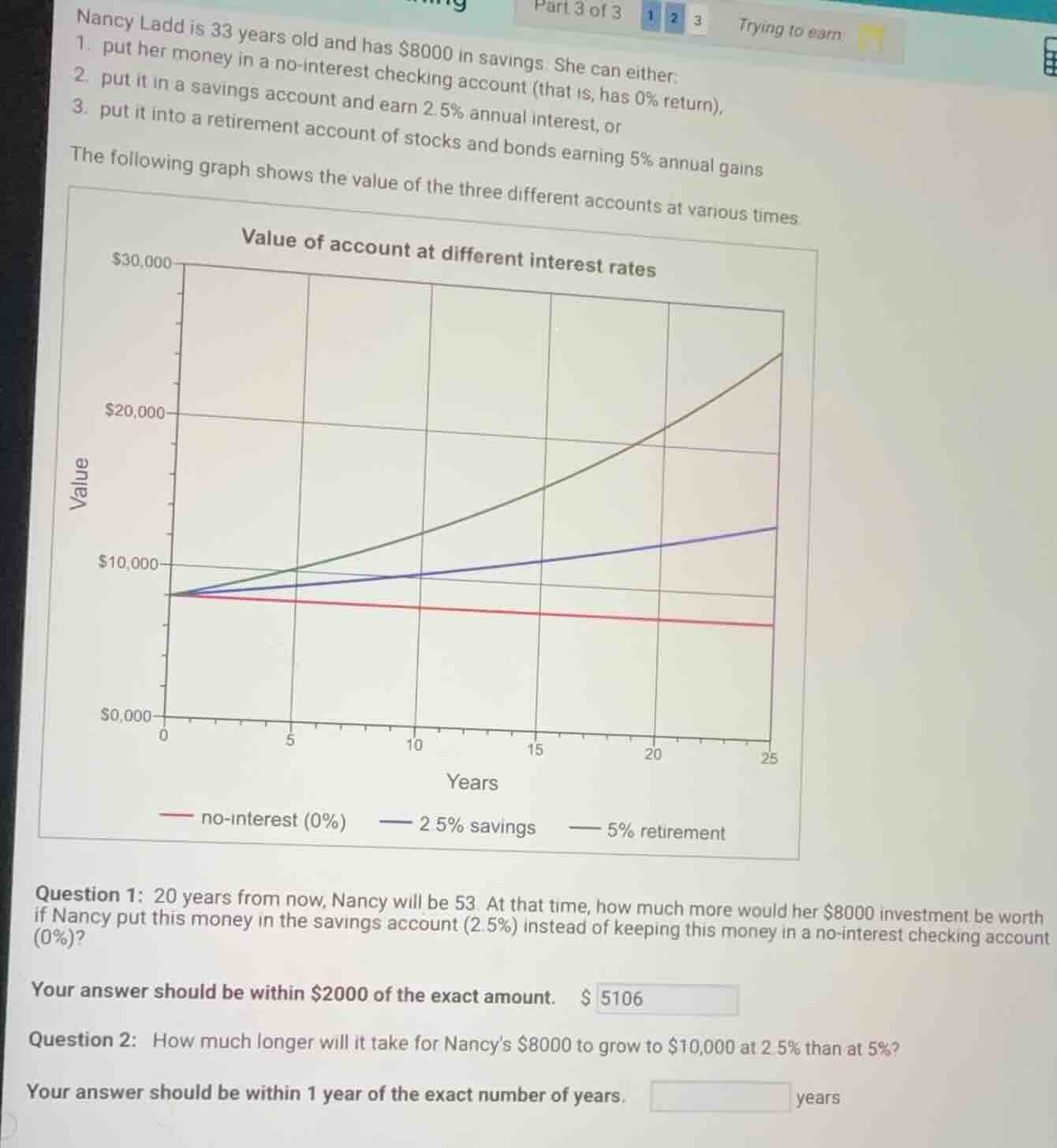
nancy ladd is 33 years old and has $8000 in savings. she can either: 1. put her money in a no - interest checking account (that is, has 0% return), 2. put it in a savings account and earn 2.5% annual interest, or 3. put it into a retirement account of stocks and bonds earning 5% annual gains. the following graph shows the value of the three different accounts at various times. (graph description: a graph titled value of account at different interest rates with x - axis as years (ranging from 0 to 25) and y - axis as value (ranging from $0,000 to $30,000). there are three lines: red for no - interest (0%), blue for 2.5% savings, and black for 5% retirement. ) question 1: 20 years from now, nancy will be 53. at that time, how much more would her $8000 investment be worth if nancy put this money in the savings account (2.5%) instead of keeping this money in a no - interest checking account (0%)? your answer should be within $2000 of the exact amount. $5106 (filled in). question 2: how much longer will it take for nancy’s $8000 to grow to $10,000 at 2.5% than at 5%? your answer should be within 1 year of the exact number of years. years (blank).
Step1: Question1: Calculate 2.5% account value
We use the compound interest formula $A = P(1 + r)^t$, where $P=\$8000$, $r=0.025$, $t=20$.
$A_{2.5\%} = 8000(1 + 0.025)^{20}$
$A_{2.5\%} = 8000(1.025)^{20} \approx 8000 \times 1.6386 = 13108.8$
Step2: Question1: Get 0% account value
The no-interest account retains the principal: $A_{0\%} = 8000$
Step3: Question1: Find the difference
$\text{Difference} = 13108.8 - 8000 = 5108.8$
Step4: Question2: Solve for 2.5% time to $10,000
Use $A = P(1 + r)^t$, solve for $t$:
$10000 = 8000(1.025)^t$
$\frac{10000}{8000} = (1.025)^t$
$\log(1.25) = t\log(1.025)$
$t_{2.5\%} = \frac{\log(1.25)}{\log(1.025)} \approx \frac{0.09691}{0.01072} \approx 9$ years
Step5: Question2: Solve for 5% time to $10,000
Use $A = P(1 + r)^t$, solve for $t$:
$10000 = 8000(1.05)^t$
$\frac{10000}{8000} = (1.05)^t$
$\log(1.25) = t\log(1.05)$
$t_{5\%} = \frac{\log(1.25)}{\log(1.05)} \approx \frac{0.09691}{0.02119} \approx 4.57 \approx 5$ years
Step6: Question2: Find time difference
$\text{Difference} = 9 - 5 = 4$ years

Snap & solve any problem in the app
Get step-by-step solutions on Sovi AI
Photo-based solutions with guided steps
Explore more problems and detailed explanations
Question 1: $\$5109$ (matches the given approximate value of $\$5106$ within the $\$2000$ range)
Question 2: 4 years