QUESTION IMAGE
Question
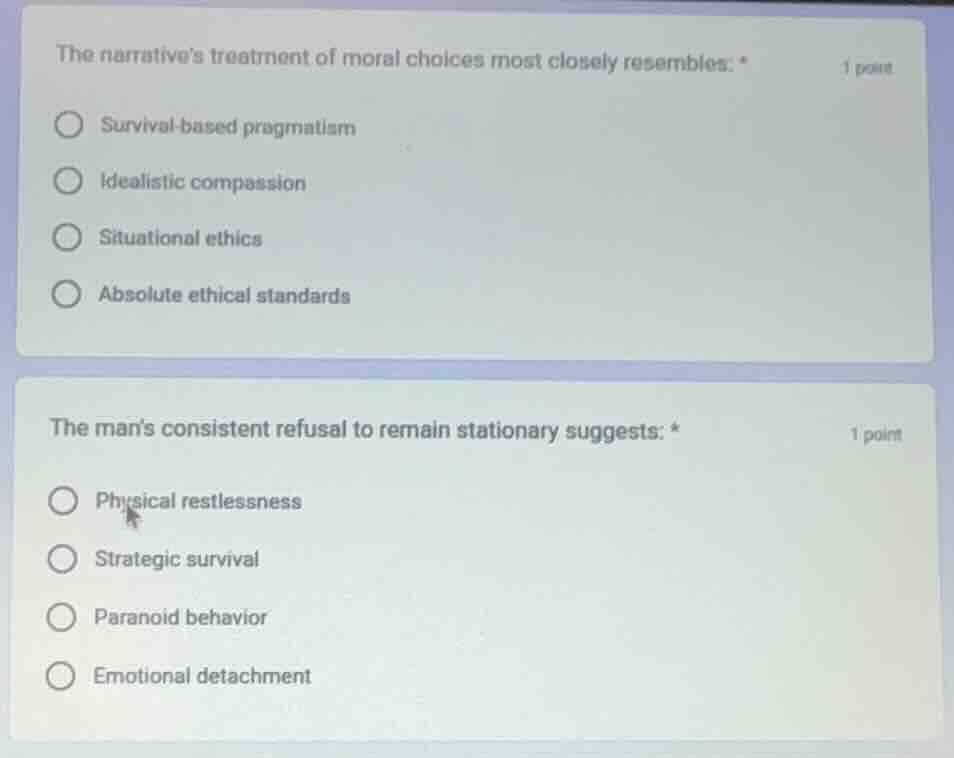
the narratives treatment of moral choices most closely resembles: *
- survival - based pragmatism
- idealistic compassion
- situational ethics
- absolute ethical standards
the mans consistent refusal to remain stationary suggests: *
- physical restlessness
- strategic survival
- paranoid behavior
- emotional detachment
Response
First Question (The narrative’s treatment of moral choices most closely resembles)
Brief Explanations
To determine the correct answer, we analyze each option:
- Survival - based pragmatism: Focuses on actions for survival, not primarily about moral choice frameworks.
- Idealistic compassion: Emphasizes idealized, compassionate responses, not a common framework for moral choice analysis.
- Situational ethics: Holds that moral decisions depend on the situation. If the narrative's moral choices are context - dependent, this fits.
- Absolute ethical standards: Posits fixed moral rules, opposite to situation - dependent choices.
Brief Explanations
Analyzing each option:
- Physical restlessness: Implies a physical urge to move, but the context of "refusal to remain stationary" in a survival - like scenario (implied by the options) is more about strategy.
- Strategic survival: If remaining stationary is dangerous (e.g., in a harsh environment or life - threatening situation), refusing to stay still could be a strategic move for survival.
- Paranoid behavior: Implies irrational fear - based actions, not a strategic refusal.
- Emotional detachment: Related to emotional state, not physical movement refusal.

Snap & solve any problem in the app
Get step-by-step solutions on Sovi AI
Photo-based solutions with guided steps
Explore more problems and detailed explanations
C. Situational ethics