QUESTION IMAGE
Question
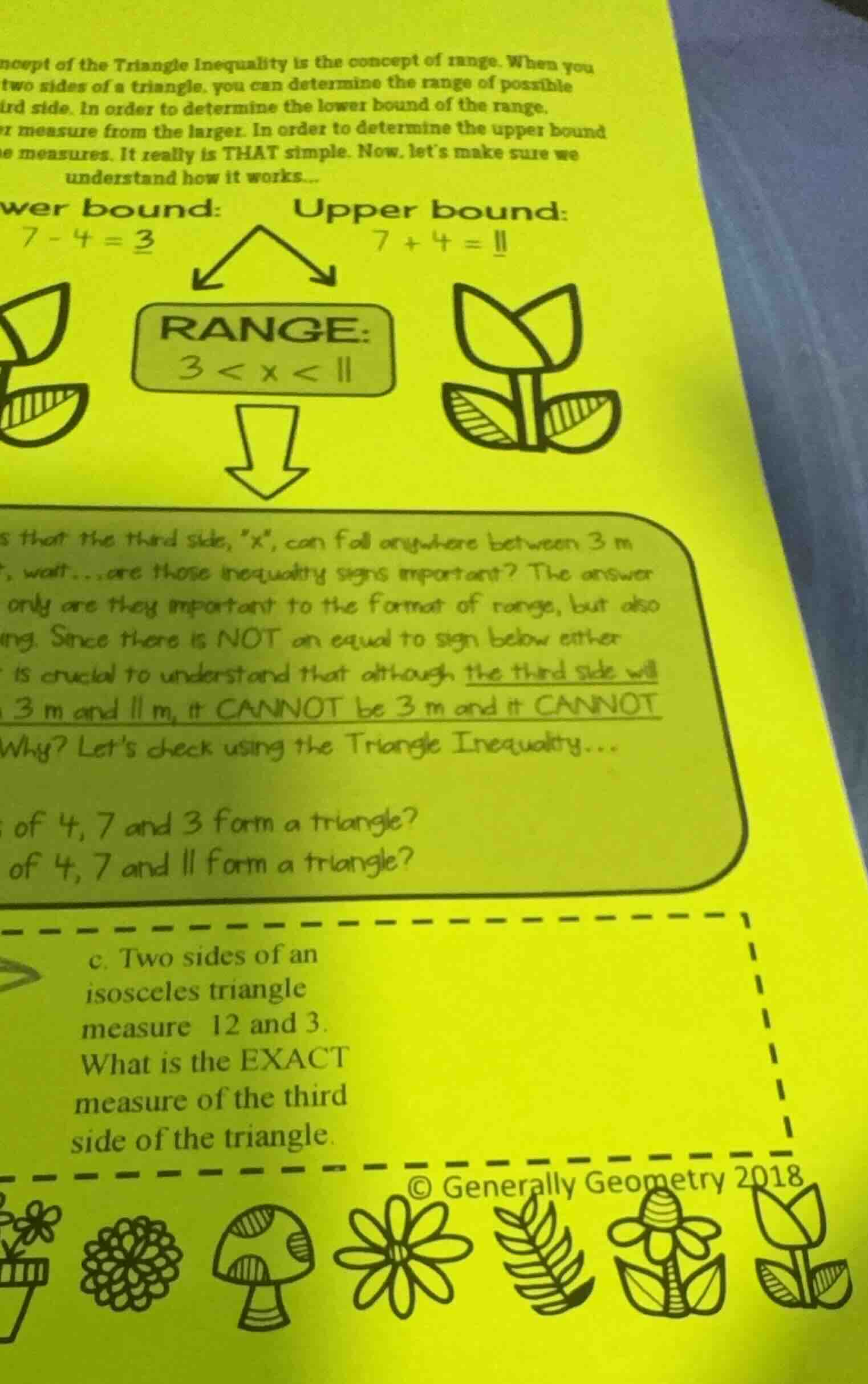
ncept of the triangle inequality is the concept of range. when you two sides of a triangle, you can determine the range of possible ird side. in order to determine the lower bound of the range, r measure from the larger. in order to determine the upper bound e measures. it really is that simple. now, lets make sure we understand how it works... wer bound: upper bound: 7 - 4 = 3 7 + 4 = 11 range: 3 < x < 11 s that the third side, x, can fall anywhere between 3 m , wait...are those inequality signs important? the answer only are they important to the format of range, but also ing. since there is not an equal to sign below either is crucial to understand that although the third side will 3 m and 11 m, it cannot be 3 m and it cannot why? lets check using the triangle inequality... of 4, 7 and 3 form a triangle? of 4, 7 and 11 form a triangle? c. two sides of an isosceles triangle measure 12 and 3. what is the exact measure of the third side of the triangle. © generally geometry 2018
Step1: Find range for third side
First, calculate the bounds using the triangle inequality.
Lower bound: $12 - 3 = 9$
Upper bound: $12 + 3 = 15$
So the range is $9 < x < 15$.
Step2: Test possible isosceles sides
An isosceles triangle has two equal sides. Test if the third side could be 3:
Check triangle inequality: $3 + 3 = 6$, and $6 < 12$, which violates the rule.
Test if the third side is 12:
Check triangle inequality: $12 + 3 > 12$, $12 + 12 > 3$, which satisfies the rule.

Snap & solve any problem in the app
Get step-by-step solutions on Sovi AI
Photo-based solutions with guided steps
Explore more problems and detailed explanations
12