QUESTION IMAGE
Question
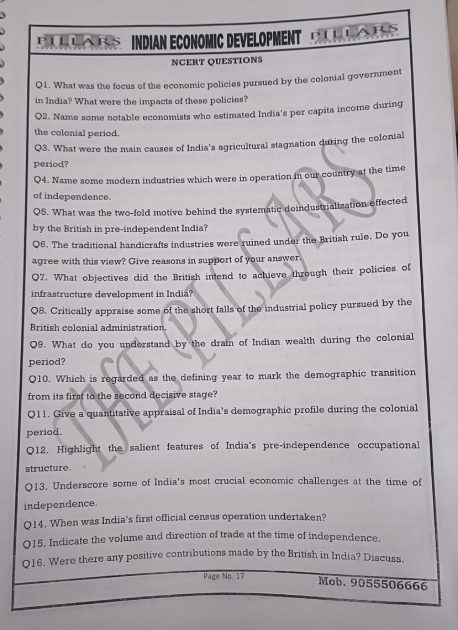
ncert questions
q1. what was the focus of the economic policies pursued by the colonial government in india? what was the impacts of these policies?
q2. name some notable economists who estimated indias per capita income during the colonial period.
q3. what were the main causes of indias agricultural stagnation during the colonial period?
q4. name some modern industries which were in operation in our country at the time of independence.
q5. what was the two - fold motive behind the systematic deindustrialisation effected by the british in pre - independent india?
q6. the traditional handicrafts industries were ruined under the british rule. do you agree with this view? give reasons in support of your answer.
q7. what objectives did the british intend to achieve through their policies of infrastructure development in india?
q8. critically appraise some of the shortfalls of the industrial policy pursued by the british colonial administration.
q9. what do you understand by the drain of indian wealth during the colonial period?
q10. which is regarded as the defining year to mark the demographic transition from its first to the second decisive stage?
q11. give a quantitative appraisal of indias demographic profile during the colonial period.
q12. highlight the salient features of indias pre - independence occupational structure.
q13. underscore some of indias most crucial economic challenges at the time of independence.
q14. when was indias first official census operation undertaken?
q15. indicate the volume and direction of trade at the time of independence.
q16. were there any positive contributions made by the british in india? discuss.
(2) To make India a market for British manufactured goods (so that British - made products like textiles could be sold in India, ruining Indian handicrafts).
Yes, traditional handicrafts industries were ruined under British rule. Reasons: (1) British policies made Indian handicrafts uncompetitive (high tariffs on Indian exports, low tariffs on British imports). (2) Disruption of local markets due to British - made goods flooding Indian markets. (3) Decline of royal patronage (as princely states were subjugated, no more support for handicrafts). (4) Lack of modern technology and capital investment in traditional industries.
The British aimed to achieve infrastructure development (like railways, ports, roads) in India for: (1) Facilitating the movement of raw materials from interior to ports (for export to Britain). (2) Facilitating the movement of British manufactured goods from ports to interior (for sale in Indian markets). (3) For strategic military purposes (to move troops quickly).
Shortfalls of British industrial policy: (1) Neglect of heavy and capital - goods industries (focus on consumer goods or industries using Indian raw materials for British benefit). (2) Disregard for Indian entrepreneurship (British - owned industries dominated, Indian entrepreneurs faced discrimination). (3) Lack of technology transfer (modern technology not shared with Indians, stunting industrial growth). (4) Uneven regional development (industries concentrated in few areas like Mumbai, Kolkata, neglecting others).

Snap & solve any problem in the app
Get step-by-step solutions on Sovi AI
Photo-based solutions with guided steps
Explore more problems and detailed explanations
Two - fold motive for deindustrialization: 1. Make India raw material supplier for Britain. 2. Make India a market for British manufactured goods.
For Q6: