QUESTION IMAGE
Question
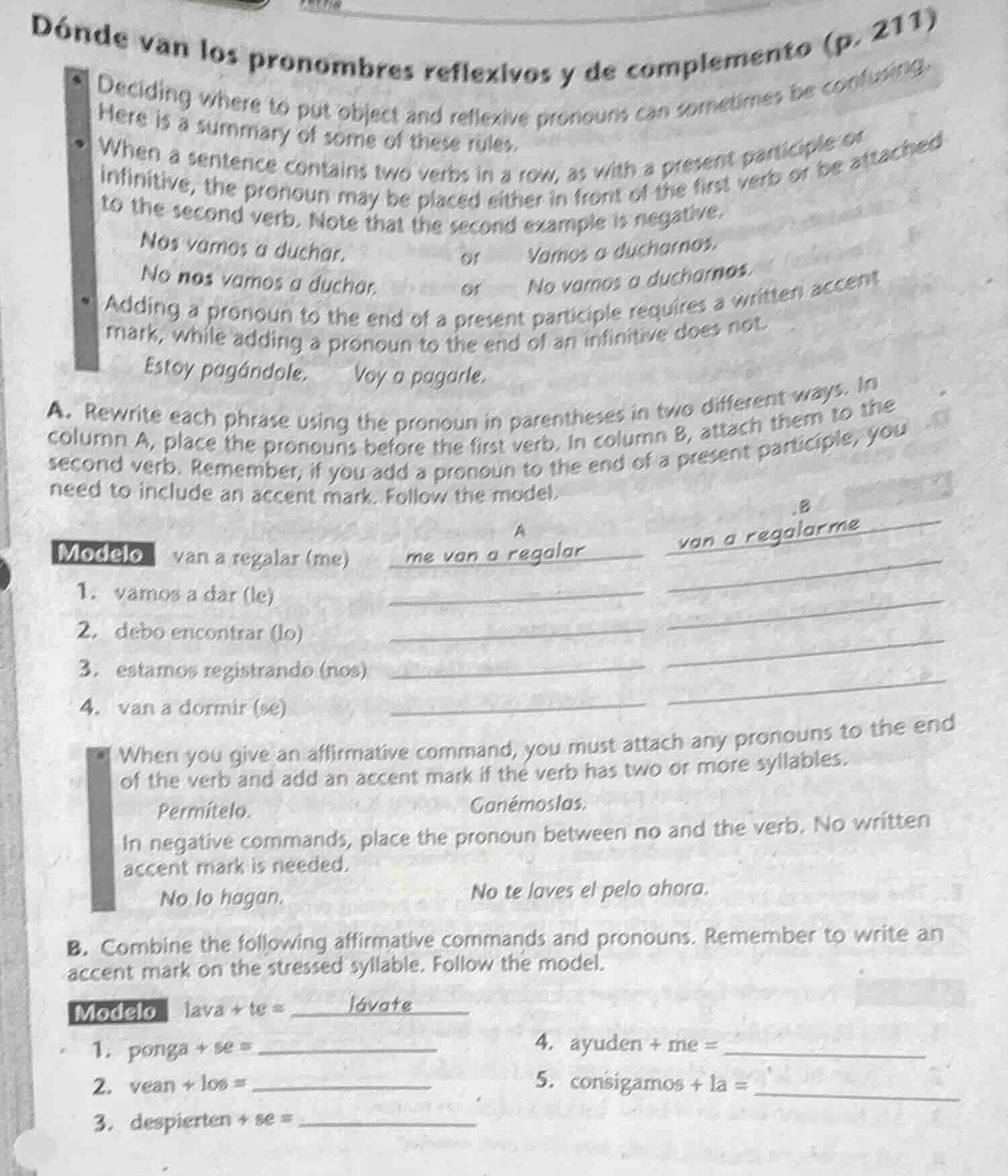
dónde van los pronombres reflexivos y de complemento (p. 211)
deciding where to put object and reflexive pronouns can sometimes be confusing. here is a summary of some of these rules.
when a sentence contains two verbs in a row, as with a present participle or infinitive, the pronoun may be placed either in front of the first verb or be attached to the second verb. note that the second example is negative.
nos vamos a duchar. or vamos a ducharnos.
no nos vamos a duchar. or no vamos a ducharnos.
adding a pronoun to the end of a present participle requires a written accent mark, while adding a pronoun to the end of an infinitive does not.
estoy pagándole. voy a pagarle.
a. rewrite each phrase using the pronoun in parentheses in two different ways. in column a, place the pronouns before the first verb. in column b, attach them to the second verb. remember, if you add a pronoun to the end of a present participle, you need to include an accent mark. follow the model.
modelo van a regalar (me) me van a regalar van a regalarme
- vamos a dar (le)
- debo encontrar (lo)
- estamos registrando (nos)
- van a dormir (se)
when you give an affirmative command, you must attach any pronouns to the end of the verb and add an accent mark if the verb has two or more syllables.
permítelo. conémoslas.
in negative commands, place the pronoun between no and the verb. no written accent mark is needed.
no lo hagan. no te laves el pelo ahora.
b. combine the following affirmative commands and pronouns. remember to write an accent mark on the stressed syllable. follow the model.
modelo lava + te = lávate
- ponga + se =
- vean + los =
- despierten + se =
- ayuden + me =
- consigamos + la =
Part A
1. vamos a dar (le)
- Column A (pronoun before first verb): We take the pronoun "le" and place it before the first verb "vamos". So it becomes "le vamos a dar".
- Column B (pronoun attached to second verb): The second verb is "dar", so we attach "le" to "dar". Since "dar" is an infinitive, no accent mark is needed. So it becomes "vamos a darle".
2. debo encontrar (lo)
- Column A (pronoun before first verb): The pronoun "lo" is placed before the first verb "debo", resulting in "lo debo encontrar".
- Column B (pronoun attached to second verb): The second verb is "encontrar", so we attach "lo" to "encontrar". As "encontrar" is an infinitive, no accent mark is needed. So it becomes "debo encontrarlo".
3. estamos registrando (nos)
- Column A (pronoun before first verb): The pronoun "nos" is placed before the first verb "estamos", giving "nos estamos registrando".
- Column B (pronoun attached to second verb): The second verb is "registrando" (a present participle), so we attach "nos" to "registrando" and add an accent mark to the stressed syllable. The stressed syllable in "registrando" is the third syllable (from the end: -ran-), so we add the accent mark to "registrándonos".
4. van a dormir (se)
- Column A (pronoun before first verb): The pronoun "se" is placed before the first verb "van", resulting in "se van a dormir".
- Column B (pronoun attached to second verb): The second verb is "dormir" (an infinitive), so we attach "se" to "dormir" with no accent mark. So it becomes "van a dormirse".
Part B
1. ponga + se =
- The verb "ponga" has two syllables (pon-ga). When we attach "se" to it, we need to add an accent mark to the stressed syllable. The stressed syllable in "ponga" is "pon", so we add the accent mark to "póngase".
2. vean + los =
- The verb "vean" has two syllables (ve-an). When we attach "los" to it, we add an accent mark to the stressed syllable. The stressed syllable in "vean" is "ve", so we get "véanlos".
3. despierten + se =
- The verb "despierten" has three syllables (des-pier-ten). When we attach "se" to it, we add an accent mark to the stressed syllable. The stressed syllable in "despierten" is "pier", so we have "despiértense".
4. ayuden + me =
- The verb "ayuden" has two syllables (ayu-den). When we attach "me" to it, we add an accent mark to the stressed syllable. The stressed syllable in "ayuden" is "ayu", so we get "áyudeme".
5. consigamos + la =
- The verb "consigamos" has four syllables (con-si-ga-mos). When we attach "la" to it, we add an accent mark to the stressed syllable. The stressed syllable in "consigamos" is "ga", so we have "consigámosla".
Final Answers (Filled as per the exercise)
Part A
- A: le vamos a dar; B: vamos a darle
- A: lo debo encontrar; B: debo encontrarlo
- A: nos estamos registrando; B: estamos registrándonos
- A: se van a dormir; B: van a dormirse
Part B
- póngase
- véanlos
- despiértense
- áyudeme
- consigámosla

Snap & solve any problem in the app
Get step-by-step solutions on Sovi AI
Photo-based solutions with guided steps
Explore more problems and detailed explanations
Part A
1. vamos a dar (le)
- Column A (pronoun before first verb): We take the pronoun "le" and place it before the first verb "vamos". So it becomes "le vamos a dar".
- Column B (pronoun attached to second verb): The second verb is "dar", so we attach "le" to "dar". Since "dar" is an infinitive, no accent mark is needed. So it becomes "vamos a darle".
2. debo encontrar (lo)
- Column A (pronoun before first verb): The pronoun "lo" is placed before the first verb "debo", resulting in "lo debo encontrar".
- Column B (pronoun attached to second verb): The second verb is "encontrar", so we attach "lo" to "encontrar". As "encontrar" is an infinitive, no accent mark is needed. So it becomes "debo encontrarlo".
3. estamos registrando (nos)
- Column A (pronoun before first verb): The pronoun "nos" is placed before the first verb "estamos", giving "nos estamos registrando".
- Column B (pronoun attached to second verb): The second verb is "registrando" (a present participle), so we attach "nos" to "registrando" and add an accent mark to the stressed syllable. The stressed syllable in "registrando" is the third syllable (from the end: -ran-), so we add the accent mark to "registrándonos".
4. van a dormir (se)
- Column A (pronoun before first verb): The pronoun "se" is placed before the first verb "van", resulting in "se van a dormir".
- Column B (pronoun attached to second verb): The second verb is "dormir" (an infinitive), so we attach "se" to "dormir" with no accent mark. So it becomes "van a dormirse".
Part B
1. ponga + se =
- The verb "ponga" has two syllables (pon-ga). When we attach "se" to it, we need to add an accent mark to the stressed syllable. The stressed syllable in "ponga" is "pon", so we add the accent mark to "póngase".
2. vean + los =
- The verb "vean" has two syllables (ve-an). When we attach "los" to it, we add an accent mark to the stressed syllable. The stressed syllable in "vean" is "ve", so we get "véanlos".
3. despierten + se =
- The verb "despierten" has three syllables (des-pier-ten). When we attach "se" to it, we add an accent mark to the stressed syllable. The stressed syllable in "despierten" is "pier", so we have "despiértense".
4. ayuden + me =
- The verb "ayuden" has two syllables (ayu-den). When we attach "me" to it, we add an accent mark to the stressed syllable. The stressed syllable in "ayuden" is "ayu", so we get "áyudeme".
5. consigamos + la =
- The verb "consigamos" has four syllables (con-si-ga-mos). When we attach "la" to it, we add an accent mark to the stressed syllable. The stressed syllable in "consigamos" is "ga", so we have "consigámosla".
Final Answers (Filled as per the exercise)
Part A
- A: le vamos a dar; B: vamos a darle
- A: lo debo encontrar; B: debo encontrarlo
- A: nos estamos registrando; B: estamos registrándonos
- A: se van a dormir; B: van a dormirse
Part B
- póngase
- véanlos
- despiértense
- áyudeme
- consigámosla