QUESTION IMAGE
Question
ne if the graphs below represent exponential growth or decay?
y
growth
so, the base is
b>1
decay
so, the base is
0<b<1
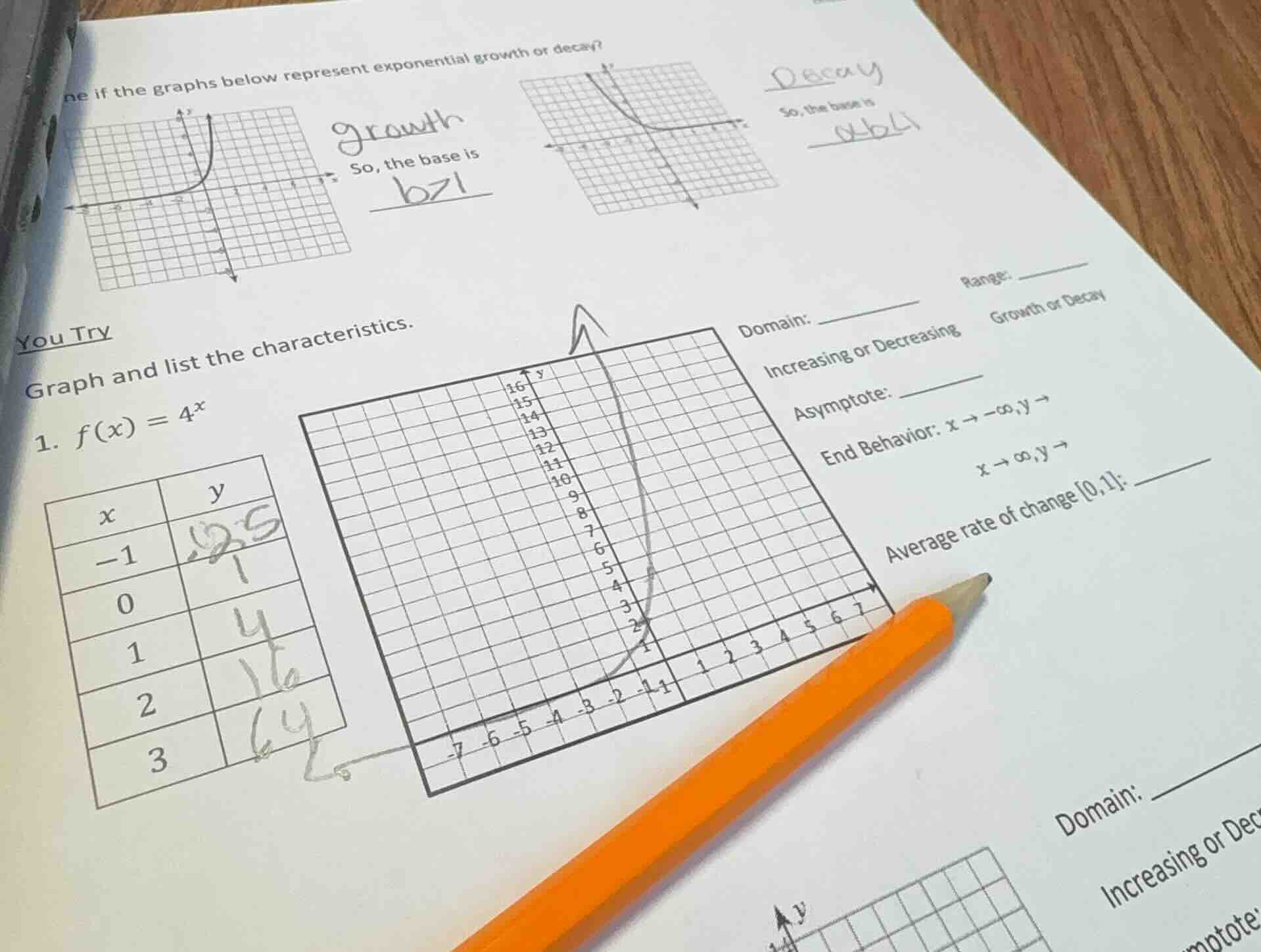
you try
graph and list the characteristics.
- $f(x) = 4^x$
x
y
$-1$
$0$
$1$
$1$
$2$
$16$
$3$
$64$
domain:
range:
increasing or decreasing
growth or decay
asymptote:
end behavior: $x \
ightarrow -\infty, y \
ightarrow$
$x \
ightarrow \infty, y \
ightarrow$
average rate of change $0,1$:
domain:
increasing or dec
Step1: Find the domain of \( f(x) = 4^x \)
The domain of an exponential function \( a^x \) (where \( a>0, a
eq1 \)) is all real numbers. So for \( f(x)=4^x \), the domain is \( (-\infty, \infty) \) or \( \mathbb{R} \).
Step2: Find the range of \( f(x) = 4^x \)
For \( y = 4^x \), since \( 4^x>0 \) for all real \( x \) (any positive number raised to a real power is positive), the range is \( (0, \infty) \).
Step3: Determine if the function is increasing or decreasing
The base of the exponential function \( f(x)=4^x \) is \( 4 \), and since \( 4 > 1 \), exponential functions with base \( b>1 \) are increasing functions. So \( f(x) = 4^x \) is increasing.
Step4: Determine if it is growth or decay
Since the base \( 4>1 \), this is an exponential growth function.
Step5: Find the asymptote of \( f(x) = 4^x \)
For exponential functions of the form \( a^x \), the horizontal asymptote is \( y = 0 \) (as \( x
ightarrow -\infty \), \( a^x
ightarrow 0 \) when \( a > 1 \)).
Step6: Find the end - behavior
- As \( x
ightarrow -\infty \): We know that \( \lim_{x
ightarrow -\infty}4^x=\lim_{x
ightarrow -\infty}\frac{1}{4^{|x|}} = 0 \), so \( y
ightarrow 0 \).
- As \( x
ightarrow \infty \): We know that \( \lim_{x
ightarrow \infty}4^x=\infty \), so \( y
ightarrow \infty \).
Step7: Find the average rate of change on \([0,1]\)
The formula for the average rate of change of a function \( y = f(x) \) on the interval \([a,b]\) is \( \frac{f(b)-f(a)}{b - a} \).
For \( f(x)=4^x \), \( a = 0 \), \( b = 1 \).
First, find \( f(0) \) and \( f(1) \):
- \( f(0)=4^0 = 1 \)
- \( f(1)=4^1 = 4 \)
Then, the average rate of change \(=\frac{f(1)-f(0)}{1 - 0}=\frac{4 - 1}{1}=3 \).

Snap & solve any problem in the app
Get step-by-step solutions on Sovi AI
Photo-based solutions with guided steps
Explore more problems and detailed explanations
- Domain: \( (-\infty, \infty) \)
- Range: \( (0, \infty) \)
- Increasing or Decreasing: Increasing
- Growth or Decay: Growth
- Asymptote: \( y = 0 \)
- End Behavior: \( x
ightarrow -\infty,y
ightarrow 0 \); \( x
ightarrow \infty,y
ightarrow \infty \)
- Average rate of change \([0,1]\): \( 3 \)