QUESTION IMAGE
Question
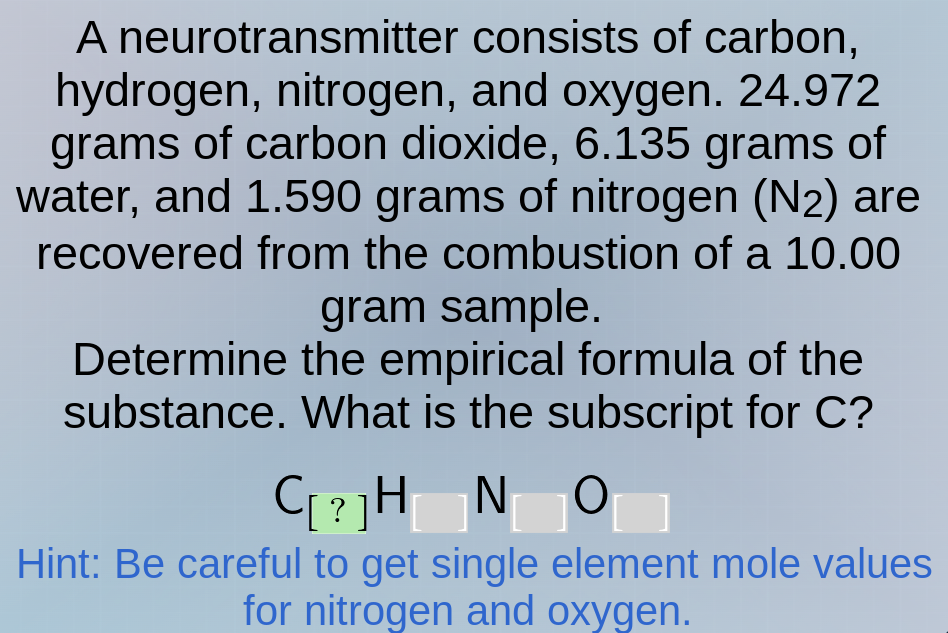
a neurotransmitter consists of carbon, hydrogen, nitrogen, and oxygen. 24.972 grams of carbon dioxide, 6.135 grams of water, and 1.590 grams of nitrogen (n₂) are recovered from the combustion of a 10.00 gram sample. determine the empirical formula of the substance. what is the subscript for c? c?h n o hint: be careful to get single element mole values for nitrogen and oxygen.
Step1: Calculate moles of C from CO₂
Molar mass of CO₂ = 12.01 + 2×16.00 = 44.01 g/mol.
Moles of CO₂ = $\frac{24.972\ \text{g}}{44.01\ \text{g/mol}}$ = 0.5674 mol.
Since 1 mol CO₂ has 1 mol C, moles of C = 0.5674 mol.
Step2: Calculate moles of H from H₂O
Molar mass of H₂O = 2×1.008 + 16.00 = 18.016 g/mol.
Moles of H₂O = $\frac{6.135\ \text{g}}{18.016\ \text{g/mol}}$ ≈ 0.3405 mol.
Since 1 mol H₂O has 2 mol H, moles of H = 2×0.3405 = 0.6810 mol.
Step3: Calculate moles of N from N₂
Molar mass of N₂ = 2×14.01 = 28.02 g/mol.
Moles of N₂ = $\frac{1.590\ \text{g}}{28.02\ \text{g/mol}}$ ≈ 0.05675 mol.
Since 1 mol N₂ has 2 mol N, moles of N = 2×0.05675 = 0.1135 mol.
Step4: Calculate mass of O in sample
Mass of C = 0.5674 mol × 12.01 g/mol ≈ 6.814 g.
Mass of H = 0.6810 mol × 1.008 g/mol ≈ 0.686 g.
Mass of N = 1.590 g (given as N₂, so mass of N is 1.590 g).
Mass of O = 10.00 g - (6.814 + 0.686 + 1.590) g = 10.00 - 9.09 = 0.91 g.
Step5: Calculate moles of O
Molar mass of O = 16.00 g/mol.
Moles of O = $\frac{0.91\ \text{g}}{16.00\ \text{g/mol}}$ ≈ 0.056875 mol.
Step6: Find the smallest mole value
Smallest moles: N (0.1135) or O (0.056875)? Wait, no—wait, moles of O is ~0.0569, N is ~0.1135, C is 0.5674, H is 0.6810. Wait, no, wait: Wait, moles of O calculation: Wait, mass of O: 10.00 - (C + H + N) = 10 - (6.814 + 0.686 + 1.590) = 10 - 9.09 = 0.91 g. Then moles O = 0.91 / 16 ≈ 0.056875.
Wait, but let's recheck: Wait, moles of N: N₂ is 1.590 g, molar mass 28.02, so moles N₂ = 1.590 / 28.02 ≈ 0.05675, so moles N = 2×0.05675 = 0.1135. Ah, I see, earlier mistake: moles of N₂ is 0.05675, so N is 0.1135 mol.
Now, find the smallest mole value among C (0.5674), H (0.6810), N (0.1135), O (0.056875). The smallest is O: ~0.056875. Wait, no, O is 0.056875, N is 0.1135 (which is ~twice O). Wait, maybe I messed up O calculation. Wait, mass of sample is 10.00 g. Mass of C: 0.5674 mol ×12.01 = ~6.814 g. Mass of H: 0.6810 mol ×1.008 = ~0.686 g. Mass of N: 1.590 g (since N₂ is 1.590 g, so N is 1.590 g). So total mass of C + H + N = 6.814 + 0.686 + 1.590 = 9.09 g. Therefore, mass of O = 10.00 - 9.09 = 0.91 g. Moles of O = 0.91 / 16 = 0.056875 mol.
Now, divide each mole by the smallest mole (O: 0.056875) to get ratios:
C: 0.5674 / 0.056875 ≈ 9.977 ≈ 10.
H: 0.6810 / 0.056875 ≈ 11.97 ≈ 12.
N: 0.1135 / 0.056875 ≈ 1.996 ≈ 2.
O: 0.056875 / 0.056875 = 1.
Wait, but wait, maybe the smallest is N? Wait, no, N is 0.1135, O is 0.056875 (half of N). Wait, maybe I made a mistake in O mass. Wait, let's recalculate mass of O:
Mass of C: from CO₂: 24.972 g CO₂ × (12.01 / 44.01) = 24.972 × 0.2729 ≈ 6.814 g (correct).
Mass of H: from H₂O: 6.135 g H₂O × (2×1.008 / 18.016) = 6.135 × 0.1119 ≈ 0.686 g (correct).
Mass of N: 1.590 g (correct, since N₂ is 1.590 g, so N is 1.590 g).
Total: 6.814 + 0.686 + 1.590 = 9.09 g. So O is 10.00 - 9.09 = 0.91 g (correct). Moles O: 0.91 / 16 = 0.056875 (correct).
Now, moles:
C: 0.5674, H: 0.6810, N: 0.1135, O: 0.056875.
Divide each by O's moles (0.056875):
C: 0.5674 / 0.056875 ≈ 9.977 ≈ 10.
Ah, so the subscript for C is 10.
Wait, let's check again. Moles of C: 24.972 g CO₂. Molar mass CO₂ 44.01, so moles CO₂ = 24.972 / 44.01 = 0.5674 mol. So C is 0.5674 mol.
Moles of O from CO₂: 2×0.5674 = 1.1348 mol.
Moles of O from H₂O: 0.3405 mol (since H₂O is 0.3405 mol, O is 0.3405 mol).
Moles of O from N₂? No, N₂ has no O. So total O in products: 1.1348 + 0.3405 = 1.4753 mol.
But O in sample: O in sample = total O in products - O from O₂ (but wait, combustion: sample + O₂ → CO₂ + H₂O + N₂. So O in sample = (O in CO₂ + O in…

Snap & solve any problem in the app
Get step-by-step solutions on Sovi AI
Photo-based solutions with guided steps
Explore more problems and detailed explanations
10