QUESTION IMAGE
Question
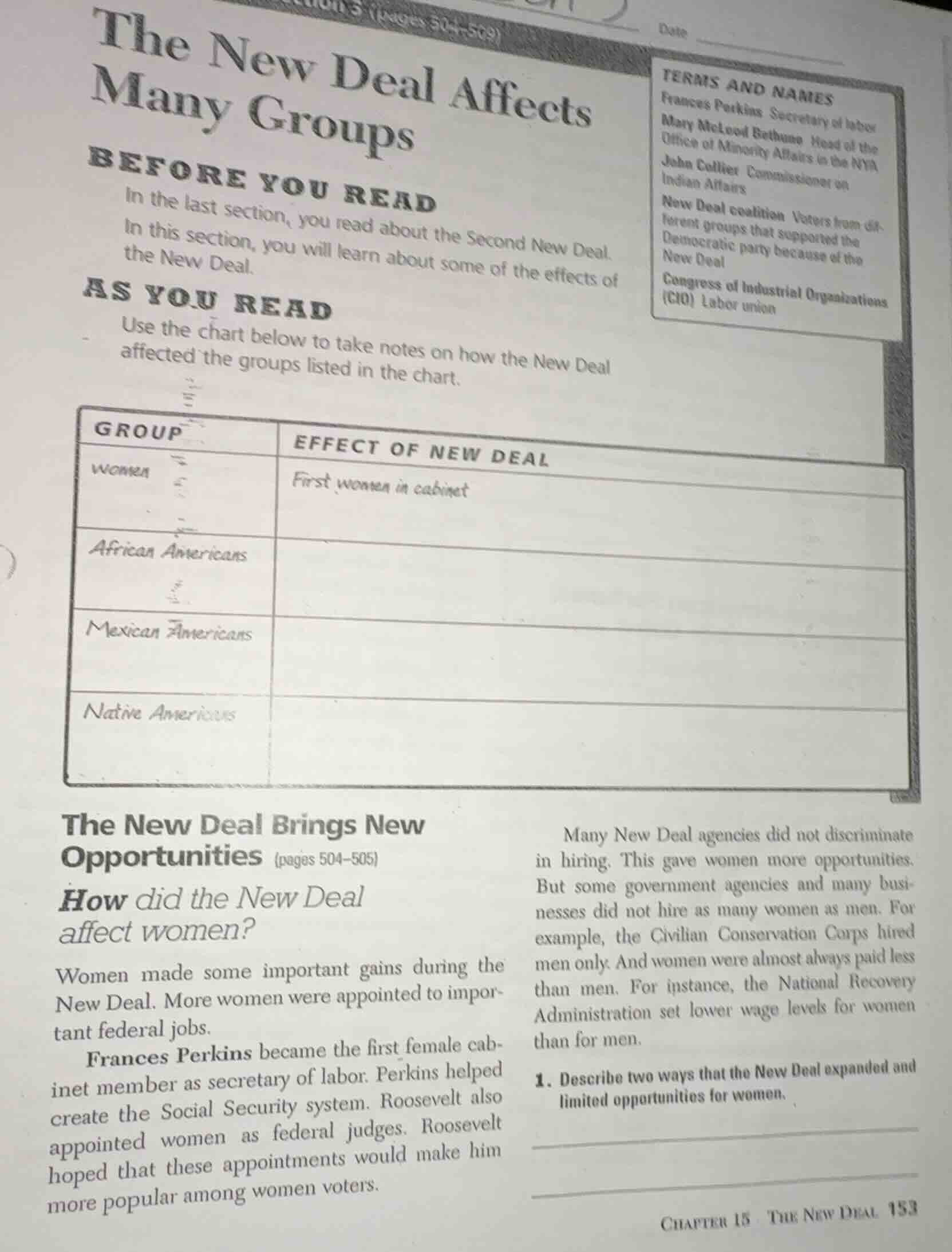
the new deal affects many groups
before you read
in the last section, you read about the second new deal.
in this section, you will learn about some of the effects of the new deal.
as you read
use the chart below to take notes on how the new deal affected the groups listed in the chart.
terms and names
frances perkins secretary of labor
mary mcleod bethune head of the office of minority affairs in the nya
john collier commissioner on indian affairs
new deal coalition voters from different groups that supported the democratic party because of the new deal
congress of industrial organizations (cio) labor union
group effect of new deal
women first women in cabinet
african americans
mexican americans
native americans
the new deal brings new opportunities (pages 504–505)
how did the new deal affect women?
women made some important gains during the new deal. more women were appointed to important federal jobs.
frances perkins became the first female cabinet member as secretary of labor. perkins helped create the social security system. roosevelt also appointed women as federal judges. roosevelt hoped that these appointments would make him more popular among women voters.
many new deal agencies did not discriminate in hiring. this gave women more opportunities. but some government agencies and many businesses did not hire as many women as men. for example, the civilian conservation corps hired men only. and women were almost always paid less than men. for instance, the national recovery administration set lower wage levels for women than for men.
- describe two ways that the new deal expanded and limited opportunities for women.
For the "African Americans" row in the chart:
To determine the effect of the New Deal on African Americans, we refer to the context of the New Deal's impact on minority groups. Mary McLeod Bethune was the head of the Office of Minority Affairs in the NYA (National Youth Administration), which worked to provide opportunities for African American youth. Also, many New Deal programs, while not fully eliminating discrimination, did offer some employment and relief opportunities to African Americans, though they still faced discrimination in some areas (e.g., some programs had segregated facilities or paid African Americans less). A key point is the role of Bethune and the efforts to include African Americans in New Deal programs, along with the formation of a more organized approach to minority affairs. So the effect could be summarized as: Gained some employment/relief opportunities through New Deal programs; Mary McLeod Bethune led efforts for African American youth in the NYA, and there was a growing recognition of African American needs (though discrimination still existed in some programs).
For the "Mexican Americans" row in the chart:
Mexican Americans during the New Deal often faced a mix of opportunities and challenges. Some New Deal programs provided relief and employment, but they also faced discrimination and were sometimes targeted by deportation efforts (due to economic hardships and anti - immigrant sentiment). However, in terms of positive impacts, New Deal programs like the Works Progress Administration (WPA) and Civilian Conservation Corps (CCC) did employ some Mexican Americans, helping them to survive the Great Depression. Also, there were efforts by some New Deal - related organizations to address their needs, though these were limited. So the effect could be: Some Mexican Americans found employment in New Deal work programs (e.g., WPA, CCC), but they also faced discrimination and deportation threats in some regions; New Deal programs provided some economic relief, but systemic discrimination persisted.
For the "Native Americans" row in the chart:
John Collier was the Commissioner of Indian Affairs, and under his leadership, the Indian New Deal (also known as the Indian Reorganization Act of 1934) was implemented. This act reversed the previous policy of forced assimilation. It allowed Native American tribes to self - govern, re - establish tribal governments, and manage their own lands and resources. Native Americans were also given more control over their cultural and economic affairs, and efforts were made to preserve Native American cultures. So the effect is: The Indian Reorganization Act (part of the New Deal) allowed Native American tribes to self - govern, re - establish tribal governments, manage their lands/resources, and preserve their cultures; John Collier led these efforts to reverse assimilation policies.

Snap & solve any problem in the app
Get step-by-step solutions on Sovi AI
Photo-based solutions with guided steps
Explore more problems and detailed explanations
to question 1 (Describe two ways that the New Deal expanded and limited opportunities for women):
- Expanded opportunities:
- More women were appointed to important federal jobs. For example, Frances Perkins became the first female cabinet member as secretary of labor, and Roosevelt also appointed women as federal judges.
- Many New Deal agencies did not discriminate in hiring, which gave women more employment opportunities compared to the situation in some government agencies and businesses before.
- Limited opportunities:
- Some government agencies (like the Civilian Conservation Corps) and many businesses did not hire as many women as men (the CCC hired men only).
- Women were almost always paid less than men. For instance, the National Recovery Administration set lower wage levels for women than for men.