QUESTION IMAGE
Question
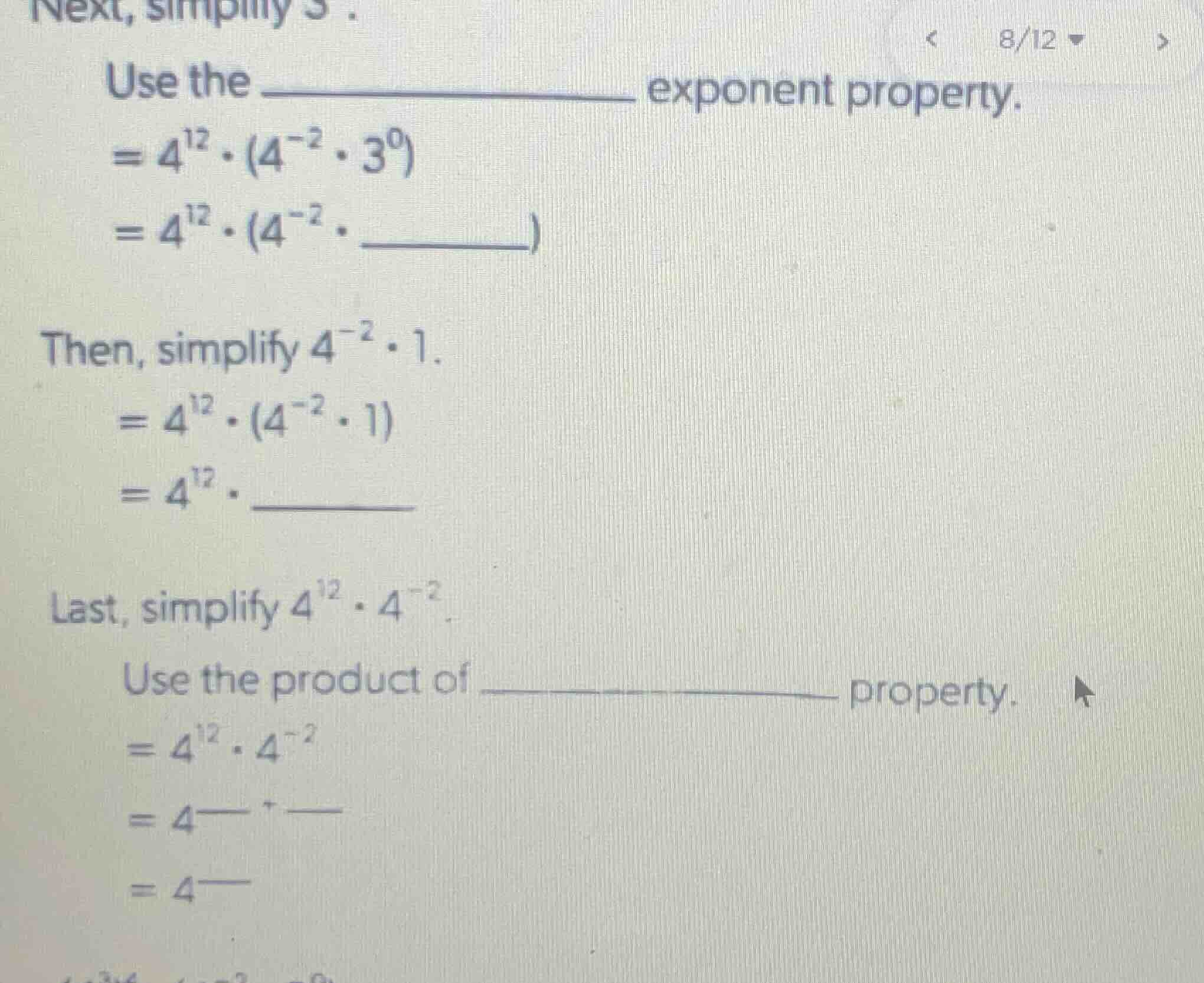
next, simplify 3^0.
use the ____________ exponent property.
= 4^12 · (4^-2 · 3^0)
= 4^12 · (4^-2 · _______)
then, simplify 4^-2 · 1.
= 4^12 · (4^-2 · 1)
= 4^12 · _______
last, simplify 4^12 · 4^-2.
use the product of ____________ property.
= 4^12 · 4^-2
= 4^{— + —}
= 4^{—}
Step1: Apply zero exponent rule
Any non-zero number to the 0 power is 1: $3^0 = 1$
Step2: Simplify $4^{-2} \cdot 1$
A number times 1 is itself: $4^{-2} \cdot 1 = 4^{-2}$
Step3: Identify product of powers rule
For same bases, add exponents: $a^m \cdot a^n = a^{m+n}$
Step4: Substitute exponents into rule
$4^{12} \cdot 4^{-2} = 4^{12 + (-2)}$
Step5: Calculate the final exponent
$12 + (-2) = 10$, so $4^{10}$

Snap & solve any problem in the app
Get step-by-step solutions on Sovi AI
Photo-based solutions with guided steps
Explore more problems and detailed explanations
- Use the zero exponent property.
$= 4^{12} \cdot (4^{-2} \cdot \boldsymbol{1})$
- $= 4^{12} \cdot \boldsymbol{4^{-2}}$
- Use the product of powers property.
$= 4^{\boldsymbol{12} + \boldsymbol{(-2)}}$
$= 4^{\boldsymbol{10}}$