QUESTION IMAGE
Question
no additional details were added for this assignment.
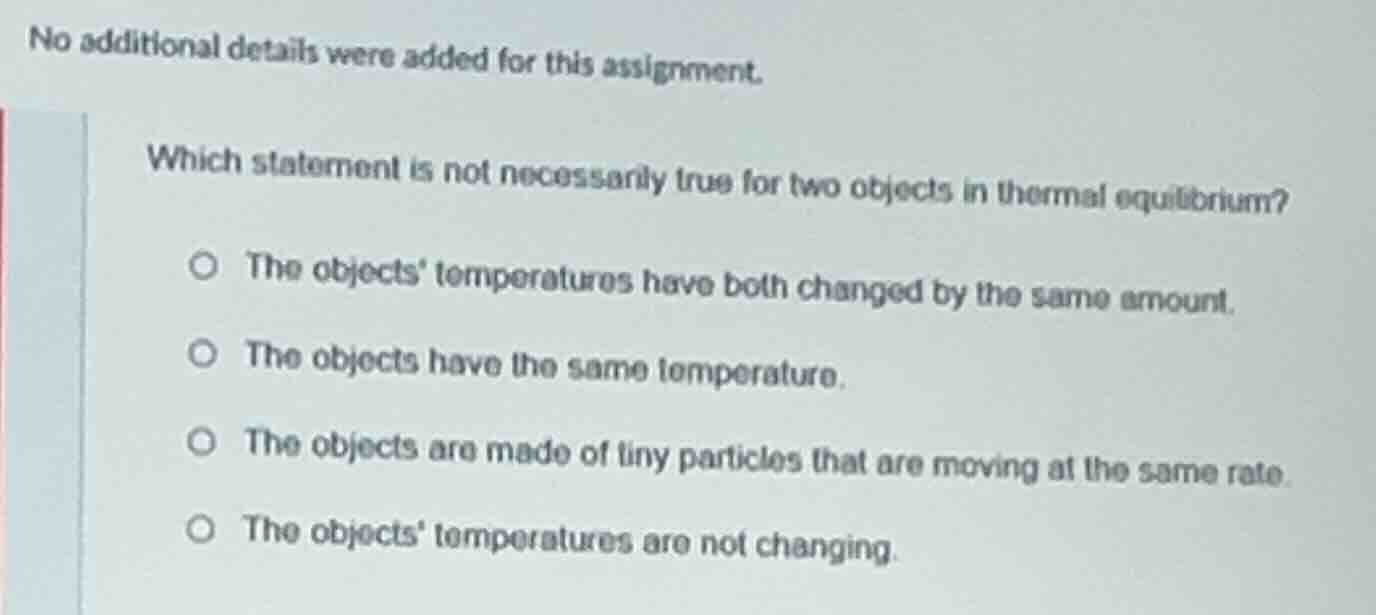
which statement is not necessarily true for two objects in thermal equilibrium?
○ the objects temperatures have both changed by the same amount.
○ the objects have the same temperature.
○ the objects are made of tiny particles that are moving at the same rate.
○ the objects temperatures are not changing.
Brief Explanations
- Recall the definition of thermal equilibrium: Two objects are in thermal equilibrium when there is no net heat transfer between them, which means they have the same temperature and their temperatures are constant (not changing). Also, temperature is related to the average kinetic energy of the tiny particles (atoms/molecules) in the objects, so if temperatures are the same, the average motion (rate) of these particles is the same.
- Analyze each option:
- "The objects have the same temperature": This is a fundamental part of thermal equilibrium, so this is true.
- "The objects are made of tiny particles that are moving at the same rate": Since temperature is related to average kinetic energy (and thus the average motion of particles), same temperature implies same average motion rate of particles, so this is true.
- "The objects' temperatures are not changing": In thermal equilibrium, there's no net heat transfer, so temperatures remain constant, so this is true.
- "The objects' temperatures have both changed by the same amount": Thermal equilibrium means they have the same temperature (and constant temperature), not that their temperatures changed by the same amount. They could have reached the same temperature without changing by the same amount (e.g., one object was at 20°C and stayed, another was at 10°C and increased by 10°C to reach 20°C – here one changed by 10, the other by 0, but they are in thermal equilibrium). So this statement is not necessarily true.

Snap & solve any problem in the app
Get step-by-step solutions on Sovi AI
Photo-based solutions with guided steps
Explore more problems and detailed explanations
The objects' temperatures have both changed by the same amount.