QUESTION IMAGE
Question
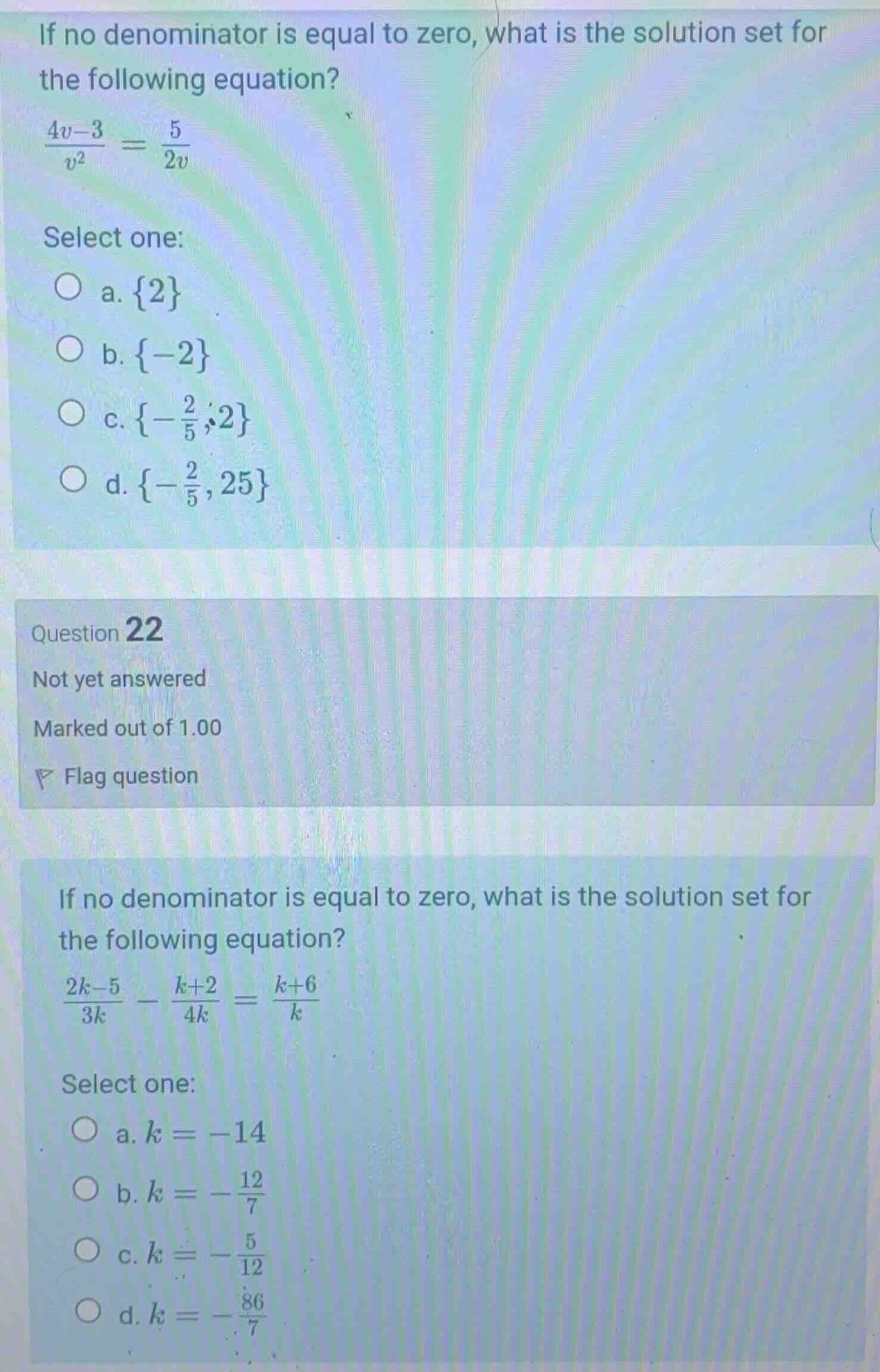
if no denominator is equal to zero, what is the solution set for the following equation?$\frac{4v-3}{v^2} = \frac{5}{2v}$select one:a. ${2}$b. ${-2}$c. ${-\frac{2}{5},2}$d. ${-\frac{2}{5},25}$question 22not yet answeredmarked out of 1.00flag questionif no denominator is equal to zero, what is the solution set for the following equation?$\frac{2k-5}{3k} - \frac{k+2}{4k} = \frac{k+6}{k}$select one:a. $k = -14$b. $k = -\frac{12}{7}$c. $k = -\frac{5}{12}$d. $k = -\frac{86}{7}$
First Equation: $\frac{4v-3}{v^2} = \frac{5}{2v}$
Step1: Eliminate denominators
Multiply both sides by $2v^2$ (the least common denominator, $v
eq 0$):
$$2v(4v-3) = 5v^2$$
Step2: Expand left side
$$8v^2 - 6v = 5v^2$$
Step3: Rearrange to standard quadratic form
Subtract $5v^2$ from both sides:
$$3v^2 - 6v = 0$$
Step4: Factor and solve
Factor out $3v$:
$$3v(v - 2) = 0$$
Solutions: $v=0$ (discarded, as it makes denominators zero) or $v=2$.
Step1: Eliminate denominators
Multiply all terms by $12k$ (the least common denominator, $k
eq 0$):
$$4(2k-5) - 3(k+2) = 12(k+6)$$
Step2: Expand all terms
$$8k - 20 - 3k - 6 = 12k + 72$$
Step3: Simplify left side
Combine like terms:
$$5k - 26 = 12k + 72$$
Step4: Isolate variable terms
Subtract $5k$ from both sides:
$$-26 = 7k + 72$$
Step5: Isolate constant terms
Subtract 72 from both sides:
$$-98 = 7k$$
Step6: Solve for $k$
Divide both sides by 7:
$$k = -14$$

Snap & solve any problem in the app
Get step-by-step solutions on Sovi AI
Photo-based solutions with guided steps
Explore more problems and detailed explanations
a. $\{2\}$
---