QUESTION IMAGE
Question
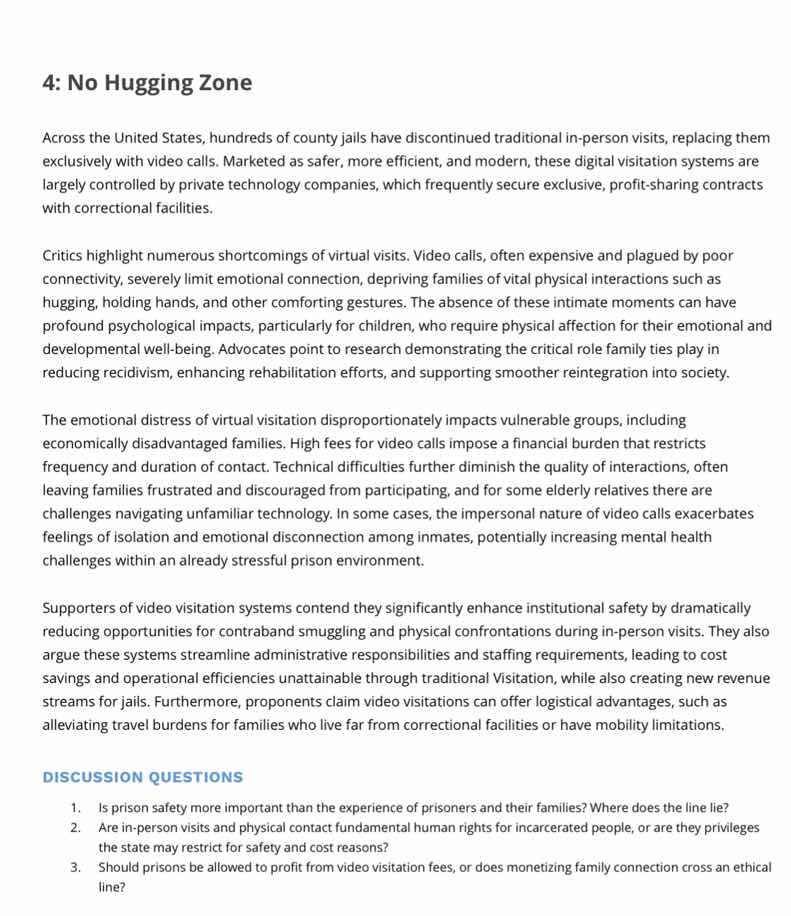
4: no hugging zone
across the united states, hundreds of county jails have discontinued traditional in - person visits, replacing them exclusively with video calls. marketed as safer, more efficient, and modern, these digital visitation systems are largely controlled by private technology companies, which frequently secure exclusive, profit - sharing contracts with correctional facilities.
critics highlight numerous shortcomings of virtual visits. video calls, often expensive and plagued by poor connectivity, severely limit emotional connection, depriving families of vital physical interactions such as hugging, holding hands, and other comforting gestures. the absence of these intimate moments can have profound psychological impacts, particularly for children, who require physical affection for their emotional and developmental well - being. advocates point to research demonstrating the critical role family ties play in reducing recidivism, enhancing rehabilitation efforts, and supporting smoother reintegration into society.
the emotional distress of virtual visitation disproportionately impacts vulnerable groups, including economically disadvantaged families. high fees for video calls impose a financial burden that restricts frequency and duration of contact. technical difficulties further diminish the quality of interactions, often leaving families frustrated and discouraged from participating, and for some elderly relatives there are challenges navigating unfamiliar technology. in some cases, the impersonal nature of video calls exacerbates feelings of isolation and emotional disconnection among inmates, potentially increasing mental health challenges within an already stressful prison environment.
supporters of video visitation systems contend they significantly enhance institutional safety by dramatically reducing opportunities for contraband smuggling and physical confrontations during in - person visits. they also argue these systems streamline administrative responsibilities and staffing requirements, leading to cost savings and operational efficiencies unattainable through traditional visitation, while also creating new revenue streams for jails. furthermore, proponents claim video visitations can offer logistical advantages, such as alleviating travel burdens for families who live far from correctional facilities or have mobility limitations.
discussion questions
- is prison safety more important than the experience of prisoners and their families? where does the line lie?
- are in - person visits and physical contact fundamental human rights for incarcerated people, or are they privileges the state may restrict for safety and cost reasons?
- should prisons be allowed to profit from video visitation fees, or does monetizing family connection cross an ethical line?
Since no specific question is asked (just the text with discussion questions), if we take one of the discussion questions, say question 2: "Are in - person visits and physical contact fundamental human rights for incarcerated people, or are they privileges the state may restrict for safety and cost reasons?"
To answer this, we consider the concepts of human rights (like the right to family and personal relationships, emotional well - being) and the state's role in ensuring safety and managing costs. Incarcerated people still have some fundamental human rights related to maintaining family ties and emotional health. However, the state also has a duty to ensure prison safety and manage resources. Physical contact during visits can be seen as part of the right to family connection (supported by research on reducing recidivism and aiding rehabilitation). But the state may argue that restricting in - person visits (and thus physical contact) is necessary for safety (preventing contraband) and cost - management (video visits can be more cost - effective in some administrative aspects). Weighing these, in - person visits and physical contact can be considered fundamental human rights as they are crucial for the emotional and psychological well - being of incarcerated people and their families, and the state's safety and cost concerns should be addressed through other means (like better security protocols for in - person visits) rather than restricting this basic human connection.

Snap & solve any problem in the app
Get step-by-step solutions on Sovi AI
Photo-based solutions with guided steps
Explore more problems and detailed explanations
In - person visits and physical contact can be considered fundamental human rights for incarcerated people. They are crucial for the emotional/psychological well - being of incarcerated individuals and their families (supported by research on rehabilitation/recidivism reduction). While the state has safety/cost management duties, these concerns should be addressed through alternative measures (e.g., improved security for in - person visits) rather than restricting this basic human connection.