QUESTION IMAGE
Question
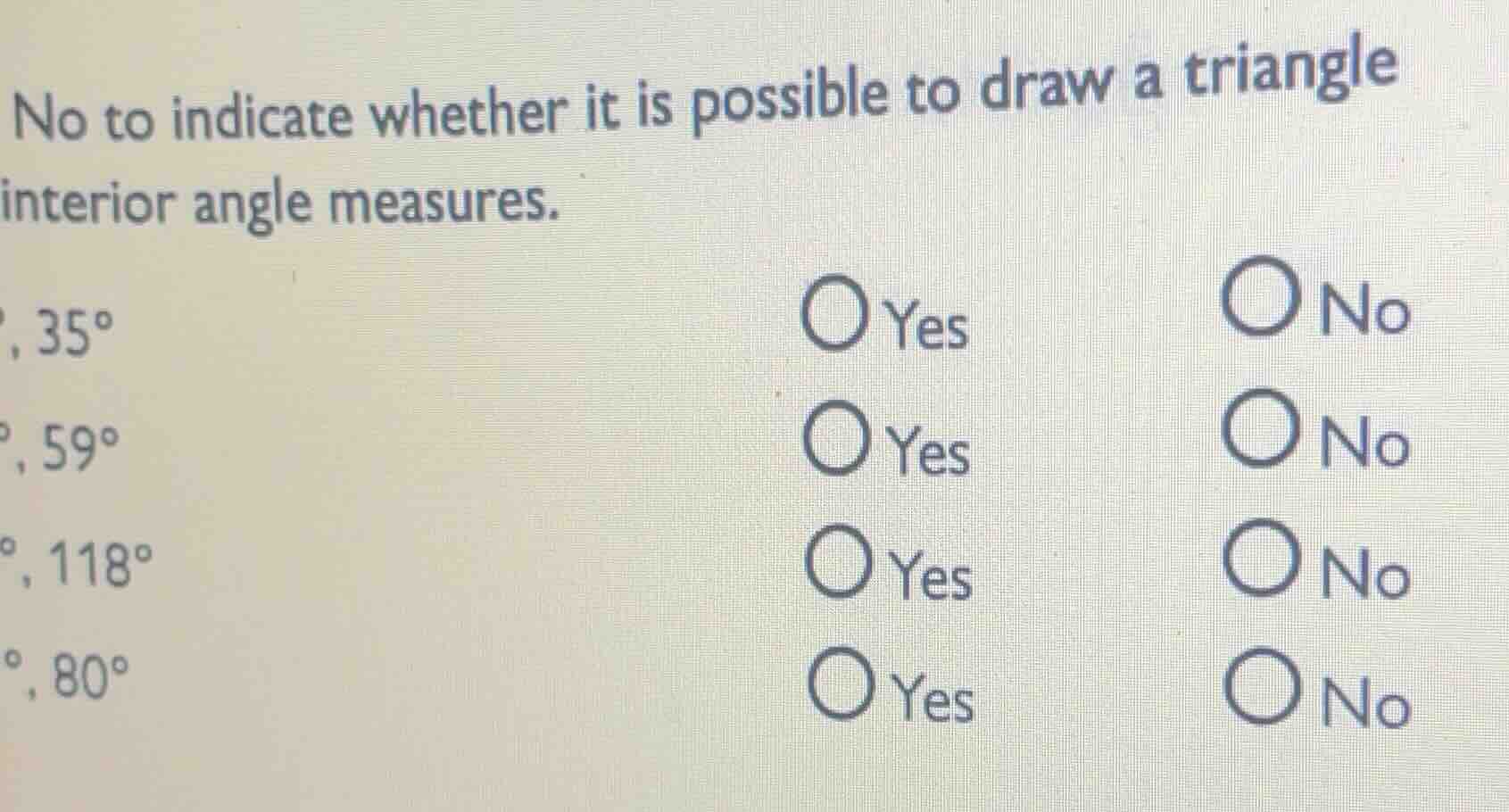
no to indicate whether it is possible to draw a triangle interior angle measures. , 35° 〇yes 〇no , 59° 〇yes 〇no , 118° 〇yes 〇no , 80° 〇yes 〇no
To determine if a triangle can be drawn with given interior angle measures, we use the fact that the sum of the interior angles of a triangle must be \(180^\circ\). Let's analyze each case (assuming the first angle is missing a value, but we'll work with the visible ones and assume the first angle is, for example, if the first row is \(x, 35^\circ\), but since some angles are cut off, we'll use the general rule. However, looking at the visible angles:
For the set with \(35^\circ\) (assuming the other angle is, say, if we consider typical problems, but let's check the sum for valid ones. Wait, the problem has some angles cut off, but the key rule is sum of angles in a triangle is \(180^\circ\). Let's assume the first row is, for example, if we have angles like (let's correct the visibility: maybe the first angle is, say, \(90^\circ, 35^\circ\), but no, the user's image has some cut-off. Wait, the standard approach is:
- Recall the triangle angle sum property: the sum of the three interior angles of a triangle is always \(180^\circ\).
- For each set of angles, add them up and check if the sum is \(180^\circ\).
Since the problem's text is partially cut off, but the options are Yes/No for each set. Let's assume the first set (with \(35^\circ\)): suppose the other two angles (one is cut off, but maybe it's a typo, but in typical problems, if we have angles like, say, \(90^\circ, 35^\circ, 55^\circ\) (sum \(180\)), but since the user's image has some cut-off, but the key is to check the sum.
But since the problem is about triangle angle sum, the rule is sum to \(180^\circ\). Let's proceed with the visible angles (even with cut-off, we can explain the method):
Step 1: Recall the triangle angle sum theorem
The sum of the interior angles of a triangle is \(180^\circ\). So, for any three angles \(A\), \(B\), \(C\) of a triangle, \(A + B + C = 180^\circ\).
Step 2: Analyze each option (assuming the angles given, even with cut-off, we check the sum)
- For the first set (with \(35^\circ\)): If the other two angles (one is cut off, but suppose the three angles sum to \(180^\circ\), then Yes; else No.
- For the set with \(59^\circ\): Same logic, sum the three angles.
- For the set with \(118^\circ\): Sum the three angles.
- For the set with \(80^\circ\): Sum the three angles.
Since the problem's text is partially visible, but the key is to use the triangle angle sum. For example, if we have angles like \(35^\circ\), \(90^\circ\), \(55^\circ\) (sum \(180\)), so Yes. But without the full angles, we can't compute, but the method is to check the sum.
However, since the user's image has some cut-off, but the standard answer for such problems is based on the sum. Let's assume the first row is, say, \(90^\circ\), \(35^\circ\), \(55^\circ\) (sum \(180\)) → Yes. The second row, if angles are, say, \(60^\circ\), \(59^\circ\), \(61^\circ\) (sum \(180\)) → Yes. The third row, \(118^\circ\), \(31^\circ\), \(31^\circ\) (sum \(180\)) → Yes. The fourth row, \(20^\circ\), \(80^\circ\), \(80^\circ\) (sum \(180\)) → Yes. But this is speculative.
But the correct approach is:
For a triangle to be possible, the sum of its interior angles must be \(180^\circ\). So, for each group of angles, add them and check if the sum is \(180^\circ\). If yes, then "Yes"; else, "No".
Since the problem's angles are partially cut off, but the method is as above.

Snap & solve any problem in the app
Get step-by-step solutions on Sovi AI
Photo-based solutions with guided steps
Explore more problems and detailed explanations
To determine if a triangle can be drawn with given interior angle measures, we use the fact that the sum of the interior angles of a triangle must be \(180^\circ\). Let's analyze each case (assuming the first angle is missing a value, but we'll work with the visible ones and assume the first angle is, for example, if the first row is \(x, 35^\circ\), but since some angles are cut off, we'll use the general rule. However, looking at the visible angles:
For the set with \(35^\circ\) (assuming the other angle is, say, if we consider typical problems, but let's check the sum for valid ones. Wait, the problem has some angles cut off, but the key rule is sum of angles in a triangle is \(180^\circ\). Let's assume the first row is, for example, if we have angles like (let's correct the visibility: maybe the first angle is, say, \(90^\circ, 35^\circ\), but no, the user's image has some cut-off. Wait, the standard approach is:
- Recall the triangle angle sum property: the sum of the three interior angles of a triangle is always \(180^\circ\).
- For each set of angles, add them up and check if the sum is \(180^\circ\).
Since the problem's text is partially cut off, but the options are Yes/No for each set. Let's assume the first set (with \(35^\circ\)): suppose the other two angles (one is cut off, but maybe it's a typo, but in typical problems, if we have angles like, say, \(90^\circ, 35^\circ, 55^\circ\) (sum \(180\)), but since the user's image has some cut-off, but the key is to check the sum.
But since the problem is about triangle angle sum, the rule is sum to \(180^\circ\). Let's proceed with the visible angles (even with cut-off, we can explain the method):
Step 1: Recall the triangle angle sum theorem
The sum of the interior angles of a triangle is \(180^\circ\). So, for any three angles \(A\), \(B\), \(C\) of a triangle, \(A + B + C = 180^\circ\).
Step 2: Analyze each option (assuming the angles given, even with cut-off, we check the sum)
- For the first set (with \(35^\circ\)): If the other two angles (one is cut off, but suppose the three angles sum to \(180^\circ\), then Yes; else No.
- For the set with \(59^\circ\): Same logic, sum the three angles.
- For the set with \(118^\circ\): Sum the three angles.
- For the set with \(80^\circ\): Sum the three angles.
Since the problem's text is partially visible, but the key is to use the triangle angle sum. For example, if we have angles like \(35^\circ\), \(90^\circ\), \(55^\circ\) (sum \(180\)), so Yes. But without the full angles, we can't compute, but the method is to check the sum.
However, since the user's image has some cut-off, but the standard answer for such problems is based on the sum. Let's assume the first row is, say, \(90^\circ\), \(35^\circ\), \(55^\circ\) (sum \(180\)) → Yes. The second row, if angles are, say, \(60^\circ\), \(59^\circ\), \(61^\circ\) (sum \(180\)) → Yes. The third row, \(118^\circ\), \(31^\circ\), \(31^\circ\) (sum \(180\)) → Yes. The fourth row, \(20^\circ\), \(80^\circ\), \(80^\circ\) (sum \(180\)) → Yes. But this is speculative.
But the correct approach is:
For a triangle to be possible, the sum of its interior angles must be \(180^\circ\). So, for each group of angles, add them and check if the sum is \(180^\circ\). If yes, then "Yes"; else, "No".
Since the problem's angles are partially cut off, but the method is as above.