QUESTION IMAGE
Question
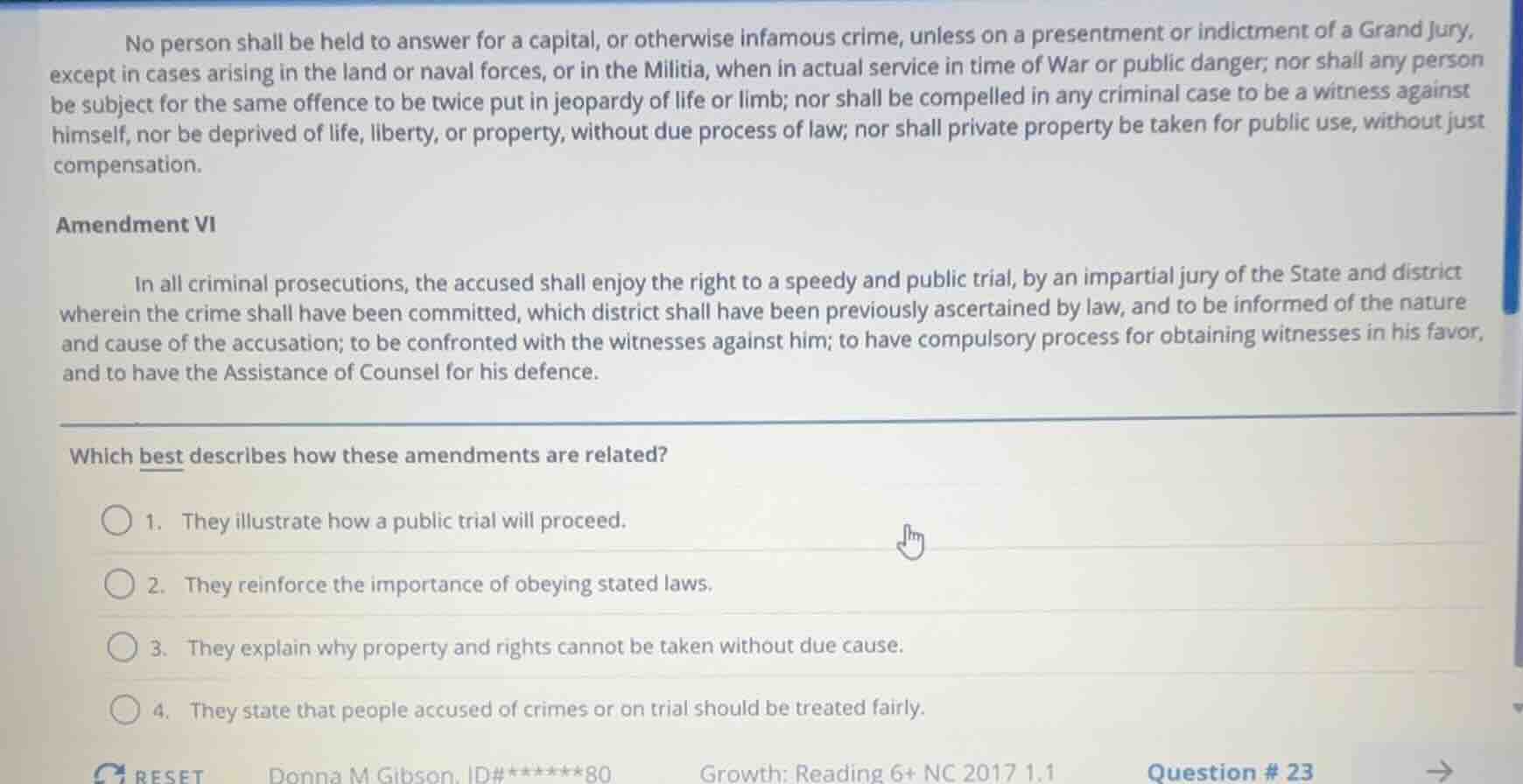
no person shall be held to answer for a capital, or otherwise infamous crime, unless on a presentment or indictment of a grand jury, except in cases arising in the land or naval forces, or in the militia, when in actual service in time of war or public danger; nor shall any person be subject for the same offence to be twice put in jeopardy of life or limb; nor shall be compelled in any criminal case to be a witness against himself, nor be deprived of life, liberty, or property, without due process of law; nor shall private property be taken for public use, without just compensation.
amendment vi
in all criminal prosecutions, the accused shall enjoy the right to a speedy and public trial, by an impartial jury of the state and district wherein the crime shall have been committed, which district shall have been previously ascertained by law, and to be informed of the nature and cause of the accusation; to be confronted with the witnesses against him; to have compulsory process for obtaining witnesses in his favor, and to have the assistance of counsel for his defence.
which best describes how these amendments are related?
- they illustrate how a public trial will proceed.
- they reinforce the importance of obeying stated laws.
- they explain why property and rights cannot be taken without due cause.
- they state that people accused of crimes or on trial should be treated fairly.
reset donna m gibson, id#******80 growth: reading 6+ nc 2017 1.1 question # 23
The 5th Amendment establishes protections like grand jury requirements, double jeopardy, self-incrimination, due process, and just compensation for criminal and legal proceedings. The 6th Amendment outlines specific fair trial rights for the accused, such as speedy public trials, jury trials, access to counsel, and confronting witnesses. Together, both amendments focus on ensuring fairness for individuals facing criminal charges or legal scrutiny. Option 1 only addresses the 6th Amendment's public trial, not the relationship. Option 2 misframes the focus, which is on protecting accused people, not enforcing law obedience. Option 3 only covers a narrow part of the 5th Amendment, not the full relationship. Option 4 encompasses the core purpose of both amendments: fair treatment for those accused or on trial.

Snap & solve any problem in the app
Get step-by-step solutions on Sovi AI
Photo-based solutions with guided steps
Explore more problems and detailed explanations
- They state that people accused of crimes or on trial should be treated fairly.