QUESTION IMAGE
Question
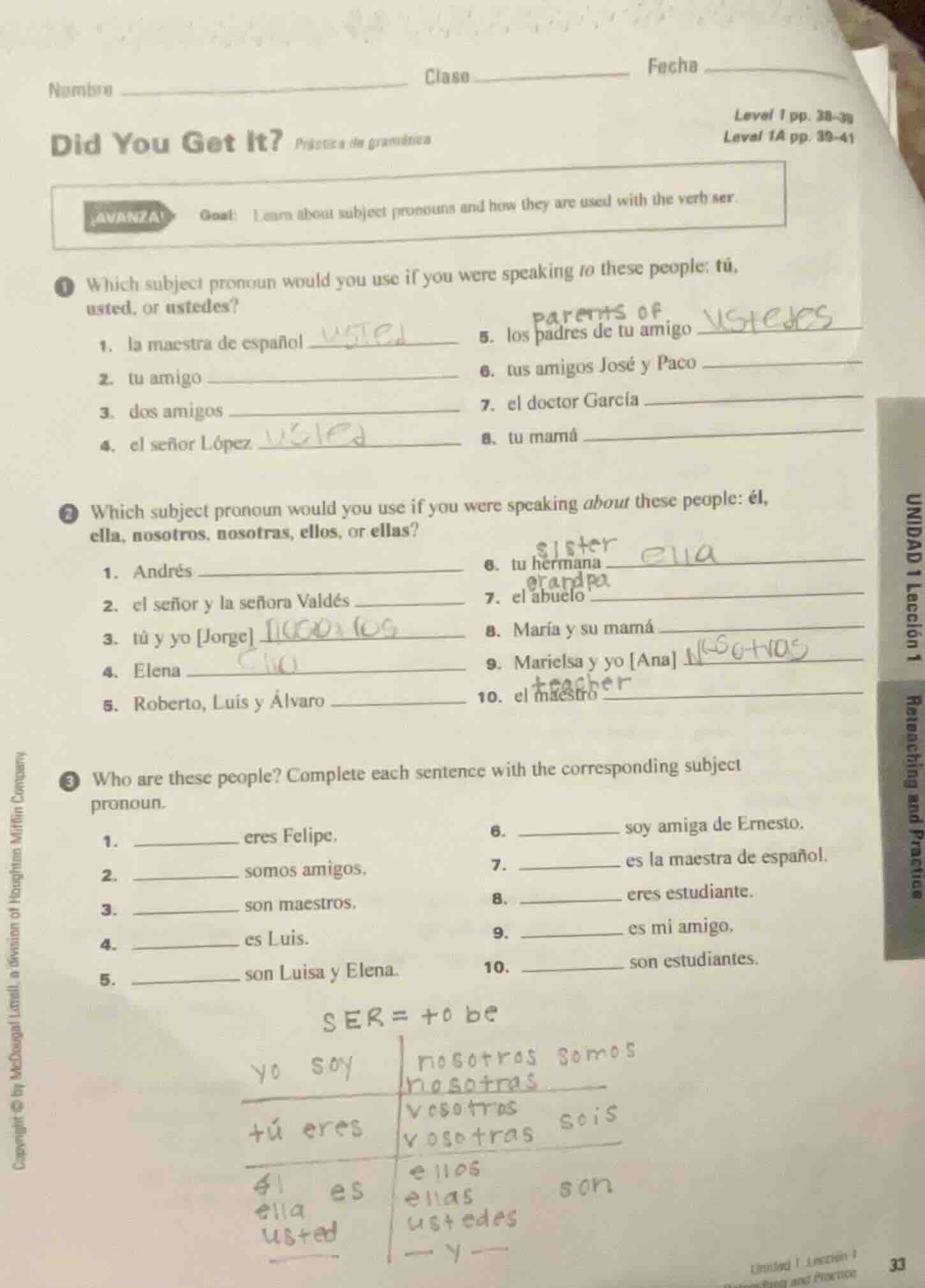
nombre clase fecha did you get it? práctica de gramática level 1 pp. 38 - 39 level 1a pp. 39 - 41 avanza! goal: learn about subject pronouns and how they are used with the verb ser. 1 which subject pronoun would you use if you were speaking to these people: tú, usted, or ustedes? 1. la maestra de español 5. los padres de tu amigo 2. tu amigo 6. tus amigos josé y paco 3. dos amigos 7. el doctor garcía 4. el señor lópez 8. tu mamá 2 which subject pronoun would you use if you were speaking about these people: él, ella, nosotros, nosotras, ellos, or ellas? 1. andrés 6. tu hermana 2. el señor y la señora valdés 7. el abuelo 3. tú y yo jorge 8. maría y su mamá 4. elena 9. marielsa y yo ana 5. roberto, luis y álvaro 10. el maestro 3 who are these people? complete each sentence with the corresponding subject pronoun. 1. eres felipe. 6. soy amiga de ernesto. 2. somos amigos. 7. es la maestra de español. 3. son maestros. 8. eres estudiante. 4. es luis. 9. es mi amigo. 5. son luisa y elena. 10. son estudiantes. ser = to be yo soy nosotros somos nosotras tú eres vosotras sois vosotros él es ellas son ella es ustedes usted
Part 1: Speaking to people (tú, usted, ustedes)
- la maestra de español: usted (formal address for a single adult, a teacher)
- tu amigo: tú (informal, addressing a friend)
- dos amigos: ustedes (plural, addressing two friends; in many Spanish - speaking regions, ustedes is used for plural informal as well)
- el señor López: usted (formal address for a single adult male)
- los padres de tu amigo: ustedes (plural, addressing two people - the parents)
- tus amigos José y Paco: ustedes (plural, addressing two friends)
- el doctor García: usted (formal address for a professional, a doctor)
- tu mamá: tú (informal, addressing one's mother)
Part 2: Speaking about people (él, ella, nosotros, nosotras, ellos, ellas)
- Andrés: él (masculine singular, referring to a male)
- el señor y la señora Valdés: ellos (plural, referring to a man and a woman; ellos is used for mixed - gender plural)
- tú y yo [Jorge]: nosotros (first - person plural, including a male (Jorge) and "tú", so nosotros)
- Elena: ella (feminine singular, referring to a female)
- Roberto, Luis y Álvaro: ellos (masculine plural, referring to multiple males)
- tu hermana: ella (feminine singular, referring to a sister)
- el abuelo: él (masculine singular, referring to a grandfather)
- María y su mamá: ellas (feminine plural, referring to two females)
- Marielsa y yo [Ana]: nosotras (first - person plural, including a female (Ana) and Marielsa, so nosotras)
- el maestro: él (masculine singular, referring to a male teacher)
Part 3: Completing sentences with subject pronouns
- ____ eres Felipe: Tú (the verb eres is the tú form of ser, so the subject is tú)
- ____ somos amigos: Nosotros (the verb somos is the nosotros/nosotras form of ser, so the subject is nosotros (assuming male - dominated or mixed; if all female, nosotras))
- ____ son maestros: Ellos (the verb son is the third - person plural form; ellos is used for plural, referring to male or mixed - gender teachers)
- ____ es Luis: Él (the verb es is the third - person singular form; él for a male (Luis))
- ____ son Luisa y Elena: Ellas (the verb son is third - person plural; ellas for two females)
- ____ soy amiga de Ernesto: Yo (the verb soy is the yo form of ser, so the subject is yo)
- ____ es la maestra de español: Ella (the verb es is third - person singular; ella for a female teacher)
- ____ eres estudiante: Tú (the verb eres is the tú form of ser, so the subject is tú)
- ____ es mi amigo: Él (the verb es is third - person singular; él for a male friend)
- ____ son estudiantes: Ellos (the verb son is third - person plural; ellos for plural students (male or mixed))

Snap & solve any problem in the app
Get step-by-step solutions on Sovi AI
Photo-based solutions with guided steps
Explore more problems and detailed explanations
Part 1: Speaking to people (tú, usted, ustedes)
- la maestra de español: usted (formal address for a single adult, a teacher)
- tu amigo: tú (informal, addressing a friend)
- dos amigos: ustedes (plural, addressing two friends; in many Spanish - speaking regions, ustedes is used for plural informal as well)
- el señor López: usted (formal address for a single adult male)
- los padres de tu amigo: ustedes (plural, addressing two people - the parents)
- tus amigos José y Paco: ustedes (plural, addressing two friends)
- el doctor García: usted (formal address for a professional, a doctor)
- tu mamá: tú (informal, addressing one's mother)
Part 2: Speaking about people (él, ella, nosotros, nosotras, ellos, ellas)
- Andrés: él (masculine singular, referring to a male)
- el señor y la señora Valdés: ellos (plural, referring to a man and a woman; ellos is used for mixed - gender plural)
- tú y yo [Jorge]: nosotros (first - person plural, including a male (Jorge) and "tú", so nosotros)
- Elena: ella (feminine singular, referring to a female)
- Roberto, Luis y Álvaro: ellos (masculine plural, referring to multiple males)
- tu hermana: ella (feminine singular, referring to a sister)
- el abuelo: él (masculine singular, referring to a grandfather)
- María y su mamá: ellas (feminine plural, referring to two females)
- Marielsa y yo [Ana]: nosotras (first - person plural, including a female (Ana) and Marielsa, so nosotras)
- el maestro: él (masculine singular, referring to a male teacher)
Part 3: Completing sentences with subject pronouns
- ____ eres Felipe: Tú (the verb eres is the tú form of ser, so the subject is tú)
- ____ somos amigos: Nosotros (the verb somos is the nosotros/nosotras form of ser, so the subject is nosotros (assuming male - dominated or mixed; if all female, nosotras))
- ____ son maestros: Ellos (the verb son is the third - person plural form; ellos is used for plural, referring to male or mixed - gender teachers)
- ____ es Luis: Él (the verb es is the third - person singular form; él for a male (Luis))
- ____ son Luisa y Elena: Ellas (the verb son is third - person plural; ellas for two females)
- ____ soy amiga de Ernesto: Yo (the verb soy is the yo form of ser, so the subject is yo)
- ____ es la maestra de español: Ella (the verb es is third - person singular; ella for a female teacher)
- ____ eres estudiante: Tú (the verb eres is the tú form of ser, so the subject is tú)
- ____ es mi amigo: Él (the verb es is third - person singular; él for a male friend)
- ____ son estudiantes: Ellos (the verb son is third - person plural; ellos for plural students (male or mixed))