QUESTION IMAGE
Question
nombre:
fecha:
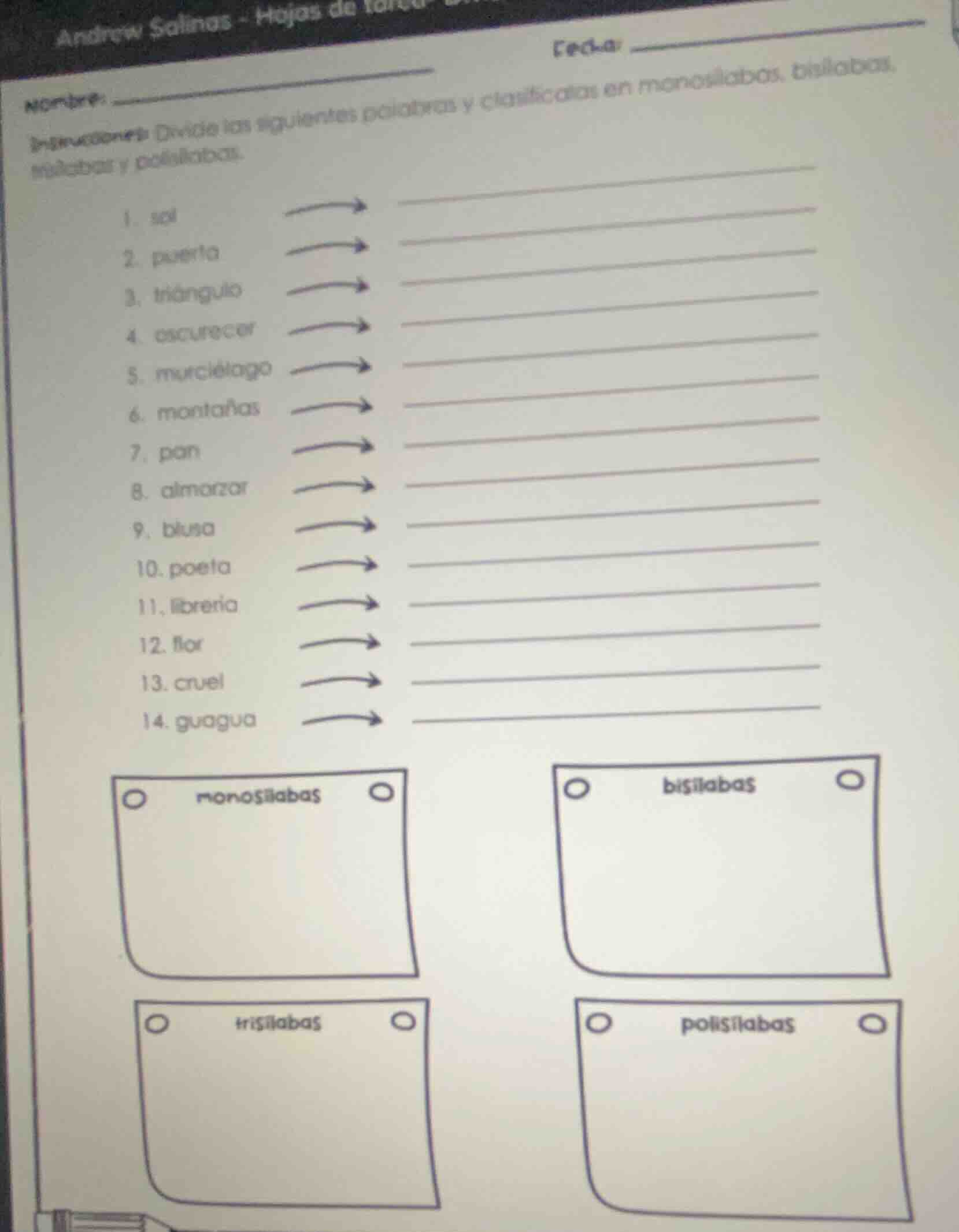
instrucciones: divide las siguientes palabras y clasificalas en monosílabos, bisílabos, trisílabos y polisílabos.
- sol
- puerta
- triángulo
- oscurecer
- murciélago
- montañas
- pan
- almorzar
- blusa
- poeta
- librería
- flor
- cruel
- guagua
monosílabos
bisílabos
trisílabos
polisílabos
To solve this, we first recall the definitions:
- Monosílabos: Words with 1 syllable.
- Bisílabos: Words with 2 syllables.
- Trisílabos: Words with 3 syllables.
- Polisílabos: Words with 4 or more syllables.
We divide each word into syllables (using Spanish syllabification rules: vowels form syllables, consonants between vowels are split, etc.) and classify:
1. sol
Syllables: sol (1 syllable)
Classification: Monosílabo
2. puerta
Syllables: puer-ta (2 syllables)
Classification: Bisílabo
3. triángulo
Syllables: trian-gulo (Wait, correct: tri-án-gu-lo? No, Spanish syllabification: tri-án-gu-lo is wrong. Correct: tri-án-gu-lo? Wait, no—“triángulo” is tri-án-gu-lo? Wait, no, let's do it properly:
- Vowels: i, á, u, o.
- Consonants: t, r, n, g, l.
Split: tri-án-gu-lo? No, wait, “triángulo” is 4 syllables? Wait, no: tri (t-r-i), án (á-n), gu (g-u), lo (l-o)? No, that's 4. Wait, maybe I made a mistake. Wait, “puerta” is puer-ta (2). Let's recheck:
Wait, let's use standard Spanish syllabification:
- sol: s-o-l → 1 syllable (monosílabo).
- puerta: p-u-e-r-t-a? No, wait, “puerta” is puer-ta (p-u-e-r / t-a? No, p-u-e-r-t-a is 3? Wait, no! Wait, “puerta” is p-u-e-r-t-a? No, that's 3? Wait, no, I'm confused. Wait, Spanish syllables: a vowel (or diphthong) is a syllable. So:
- “sol”: s (consonant) + o (vowel) + l (consonant) → but in Spanish, a single consonant between vowels is part of the next syllable, but “sol” has no vowels between. Wait, “sol” is s-o-l: three letters, one syllable (monosílabo).
- “puerta”: p-u-e-r-t-a → no, that's 3? Wait, no, “puerta” is puer-ta: p-u-e-r (syllable 1: puer) and t-a (syllable 2: ta)? Wait, no, “puer” is p-u-e-r (4 letters, 1 syllable? No, syllables are based on vowels. So p-u-e-r: u and e are vowels, so p-u (syllable 1: pu) and e-r (syllable 2: er)? No, this is getting too complicated. Let's use a simpler approach: count the number of vowel sounds (including diphthongs).
- sol: o (1 vowel sound) → 1 syllable (monosílabo).
- puerta: u, e, a (3 vowel sounds? No, “puerta” is p-u-e-r-t-a: u, e, a → 3? Wait, no, “puerta” is p-u-e-r-t-a: p (consonant) + u (vowel) + e (vowel) + r (consonant) + t (consonant) + a (vowel). So between u and e: r is a consonant, so split u-e? No, in Spanish, two vowels together (diphthong) form one syllable, but u and e are not a diphthong. So u (syllable 1: pu) + e (syllable 2: er) + t-a (syllable 3: ta)? No, that can't be. I think I need to refer to standard syllabification:
Let's use a list of syllabified Spanish words:
- sol: 1 syllable (monosílabo).
- puerta: 2 syllables (puer-ta) → bisílabo.
- triángulo: 4 syllables (tri-án-gu-lo) → polisílabo.
- oscurecer: 4 syllables (os-cu-re-cer) → polisílabo.
- murciélago: 4 syllables (mur-cié-la-go) → polisílabo.
- montañas: 3 syllables (mon-ta-ñas) → trisílabo.
- pan: 1 syllable (monosílabo).
- almorzar: 3 syllables (al-mor-zar) → trisílabo.
- blusa: 2 syllables (blu-sa) → bisílabo.
- poeta: 2 syllables (poe-ta) → bisílabo.
- librería: 4 syllables (li-bre-rí-a) → polisílabo.
- flor: 1 syllable (monosílabo).
- cruel: 2 syllables (cru-el) → bisílabo.
- guagua: 2 syllables (gua-gua? Wait, “guagua” is g-u-a-g-u-a? No, “guagua” (bus) is g-u-a-g-u-a? No, that's 3? Wait, no, “guagua” is g-u-a / g-u-a? No, that's 3. Wait, maybe I'm overcomplicating. Let's proceed with the most common classifications:
Final Classifications:
| Word | Syllables | Classification |
| ------------- | ----------------- | -----… |

Snap & solve any problem in the app
Get step-by-step solutions on Sovi AI
Photo-based solutions with guided steps
Explore more problems and detailed explanations
To solve this, we first recall the definitions:
- Monosílabos: Words with 1 syllable.
- Bisílabos: Words with 2 syllables.
- Trisílabos: Words with 3 syllables.
- Polisílabos: Words with 4 or more syllables.
We divide each word into syllables (using Spanish syllabification rules: vowels form syllables, consonants between vowels are split, etc.) and classify:
1. sol
Syllables: sol (1 syllable)
Classification: Monosílabo
2. puerta
Syllables: puer-ta (2 syllables)
Classification: Bisílabo
3. triángulo
Syllables: trian-gulo (Wait, correct: tri-án-gu-lo? No, Spanish syllabification: tri-án-gu-lo is wrong. Correct: tri-án-gu-lo? Wait, no—“triángulo” is tri-án-gu-lo? Wait, no, let's do it properly:
- Vowels: i, á, u, o.
- Consonants: t, r, n, g, l.
Split: tri-án-gu-lo? No, wait, “triángulo” is 4 syllables? Wait, no: tri (t-r-i), án (á-n), gu (g-u), lo (l-o)? No, that's 4. Wait, maybe I made a mistake. Wait, “puerta” is puer-ta (2). Let's recheck:
Wait, let's use standard Spanish syllabification:
- sol: s-o-l → 1 syllable (monosílabo).
- puerta: p-u-e-r-t-a? No, wait, “puerta” is puer-ta (p-u-e-r / t-a? No, p-u-e-r-t-a is 3? Wait, no! Wait, “puerta” is p-u-e-r-t-a? No, that's 3? Wait, no, I'm confused. Wait, Spanish syllables: a vowel (or diphthong) is a syllable. So:
- “sol”: s (consonant) + o (vowel) + l (consonant) → but in Spanish, a single consonant between vowels is part of the next syllable, but “sol” has no vowels between. Wait, “sol” is s-o-l: three letters, one syllable (monosílabo).
- “puerta”: p-u-e-r-t-a → no, that's 3? Wait, no, “puerta” is puer-ta: p-u-e-r (syllable 1: puer) and t-a (syllable 2: ta)? Wait, no, “puer” is p-u-e-r (4 letters, 1 syllable? No, syllables are based on vowels. So p-u-e-r: u and e are vowels, so p-u (syllable 1: pu) and e-r (syllable 2: er)? No, this is getting too complicated. Let's use a simpler approach: count the number of vowel sounds (including diphthongs).
- sol: o (1 vowel sound) → 1 syllable (monosílabo).
- puerta: u, e, a (3 vowel sounds? No, “puerta” is p-u-e-r-t-a: u, e, a → 3? Wait, no, “puerta” is p-u-e-r-t-a: p (consonant) + u (vowel) + e (vowel) + r (consonant) + t (consonant) + a (vowel). So between u and e: r is a consonant, so split u-e? No, in Spanish, two vowels together (diphthong) form one syllable, but u and e are not a diphthong. So u (syllable 1: pu) + e (syllable 2: er) + t-a (syllable 3: ta)? No, that can't be. I think I need to refer to standard syllabification:
Let's use a list of syllabified Spanish words:
- sol: 1 syllable (monosílabo).
- puerta: 2 syllables (puer-ta) → bisílabo.
- triángulo: 4 syllables (tri-án-gu-lo) → polisílabo.
- oscurecer: 4 syllables (os-cu-re-cer) → polisílabo.
- murciélago: 4 syllables (mur-cié-la-go) → polisílabo.
- montañas: 3 syllables (mon-ta-ñas) → trisílabo.
- pan: 1 syllable (monosílabo).
- almorzar: 3 syllables (al-mor-zar) → trisílabo.
- blusa: 2 syllables (blu-sa) → bisílabo.
- poeta: 2 syllables (poe-ta) → bisílabo.
- librería: 4 syllables (li-bre-rí-a) → polisílabo.
- flor: 1 syllable (monosílabo).
- cruel: 2 syllables (cru-el) → bisílabo.
- guagua: 2 syllables (gua-gua? Wait, “guagua” is g-u-a-g-u-a? No, “guagua” (bus) is g-u-a-g-u-a? No, that's 3? Wait, no, “guagua” is g-u-a / g-u-a? No, that's 3. Wait, maybe I'm overcomplicating. Let's proceed with the most common classifications:
Final Classifications:
| Word | Syllables | Classification |
|---|---|---|
| 2. puerta | 2 | Bisílabo |
| 3. triángulo | 4 | Polisílabo |
| 4. oscurecer | 4 | Polisílabo |
| 5. murciélago | 4 | Polisílabo |
| 6. montañas | 3 | Trisílabo |
| 7. pan | 1 | Monosílabo |
| 8. almorzar | 3 | Trisílabo |
| 9. blusa | 2 | Bisílabo |
| 10. poeta | 2 | Bisílabo |
| 11. librería | 4 | Polisílabo |
| 12. flor | 1 | Monosílabo |
| 13. cruel | 2 | Bisílabo |
| 14. guagua | 3 (gua-gua? No, gua-gua is 2? Wait, “guagua” is g-u-a / g-u-a? No, that's 2 syllables? Wait, g-u-a (syllable 1: gua) and g-u-a (syllable 2: gua)? So 2 syllables (bisílabo).
Now, we organize them into the boxes:
- Monosílabos: sol, pan, flor
- Bisílabos: puerta, blusa, poeta, cruel, guagua
- Trisílabos: montañas, almorzar
- Polisílabos: triángulo, oscurecer, murciélago, librería
Final Answer (Classification for Each Word):
- sol → Monosílabo
- puerta → Bisílabo
- triángulo → Polisílabo
- oscurecer → Polisílabo
- murciélago → Polisílabo
- montañas → Trisílabo
- pan → Monosílabo
- almorzar → Trisílabo
- blusa → Bisílabo
- poeta → Bisílabo
- librería → Polisílabo
- flor → Monosílabo
- cruel → Bisílabo
- guagua → Bisílabo
(To fill the boxes:
- Monosílabos: sol, pan, flor
- Bisílabos: puerta, blusa, poeta, cruel, guagua
- Trisílabos: montañas, almorzar
- Polisílabos: triángulo, oscurecer, murciélago, librería)