QUESTION IMAGE
Question
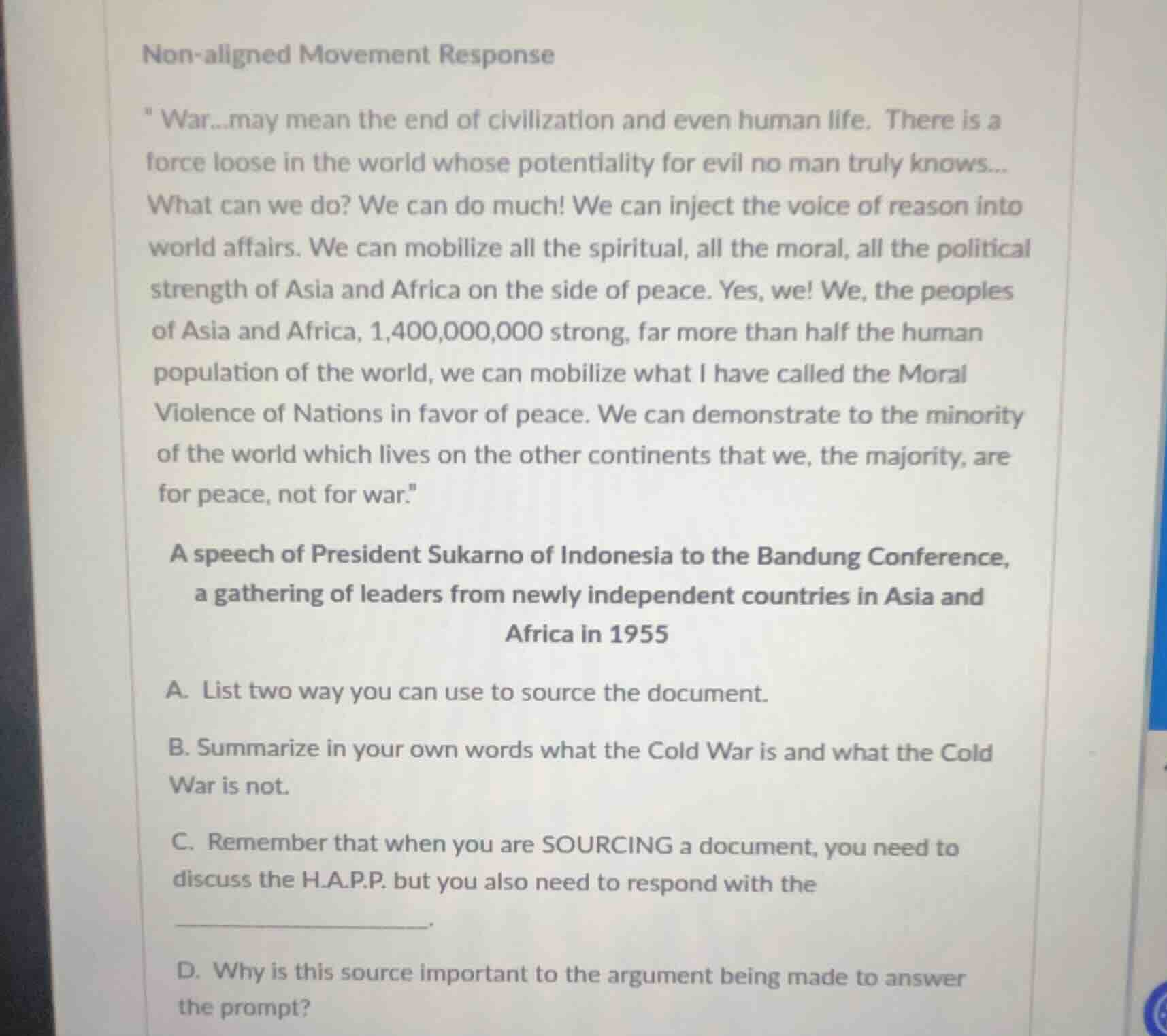
non-aligned movement response\ war...may mean the end of civilization and even human life. there is a force loose in the world whose potentiality for evil no man truly knows... what can we do? we can do much! we can inject the voice of reason into world affairs. we can mobilize all the spiritual, all the moral, all the political strength of asia and africa on the side of peace. yes, we! we, the peoples of asia and africa, 1,400,000,000 strong, far more than half the human population of the world, we can mobilize what i have called the moral violence of nations in favor of peace. we can demonstrate to the minority of the world which lives on the other continents that we, the majority, are for peace, not for war.\a speech of president sukarno of indonesia to the bandung conference, a gathering of leaders from newly independent countries in asia and africa in 1955a. list two way you can use to source the document.b. summarize in your own words what the cold war is and what the cold war is not.c. remember that when you are sourcing a document, you need to discuss the h.a.p.p. but you also need to respond with thed. why is this source important to the argument being made to answer the prompt?
A. For sourcing this document, two valid methods are:
- Cross-reference with official archives of the 1955 Bandung Conference, which holds official records and transcripts of speeches from the event.
- Consult academic databases or peer-reviewed historical publications that analyze or reproduce Sukarno's Bandung Conference speeches, as these are vetted sources.
B. The Cold War was a prolonged, tense geopolitical rivalry (roughly 1947-1991) between the U.S.-led capitalist bloc and the Soviet-led communist bloc. It was characterized by proxy wars, ideological conflict, arms races, and diplomatic maneuvering, but no direct large-scale military war between the two main superpowers. It is not a direct, open conventional war between the U.S. and USSR, nor was it a conflict focused on a single territorial or resource dispute; its core was competing global ideologies and influence.
C. When sourcing a document using H.A.P.P. (Historical Context, Audience, Purpose, Point of View), you also need to respond with the reliability and limitations of the source.
D. This source is important because it is a primary, firsthand account from a key leader of the Non-Aligned Movement, delivered at a foundational conference for post-colonial nations. It directly reflects the perspective of the global majority (Asian and African peoples) during the Cold War, emphasizing their push for peace amid superpower tensions, which provides critical insight into how non-aligned nations positioned themselves to avoid being drawn into the Cold War's conflicts.

Snap & solve any problem in the app
Get step-by-step solutions on Sovi AI
Photo-based solutions with guided steps
Explore more problems and detailed explanations
A. 1. Cross-reference official Bandung Conference archives
- Consult peer-reviewed historical academic publications
B. The Cold War was a decades-long ideological and geopolitical rivalry between capitalist and communist blocs, marked by proxy conflicts and tension but no direct superpower war. It is not an open, direct military war between the U.S. and USSR, nor a conflict centered on a single narrow dispute.
C. reliability and limitations of the source
D. It is a primary source from a pivotal Non-Aligned Movement leader, capturing the post-colonial global majority's push for peace during Cold War tensions, offering critical insight into non-aligned nations' neutral stance.