QUESTION IMAGE
Question
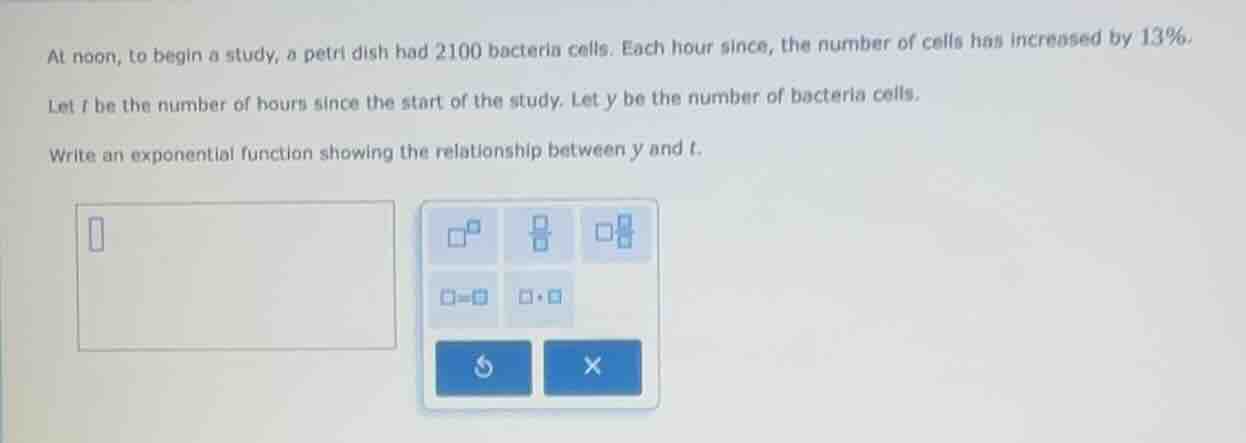
at noon, to begin a study, a petri dish had 2100 bacteria cells. each hour since, the number of cells has increased by 13%. let t be the number of hours since the start of the study. let y be the number of bacteria cells. write an exponential function showing the relationship between y and t.
Step1: Recall exponential growth formula
The general form of an exponential growth function is \( y = a(1 + r)^t \), where \( a \) is the initial amount, \( r \) is the growth rate (in decimal), and \( t \) is the time.
Step2: Identify values of \( a \) and \( r \)
Here, the initial number of bacteria cells \( a = 2100 \). The growth rate is \( 13\% \), which in decimal form is \( r = 0.13 \).
Step3: Substitute values into the formula
Substituting \( a = 2100 \) and \( r = 0.13 \) into the exponential growth formula, we get \( y = 2100(1 + 0.13)^t \), which simplifies to \( y = 2100(1.13)^t \).

Snap & solve any problem in the app
Get step-by-step solutions on Sovi AI
Photo-based solutions with guided steps
Explore more problems and detailed explanations
\( y = 2100(1.13)^t \)