QUESTION IMAGE
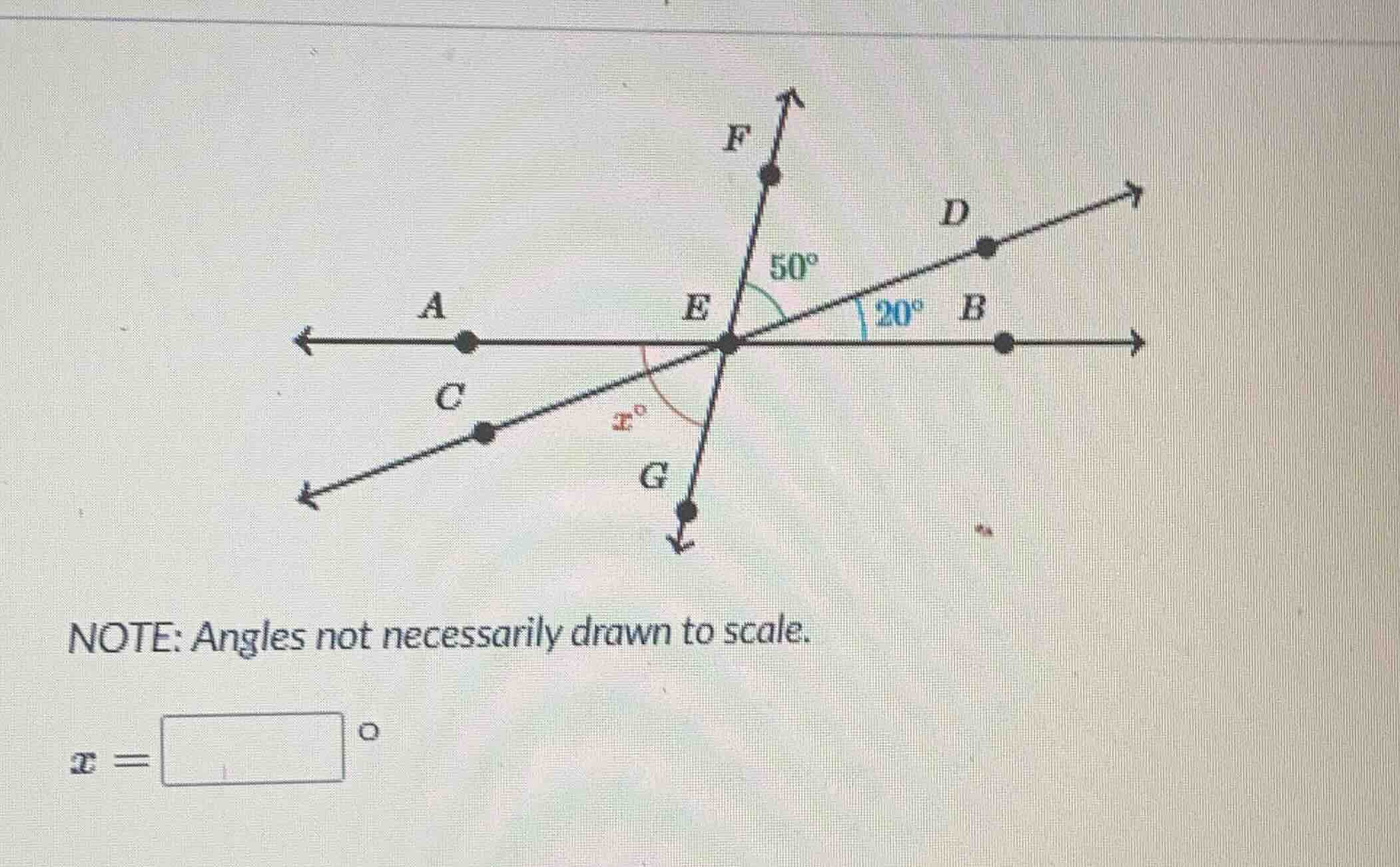
Question
note: angles not necessarily drawn to scale.
x = \square ^\circ
Step1: Identify straight line angles
A straight line forms a 180° angle. The sum of angles on a straight line (AB) at point E should be 180°. We know angles ∠FEB (50° + 20°), ∠GEB (x°), and the vertical or adjacent angles? Wait, actually, the angles around a straight line: the sum of angles on one side of a straight line is 180°. Let's see, the angles given are 50°, 20°, and we need to find x such that 50° + 20° + x° = 180°? Wait, no, maybe vertical angles or supplementary. Wait, actually, the angle between FE and EB is 50° + 20° = 70°? Wait, no, the angle between FE and ED is 50°, ED and EB is 20°, so ∠FEB = 50° + 20° = 70°. Then, since AB is a straight line, the angle ∠FEB and ∠GEA? Wait, no, the angle adjacent to ∠FEB on the straight line AB would be 180° - (50° + 20°) - x°? Wait, maybe better: the sum of angles on a straight line (AB) at E: the angles are 50° (between FE and ED), 20° (between ED and EB), and then x° (between EC and EG), and the vertical angle? Wait, no, let's think again. The straight line AB, so the sum of angles on one side (above or below) should be 180°. Wait, the angles given: ∠FED = 50°, ∠DEB = 20°, so ∠FEB = 50° + 20° = 70°. Then, the angle opposite to ∠FEB? No, the angle adjacent to ∠FEB on the straight line AB is ∠GEA? Wait, no, the straight line is AB, so the angles from F to G through E: ∠FED = 50°, ∠DEB = 20°, ∠BEG? No, wait, EC and ED are vertical angles? Wait, EC and ED are vertical? No, EC and ED: wait, EC and ED are opposite rays? No, EC and ED: looking at the diagram, EC and ED are vertical angles? Wait, no, EC and ED: point C and D, so EC and ED are opposite? Wait, maybe the key is that the sum of angles on a straight line is 180°. So, the angles on line AB: ∠FEB (50° + 20° = 70°), ∠GEB's supplementary angle? Wait, no, let's calculate: 180° - 50° - 20° = x? Wait, 180 - 50 - 20 = 110? No, that can't be. Wait, maybe the angle x is supplementary to (50° + 20°). Wait, 50 + 20 = 70, so 180 - 70 = 110? No, that's not right. Wait, maybe I made a mistake. Wait, the angle between FE and EB is 50° + 20° = 70°, so the angle opposite to that (vertical angle) would be equal, but no, the angle x is adjacent. Wait, no, the straight line AB, so the sum of angles: 50° (FE to ED) + 20° (ED to EB) + x° (EC to EG) = 180°? Wait, no, maybe the angle x is equal to 50° + 20°? No, that doesn't make sense. Wait, wait, the correct approach: the sum of angles on a straight line is 180°. So, the angles are 50° (∠FED), 20° (∠DEB), and then x° (∠CEG), and the angle ∠AEC is equal to ∠DEB (20°) because they are vertical angles? Wait, no, EC and ED are vertical? Wait, EC and ED: if C and D are opposite? Wait, the diagram: A---E---B, F above, G below, C below left, D above right. So, ∠AEC and ∠DEB are vertical angles, so ∠AEC = 20°. Then, the angle ∠FED = 50°, ∠DEB = 20°, so ∠FEB = 50 + 20 = 70°. Then, the angle ∠GEA would be 180° - 70° - 20°? No, wait, the straight line AB, so the sum of angles from F to G through E: ∠FED (50°) + ∠DEB (20°) + ∠BEG (x°) + ∠GEC (wait, no). Wait, maybe the angle x is equal to 50° + 20°? No, that's 70, but 180 - 70 - 20? No, I'm confused. Wait, let's use the fact that the sum of angles on a straight line is 180°. So, the angles on line AB at point E: the angles are ∠FED = 50°, ∠DEB = 20°, and the angle ∠GEA is x°, and the angle ∠AEC is 20° (vertical to ∠DEB). Wait, no, vertical angles: ∠AEC and ∠DEB are vertical, so ∠AEC = 20°. Then, the angle ∠FED = 50°, ∠DEB = 20°, so ∠FEB = 70°. Then, the angle ∠GEA is 180° - 70° - 20° = 90°? No, that's not. Wait, maybe the correct way: the sum of angles on a…

Snap & solve any problem in the app
Get step-by-step solutions on Sovi AI
Photo-based solutions with guided steps
Explore more problems and detailed explanations
70