QUESTION IMAGE
Question
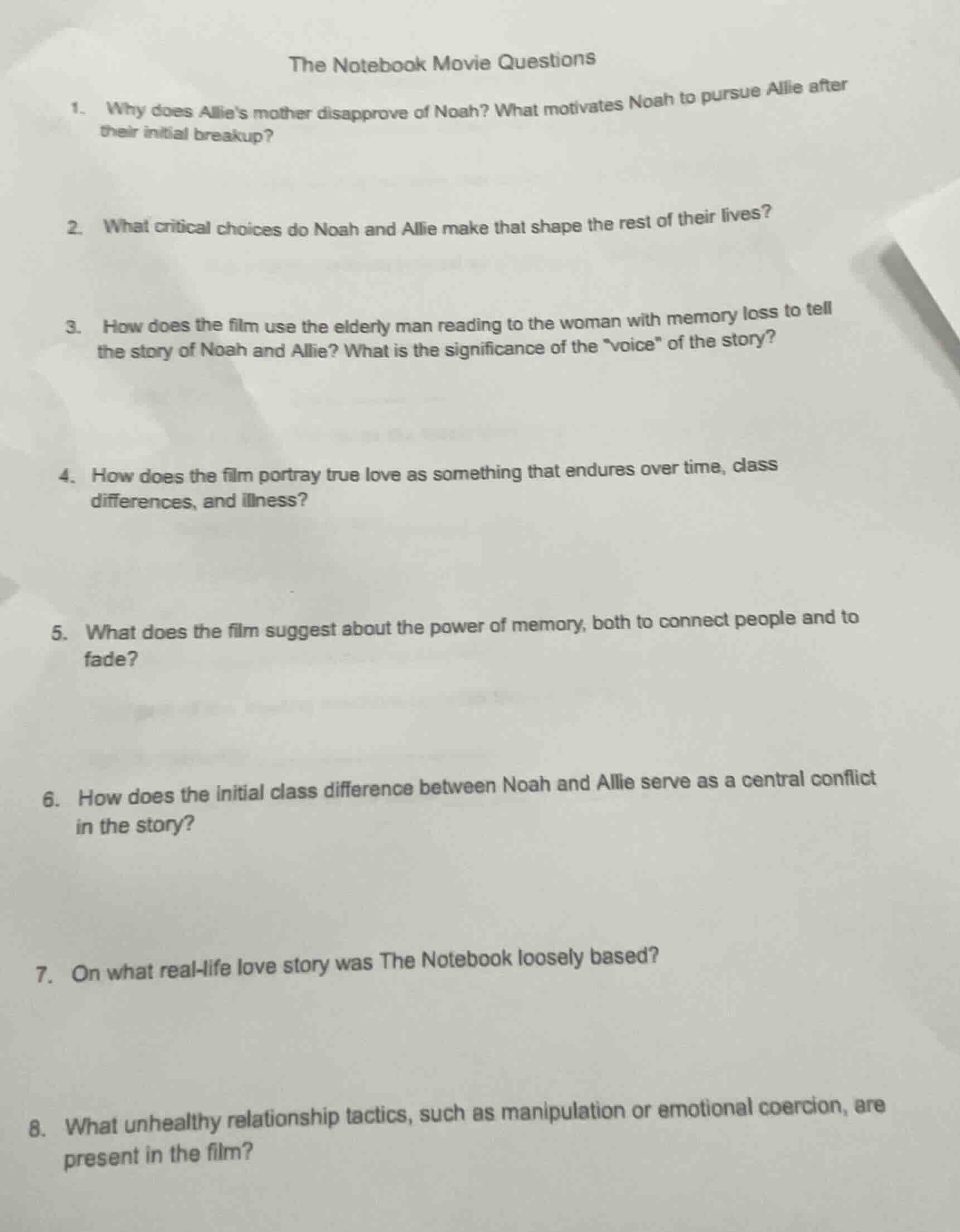
the notebook movie questions
- why does allies mother disapprove of noah? what motivates noah to pursue allie after their initial breakup?
- what critical choices do noah and allie make that shape the rest of their lives?
- how does the film use the elderly man reading to the woman with memory loss to tell the story of noah and allie? what is the significance of the \voice\ of the story?
- how does the film portray true love as something that endures over time, class differences, and illness?
- what does the film suggest about the power of memory, both to connect people and to fade?
- how does the initial class difference between noah and allie serve as a central conflict in the story?
- on what real - life love story was the notebook loosely based?
- what unhealthy relationship tactics, such as manipulation or emotional coercion, are present in the film?
To answer these questions about The Notebook, we analyze each one based on the film's plot, themes, and character dynamics:
Question 1
- Allie’s mother’s disapproval: Noah is from a working - class background, while Allie’s family is upper - class. The mother believes Noah is not a suitable match for Allie as he cannot provide the same social status and financial security as someone from their own class.
- Noah’s motivation to pursue Allie: His deep - seated love for Allie is the main driver. Even after their initial breakup, his strong feelings and the hope of rekindling their relationship push him to keep trying to win her back.
Question 2
- Noah’s choices: He decides to restore the old house, which is a symbol of his love for Allie and his commitment to their relationship. Also, he persists in pursuing Allie despite the class differences and the obstacles put in his way.
- Allie’s choices: She chooses to reunite with Noah, going against the expectations of her family and her fiancé. Later, when she is faced with the situation of Noah’s and her own circumstances, she decides to stay with him even as she deals with memory loss.
Question 3
- Narrative device: The elderly man (Noah) reading to the woman with memory loss (Allie) is a framing device. It allows the story of their younger days to be told as a flashback. This structure also shows the enduring nature of their love, as Noah is still trying to connect with Allie through the story.
- Significance of the “voice”: The voice of the story, which is mainly Noah’s (both as the elderly reader and the young lover in the flashbacks), is filled with love and longing. It emphasizes the emotional core of their relationship and how love can transcend the boundaries of memory loss.
Question 4
- Enduring over time: The film shows Noah and Allie’s relationship from their youth to old age. Even when Allie has memory loss, Noah’s continued care and their shared past (like the house, their memories) show that love remains.
- Enduring over class differences: Despite Noah being working - class and Allie being upper - class, their love develops and they fight against the social norms that try to keep them apart.
- Enduring over illness: When Allie has dementia, Noah’s unwavering love and care for her, like reading to her and staying by her side, demonstrate that love can persist even in the face of a devastating illness.
Question 5
- Connecting people: Memory is shown as a powerful bond. The shared memories of their past, like their time together at the lake, the old house, and their romantic moments, keep Noah and Allie connected. Even when Allie’s memory fades, the act of recalling these memories (through Noah’s reading) helps them stay emotionally connected.
- Fading of memory: Allie’s dementia shows how memory can deteriorate. However, the film also suggests that the essence of their love, which is beyond just memory, remains. The fact that Noah still loves her and their love story is still meaningful even with her memory loss highlights the complexity of memory’s power to both connect and fade.
Question 6
The initial class difference is a central conflict as it creates a rift between Noah and Allie’s worlds. Allie’s family, especially her mother, actively tries to keep them apart. It also affects how others perceive their relationship, with Allie’s social circle looking down on Noah. This conflict tests the strength of their love and forces them to make difficult choices about their relationship.
Question 7
*The N…

Snap & solve any problem in the app
Get step-by-step solutions on Sovi AI
Photo-based solutions with guided steps
Explore more problems and detailed explanations
To answer these questions about The Notebook, we analyze each one based on the film's plot, themes, and character dynamics:
Question 1
- Allie’s mother’s disapproval: Noah is from a working - class background, while Allie’s family is upper - class. The mother believes Noah is not a suitable match for Allie as he cannot provide the same social status and financial security as someone from their own class.
- Noah’s motivation to pursue Allie: His deep - seated love for Allie is the main driver. Even after their initial breakup, his strong feelings and the hope of rekindling their relationship push him to keep trying to win her back.
Question 2
- Noah’s choices: He decides to restore the old house, which is a symbol of his love for Allie and his commitment to their relationship. Also, he persists in pursuing Allie despite the class differences and the obstacles put in his way.
- Allie’s choices: She chooses to reunite with Noah, going against the expectations of her family and her fiancé. Later, when she is faced with the situation of Noah’s and her own circumstances, she decides to stay with him even as she deals with memory loss.
Question 3
- Narrative device: The elderly man (Noah) reading to the woman with memory loss (Allie) is a framing device. It allows the story of their younger days to be told as a flashback. This structure also shows the enduring nature of their love, as Noah is still trying to connect with Allie through the story.
- Significance of the “voice”: The voice of the story, which is mainly Noah’s (both as the elderly reader and the young lover in the flashbacks), is filled with love and longing. It emphasizes the emotional core of their relationship and how love can transcend the boundaries of memory loss.
Question 4
- Enduring over time: The film shows Noah and Allie’s relationship from their youth to old age. Even when Allie has memory loss, Noah’s continued care and their shared past (like the house, their memories) show that love remains.
- Enduring over class differences: Despite Noah being working - class and Allie being upper - class, their love develops and they fight against the social norms that try to keep them apart.
- Enduring over illness: When Allie has dementia, Noah’s unwavering love and care for her, like reading to her and staying by her side, demonstrate that love can persist even in the face of a devastating illness.
Question 5
- Connecting people: Memory is shown as a powerful bond. The shared memories of their past, like their time together at the lake, the old house, and their romantic moments, keep Noah and Allie connected. Even when Allie’s memory fades, the act of recalling these memories (through Noah’s reading) helps them stay emotionally connected.
- Fading of memory: Allie’s dementia shows how memory can deteriorate. However, the film also suggests that the essence of their love, which is beyond just memory, remains. The fact that Noah still loves her and their love story is still meaningful even with her memory loss highlights the complexity of memory’s power to both connect and fade.
Question 6
The initial class difference is a central conflict as it creates a rift between Noah and Allie’s worlds. Allie’s family, especially her mother, actively tries to keep them apart. It also affects how others perceive their relationship, with Allie’s social circle looking down on Noah. This conflict tests the strength of their love and forces them to make difficult choices about their relationship.
Question 7
The Notebook is loosely based on the real - life love story of Noah and Allie Calhoun (the names were used for the characters in the film - inspired story), with elements drawn from the experiences of the author Nicholas Sparks’ own observations and the story of his grandparents’ long - lasting relationship.
Question 8
- Manipulation: There are moments where characters try to influence others’ decisions. For example, Allie’s mother tries to manipulate Allie into forgetting Noah by showing her a letter (though the full context is more complex). Also, when Allie is engaged, her fiancé may unknowingly try to keep her from Noah by presenting a more “socially acceptable” future.
- Emotional coercion: Noah’s persistence, while driven by love, could be seen as a form of emotional coercion in some ways, as he keeps pursuing Allie even when she is engaged. However, it is also portrayed as a testament to his love. Also, the pressure from Allie’s family to conform to their class - based expectations can be seen as a form of emotional coercion on Allie.
These answers are based on the film’s exploration of love, class, memory, and relationship dynamics. If you want a more in - depth analysis of a particular question, feel free to ask!