QUESTION IMAGE
Question
notes
read to learn
the total expenditures test (page 105)
drawing conclusions
after you read,
underline the sen-
tence in the second
paragraph that sup-
ports the following
conclusion:
a business owner
who wants to
increase revenue
should not increase
the price of a prod-
uct that has an elas-
tic demand.
a discussion of elasticity may seem very technical. however,
elasticity is a very important concept for all businesses. suppose
a business wants to increase its revenue by raising prices. it
could test elasticity first to see if demand for the product is elas-
tic, inelastic, or unit elastic.
in order to determine elasticity, businesses use the total
expenditures test. the test is a study of the impact of a price
change on total expenditures, or how much consumers spend
on a product at a particular price. businesses find total expendi-
tures by multiplying the price of a product by the quantity
demanded. then they test elasticity by observing the change in
total expenditures between two points on the demand curve.
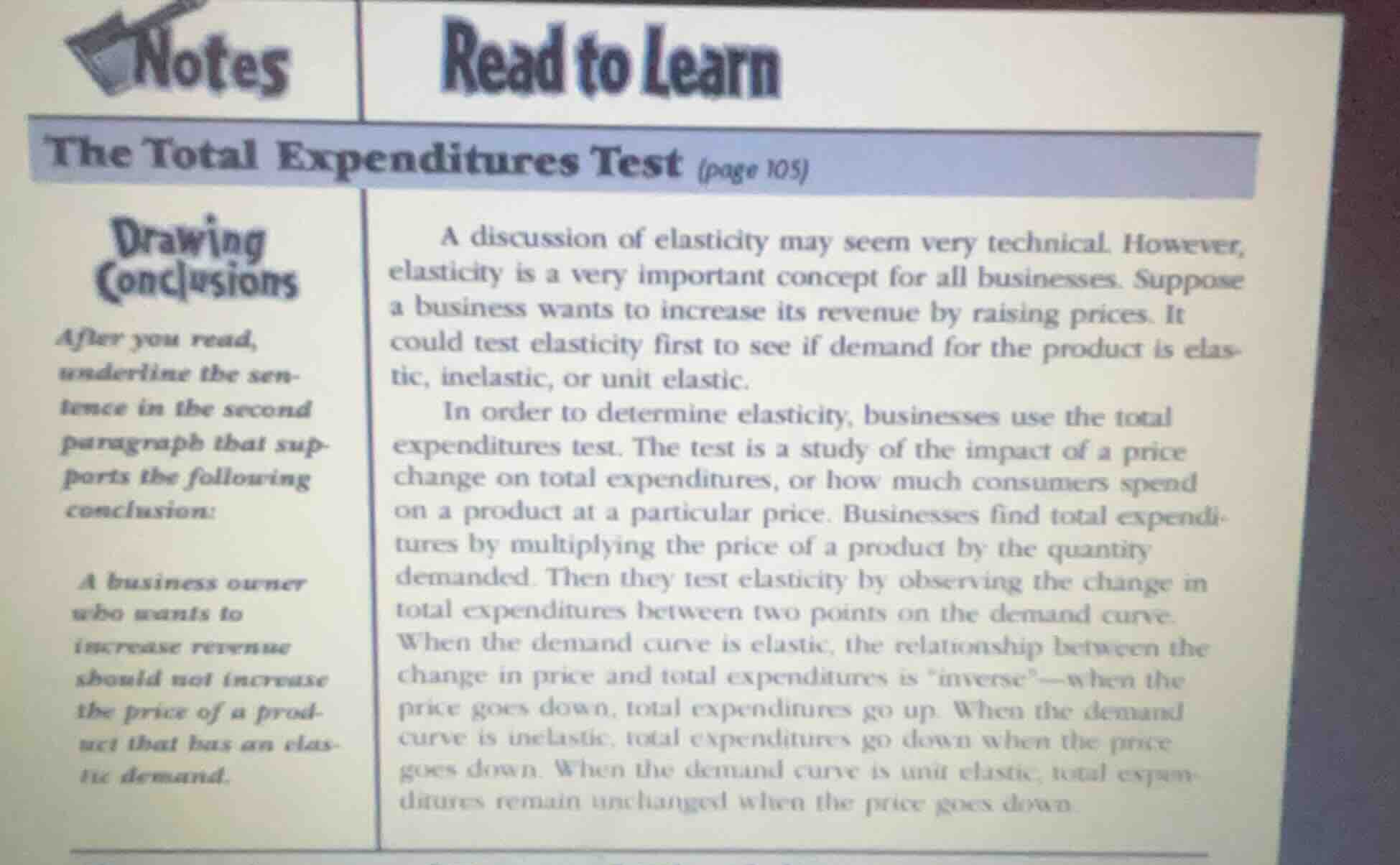
when the demand curve is elastic, the relationship between the
change in price and total expenditures is \inverse\—when the
price goes down, total expenditures go up. when the demand
curve is inelastic, total expenditures go down when the price
goes down. when the demand curve is unit elastic, total expen-
ditures remain unchanged when the price goes down.
The supporting sentence is found in the second paragraph, which details the inverse relationship between price changes and total expenditures for products with elastic demand, directly backing the conclusion that raising prices for such products will not increase revenue.

Snap & solve any problem in the app
Get step-by-step solutions on Sovi AI
Photo-based solutions with guided steps
Explore more problems and detailed explanations
When the demand curve is elastic, the relationship between the change in price and total expenditures is "inverse"—when the price goes down, total expenditures go up.