QUESTION IMAGE
Question
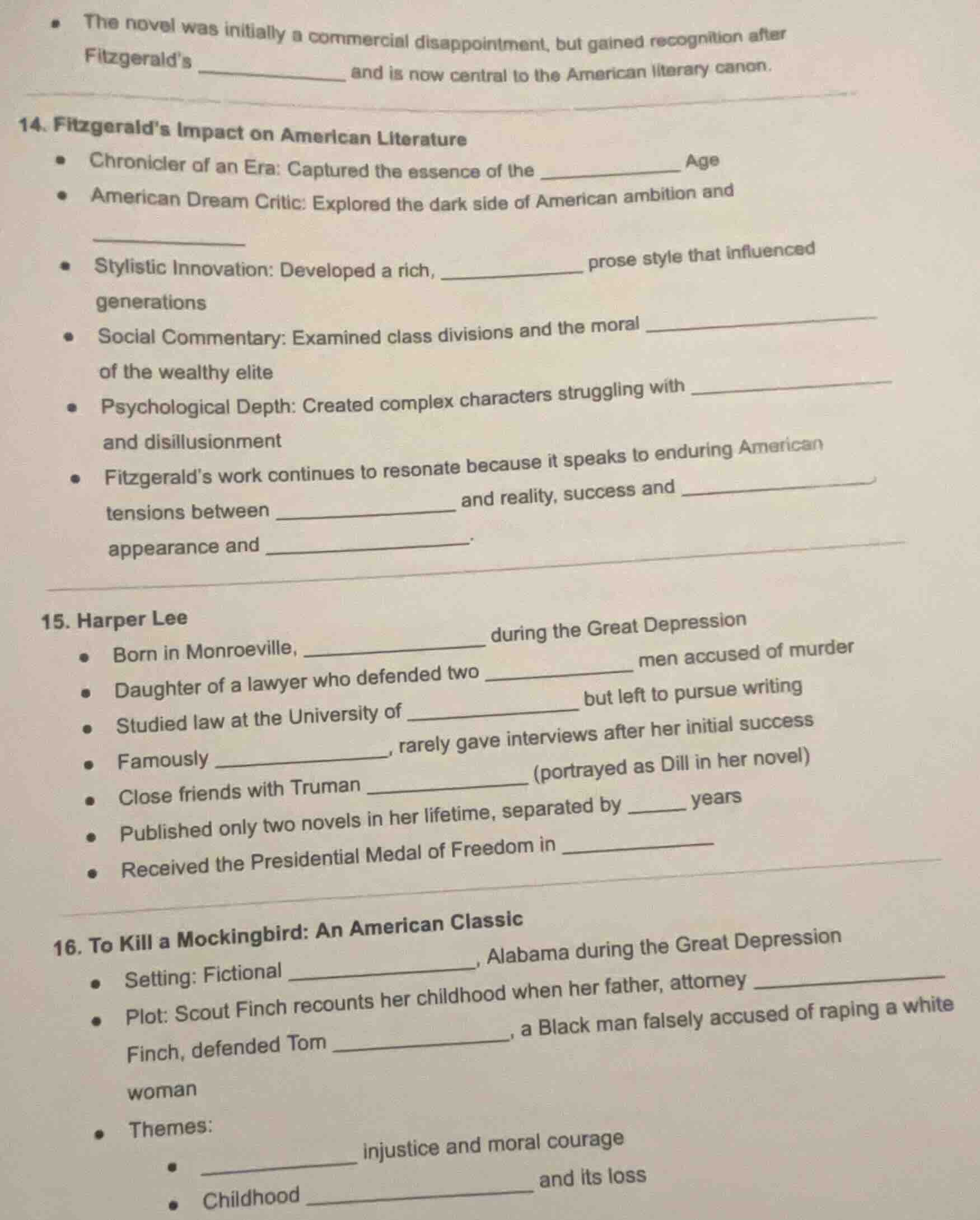
- the novel was initially a commercial disappointment, but gained recognition after fitzgerald’s ________ and is now central to the american literary canon.
- fitzgerald’s impact on american literature
- chronicler of an era: captured the essence of the ________ age
- american dream critic: explored the dark side of american ambition and
________
- stylistic innovation: developed a rich, ________ prose style that influenced
generations
- social commentary: examined class divisions and the moral ________
of the wealthy elite
- psychological depth: created complex characters struggling with ________
and disillusionment
- fitzgerald’s work continues to resonate because it speaks to enduring american
tensions between ______ and reality, success and ______,
appearance and ________.
- harper lee
- born in monroeville, ________ during the great depression
- daughter of a lawyer who defended two ________ men accused of murder
- studied law at the university of ________ but left to pursue writing
- famously ________, rarely gave interviews after her initial success
- close friends with truman ________ (portrayed as dill in her novel)
- published only two novels in her lifetime, separated by ______ years
- received the presidential medal of freedom in ________
- to kill a mockingbird: an american classic
- setting: fictional ________, alabama during the great depression
- plot: scout finch recounts her childhood when her father, attorney ________
finch, defended tom ________, a black man falsely accused of raping a white
woman
- themes:
- ________ injustice and moral courage
- childhood ________ and its loss
Response
Question 14 (Fitzgerald’s Impact on American Literature)
1. First blank (after Fitzgerald’s):
- Explanation: Fitzgerald's novels (like "The Great Gatsby") initially didn't do well commercially but gained recognition after his death. So the word is "death".
2. “Chronicler of an Era: Captured the essence of the ______ Age”:
- Explanation: Fitzgerald is known for capturing the Jazz Age (Roaring Twenties). So the word is "Jazz" (or "Roaring Twenties").
3. “American Dream Critic: Explored the dark side of American ambition and ______”:
- Explanation: He explored the dark side of ambition and materialism (or "greed"). So a common fill is "materialism".
4. “Stylistic Innovation: Developed a rich, ______ prose style that influenced generations”:
- Explanation: His prose is known for being lyrical (or "elegant", "poetic"). A common term is "lyrical".
5. “Social Commentary: Examined class divisions and the moral ______ of the wealthy elite”:
- Explanation: He examined the moral emptiness (or "corruption", "vacuity") of the wealthy. "Emptiness" fits.
6. “Psychological Depth: Created complex characters struggling with ______ and disillusionment”:
- Explanation: Characters like Gatsby struggle with longing (or "desire", "ambition") and disillusionment. "Longing" is appropriate.
7. “Fitzgerald’s work continues to resonate because it speaks to enduring American tensions between ____ and reality, success and __, appearance and ____”:
- Explanation:
- First blank: Tension between "dream" (American Dream) and reality.
- Second blank: Tension between success and "failure" (or "ruin").
- Third blank: Tension between appearance and "reality" (or "truth").
Question 15 (Harper Lee)
1. “Born in Monroeville, ______ during the Great Depression”:
- Explanation: Monroeville is in Alabama. So the word is "Alabama".
2. “Daughter of a lawyer who defended two ______ men accused of murder”:
- Explanation: In the context of her background (inspiration for "To Kill a Mockingbird"), the men were Black (African - American). So "Black" (or "African - American").
3. “Studied law at the University of ______ but left to pursue writing”:
- Explanation: She studied at the University of Alabama. So "Alabama".
4. “Famously ______, rarely gave interviews after her initial success”:
- Explanation: Harper Lee was reclusive (private, withdrawn). So "reclusive".
5. “Close friends with Truman ______ (portrayed as Dill in her novel)”:
- Explanation: Truman Capote was her friend, portrayed as Dill. So "Capote".
6. “Published only two novels in her lifetime, separated by ______ years”:
- Explanation: Her first novel was "To Kill a Mockingbird" (1960) and the second "Go Set a Watchman" (2015), so 55 years. So "55".
7. “Received the Presidential Medal of Freedom in ______”:
- Explanation: She received it in 2007. So "2007".
Question 16 (To Kill a Mockingbird: An American Classic)
1. “Setting: Fictional ______, Alabama during the Great Depression”:
- Explanation: The novel is set in Maycomb, Alabama. So "Maycomb".
2. “Plot: Scout Finch recounts her childhood when her father, attorney ____ Finch, defended Tom ____, a Black man falsely accused of raping a white woman”:
- Explanation:
- First blank: Her father is Atticus Finch.
- Second blank: The accused man is Tom Robinson.
3. “Themes:
- “______ injustice and moral courage”:
- Explanation: The novel deals with racial injustice. So "R…

Snap & solve any problem in the app
Get step-by-step solutions on Sovi AI
Photo-based solutions with guided steps
Explore more problems and detailed explanations
Question 14 (Fitzgerald’s Impact on American Literature)
1. First blank (after Fitzgerald’s):
- Explanation: Fitzgerald's novels (like "The Great Gatsby") initially didn't do well commercially but gained recognition after his death. So the word is "death".
2. “Chronicler of an Era: Captured the essence of the ______ Age”:
- Explanation: Fitzgerald is known for capturing the Jazz Age (Roaring Twenties). So the word is "Jazz" (or "Roaring Twenties").
3. “American Dream Critic: Explored the dark side of American ambition and ______”:
- Explanation: He explored the dark side of ambition and materialism (or "greed"). So a common fill is "materialism".
4. “Stylistic Innovation: Developed a rich, ______ prose style that influenced generations”:
- Explanation: His prose is known for being lyrical (or "elegant", "poetic"). A common term is "lyrical".
5. “Social Commentary: Examined class divisions and the moral ______ of the wealthy elite”:
- Explanation: He examined the moral emptiness (or "corruption", "vacuity") of the wealthy. "Emptiness" fits.
6. “Psychological Depth: Created complex characters struggling with ______ and disillusionment”:
- Explanation: Characters like Gatsby struggle with longing (or "desire", "ambition") and disillusionment. "Longing" is appropriate.
7. “Fitzgerald’s work continues to resonate because it speaks to enduring American tensions between ____ and reality, success and __, appearance and ____”:
- Explanation:
- First blank: Tension between "dream" (American Dream) and reality.
- Second blank: Tension between success and "failure" (or "ruin").
- Third blank: Tension between appearance and "reality" (or "truth").
Question 15 (Harper Lee)
1. “Born in Monroeville, ______ during the Great Depression”:
- Explanation: Monroeville is in Alabama. So the word is "Alabama".
2. “Daughter of a lawyer who defended two ______ men accused of murder”:
- Explanation: In the context of her background (inspiration for "To Kill a Mockingbird"), the men were Black (African - American). So "Black" (or "African - American").
3. “Studied law at the University of ______ but left to pursue writing”:
- Explanation: She studied at the University of Alabama. So "Alabama".
4. “Famously ______, rarely gave interviews after her initial success”:
- Explanation: Harper Lee was reclusive (private, withdrawn). So "reclusive".
5. “Close friends with Truman ______ (portrayed as Dill in her novel)”:
- Explanation: Truman Capote was her friend, portrayed as Dill. So "Capote".
6. “Published only two novels in her lifetime, separated by ______ years”:
- Explanation: Her first novel was "To Kill a Mockingbird" (1960) and the second "Go Set a Watchman" (2015), so 55 years. So "55".
7. “Received the Presidential Medal of Freedom in ______”:
- Explanation: She received it in 2007. So "2007".
Question 16 (To Kill a Mockingbird: An American Classic)
1. “Setting: Fictional ______, Alabama during the Great Depression”:
- Explanation: The novel is set in Maycomb, Alabama. So "Maycomb".
2. “Plot: Scout Finch recounts her childhood when her father, attorney ____ Finch, defended Tom ____, a Black man falsely accused of raping a white woman”:
- Explanation:
- First blank: Her father is Atticus Finch.
- Second blank: The accused man is Tom Robinson.
3. “Themes:
- “______ injustice and moral courage”:
- Explanation: The novel deals with racial injustice. So "Racial".
- “Childhood ______ and its loss”:
- Explanation: It deals with childhood innocence and its loss. So "innocence".
Final Answers (Key Blanks Filled)
Question 14:
- Fitzgerald’s \(\boldsymbol{\text{death}}\)
- Captured the essence of the \(\boldsymbol{\text{Jazz (Roaring Twenties)}}\) Age
- Explored the dark side of American ambition and \(\boldsymbol{\text{materialism}}\)
- Developed a rich, \(\boldsymbol{\text{lyrical}}\) prose style
- Examined class divisions and the moral \(\boldsymbol{\text{emptiness}}\) of the wealthy elite
- Struggling with \(\boldsymbol{\text{longing}}\) and disillusionment
- Tensions between \(\boldsymbol{\text{dream}}\) and reality, success and \(\boldsymbol{\text{failure}}\), appearance and \(\boldsymbol{\text{reality (truth)}}\)
Question 15:
- Born in Monroeville, \(\boldsymbol{\text{Alabama}}\)
- Defended two \(\boldsymbol{\text{Black (African - American)}}\) men
- Studied law at the University of \(\boldsymbol{\text{Alabama}}\)
- Famously \(\boldsymbol{\text{reclusive}}\)
- Close friends with Truman \(\boldsymbol{\text{Capote}}\)
- Separated by \(\boldsymbol{\text{55}}\) years
- Received the Presidential Medal of Freedom in \(\boldsymbol{\text{2007}}\)
Question 16:
- Fictional \(\boldsymbol{\text{Maycomb}}\), Alabama
- Attorney \(\boldsymbol{\text{Atticus}}\) Finch, defended Tom \(\boldsymbol{\text{Robinson}}\)
- \(\boldsymbol{\text{Racial}}\) injustice and moral courage
- Childhood \(\boldsymbol{\text{innocence}}\) and its loss