QUESTION IMAGE
Question
1
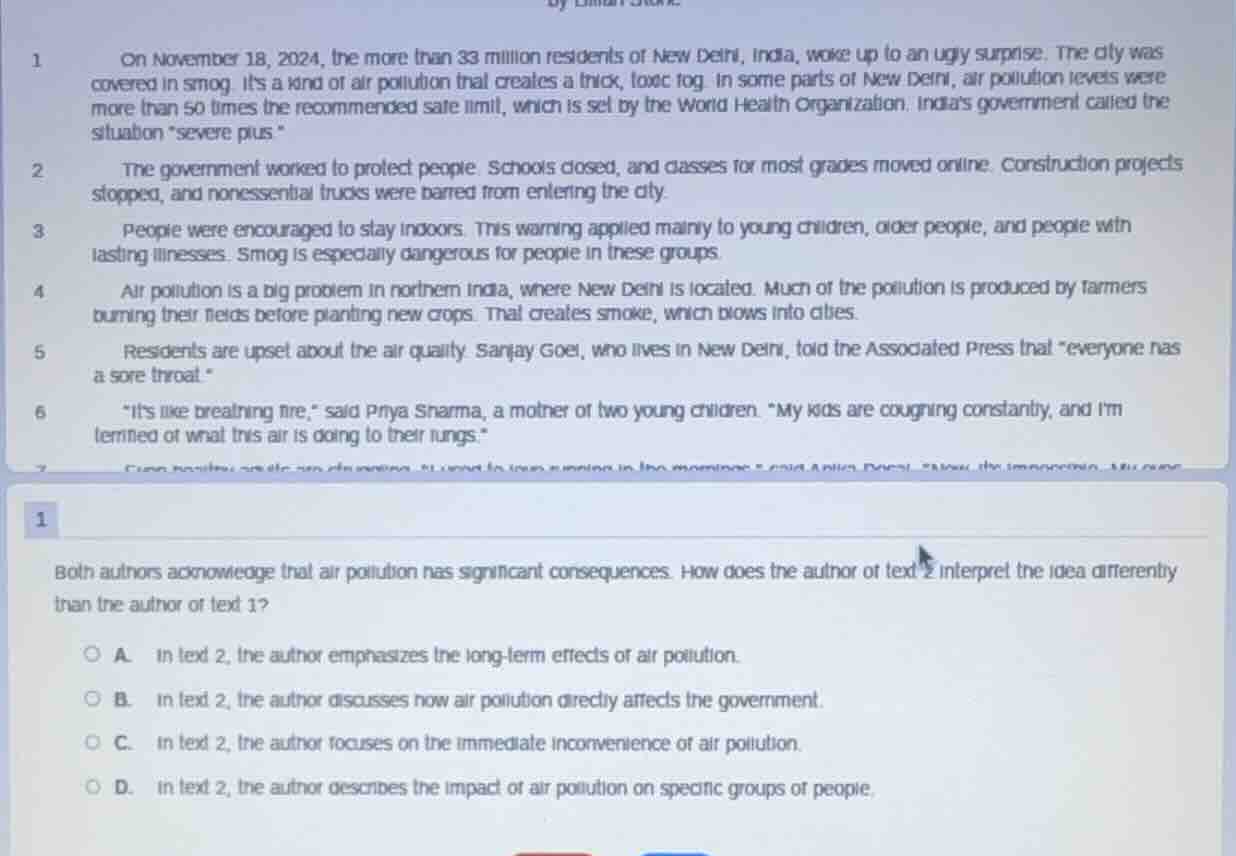
on november 18, 2024, the more than 33 million residents of new delhi, india, woke up to an ugly surprise. the city was covered in smog. its a kind of air pollution that creates a thick, toxic fog. in some parts of new delhi, air pollution levels were more than 50 times the recommended safe limit, which is set by the world health organization. indias government called the situation \severe plus.\
2
the government worked to protect people. schools closed, and classes for most grades moved online. construction projects stopped, and nonessential trucks were barred from entering the city.
3
people were encouraged to stay indoors. this warning applied mainly to young children, older people, and people with lasting illnesses. smog is especially dangerous for people in these groups.
4
air pollution is a big problem in northern india, where new delhi is located. much of the pollution is produced by farmers burning their fields before planting new crops. that creates smoke, which blows into cities.
5
residents are upset about the air quality. sanjay goel, who lives in new delhi, told the associated press that \everyone has a sore throat.\
6
\its like breathing fire,\ said pinya sharma, a mother of two young children. \my kids are coughing constantly, and im terrified of what this air is doing to their lungs.\
1
both authors acknowledge that air pollution has significant consequences. how does the author of text 2 interpret the idea differently than the author of text 1?
a. in text 2, the author emphasizes the long - term effects of air pollution.
b. in text 2, the author discusses how air pollution directly affects the government.
c. in text 2, the author focuses on the immediate inconvenience of air pollution.
d. in text 2, the author describes the impact of air pollution on specific groups of people.
To solve this, we analyze each option:
- Option A: Text 1 (about New Delhi smog) focuses on immediate actions (school closures, health impacts now) rather than long - term effects. So A is incorrect.
- Option B: Text 1 talks about government actions to protect people, not how air pollution affects the government. So B is incorrect.
- Option C: Text 1 describes immediate inconveniences like smog - related health issues (sore throats, coughing) and disruptions (school closures, construction stops). If Text 2 (not fully shown, but from the options) focuses on immediate inconvenience, this could be correct. But let's check D.
- Option D: Text 1 already describes impact on specific groups (young children, older people, ill people). So D is not a difference.
So the correct option is C as it represents a different interpretation (focus on immediate inconvenience) compared to Text 1's focus on health impacts on specific groups and immediate actions.

Snap & solve any problem in the app
Get step-by-step solutions on Sovi AI
Photo-based solutions with guided steps
Explore more problems and detailed explanations
C. in text 2, the author focuses on the immediate inconvenience of air pollution.