QUESTION IMAGE
Question
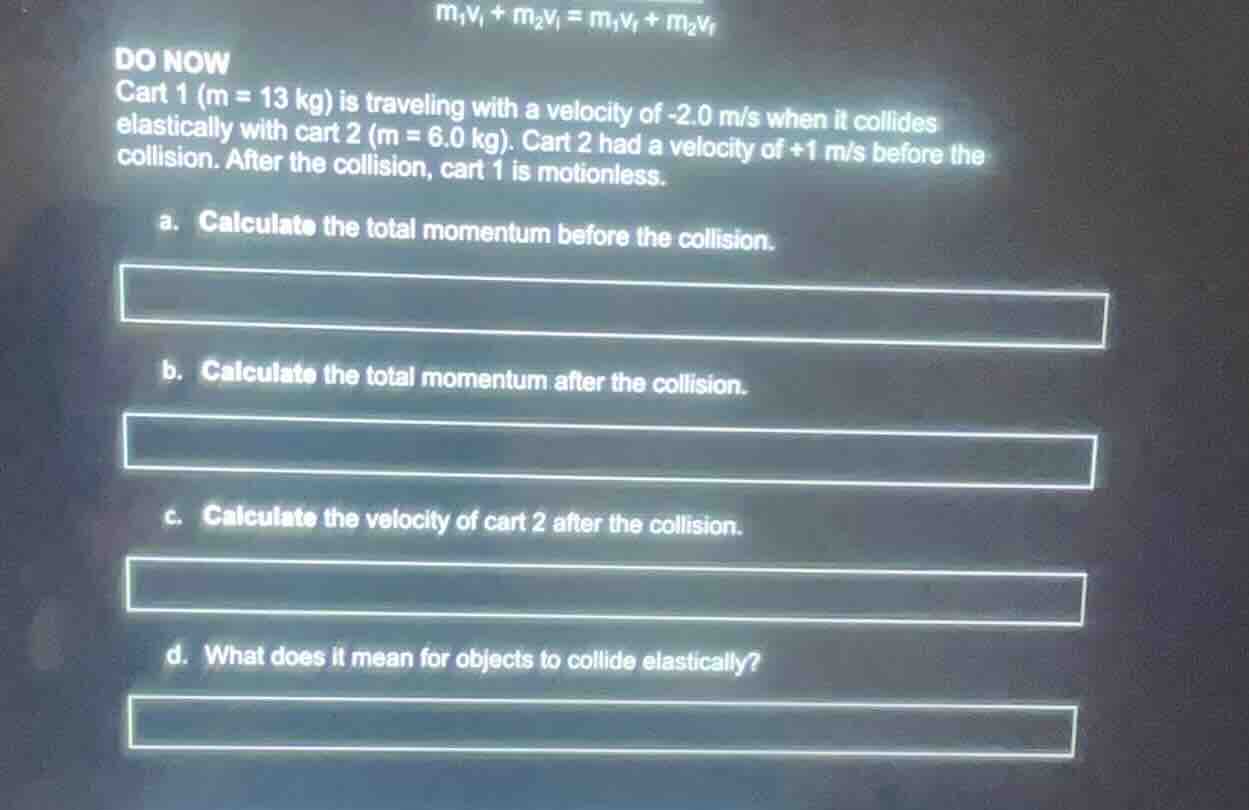
m₁vᵢ + m₂vᵢ = m₁vᵣ + m₂vᵣ
do now
cart 1 (m = 13 kg) is traveling with a velocity of -2.0 m/s when it collides elastically with cart 2 (m = 6.0 kg). cart 2 had a velocity of +1 m/s before the collision. after the collision, cart 1 is motionless.
a. calculate the total momentum before the collision.
b. calculate the total momentum after the collision.
c. calculate the velocity of cart 2 after the collision.
d. what does it mean for objects to collide elastically?
Part a
Step1: Recall momentum formula
Momentum \( p = mv \), total momentum before collision is \( p_{total,i} = m_1v_{1,i} + m_2v_{2,i} \)
Given \( m_1 = 13\space kg \), \( v_{1,i} = -2.0\space m/s \), \( m_2 = 6.0\space kg \), \( v_{2,i} = +1\space m/s \)
Step2: Substitute values
\( p_{total,i} = (13)(-2.0) + (6.0)(1) \)
\( = -26 + 6 \)
\( = -20\space kg\cdot m/s \)
Step1: Law of conservation of momentum
In any collision, total momentum before = total momentum after, so \( p_{total,f} = p_{total,i} \)
Step2: Use part a result
From part a, \( p_{total,i} = -20\space kg\cdot m/s \), so \( p_{total,f} = -20\space kg\cdot m/s \)
Step1: Recall total momentum after collision
\( p_{total,f} = m_1v_{1,f} + m_2v_{2,f} \)
Given \( v_{1,f} = 0\space m/s \), \( p_{total,f} = -20\space kg\cdot m/s \), \( m_1 = 13\space kg \), \( m_2 = 6.0\space kg \)
Step2: Substitute and solve for \( v_{2,f} \)
\( -20 = (13)(0) + (6.0)v_{2,f} \)
\( -20 = 6.0v_{2,f} \)
\( v_{2,f} = \frac{-20}{6.0} \approx -3.33\space m/s \) (Wait, but let's check again. Wait, maybe I made a sign error? Wait no, let's re - calculate. Wait, wait, in part a, the calculation: \( 13*(-2) = -26 \), \( 6*1 = 6 \), sum is -20. Then for part c, \( p_{total,f}=m_1v_{1,f}+m_2v_{2,f} \). \( m_1 = 13 \), \( v_{1,f}=0 \), so \( 0 + 6v_{2,f}=-20 \), so \( v_{2,f}=\frac{-20}{6}\approx - 3.33\space m/s \). But let's check the elastic collision. Wait, maybe I messed up the sign in velocity. Wait, cart 1 is moving at -2 m/s (let's say left), cart 2 at +1 m/s (right). After collision, cart 1 is motionless. Let's re - do part a:
Wait, \( m_1 = 13\space kg \), \( v_1=-2\space m/s \), \( m_2 = 6\space kg \), \( v_2 = 1\space m/s \)
\( p_1 = 13*(-2)=-26\space kg\cdot m/s \)
\( p_2 = 6*1 = 6\space kg\cdot m/s \)
Total initial momentum: \(-26 + 6=-20\space kg\cdot m/s\) (correct)
Total final momentum: \( m_1v_1' + m_2v_2' \), \( v_1' = 0 \), so \( 0+6v_2'=-20 \), so \( v_2'=\frac{-20}{6}\approx - 3.33\space m/s \). But let's check with elastic collision (kinetic energy should also be conserved). Wait, maybe there is a mistake in the problem or in my calculation. Wait, no, the problem says "after the collision, cart 1 is motionless". So we have to go with conservation of momentum. So the velocity of cart 2 after collision is \( \frac{-20}{6}\approx - 3.33\space m/s \) (or \( -\frac{10}{3}\space m/s \approx - 3.3\space m/s \))
Wait, but let's re - calculate:
\( p_{total,f}=m_1v_{1,f}+m_2v_{2,f} \)
We know \( p_{total,f}=-20\space kg\cdot m/s \), \( m_1 = 13\space kg \), \( v_{1,f}=0 \)
So \( -20=13*0 + 6*v_{2,f} \)
\( 6v_{2,f}=-20 \)
\( v_{2,f}=\frac{-20}{6}=-\frac{10}{3}\approx - 3.33\space m/s \)

Snap & solve any problem in the app
Get step-by-step solutions on Sovi AI
Photo-based solutions with guided steps
Explore more problems and detailed explanations
\(-20\space kg\cdot m/s\)